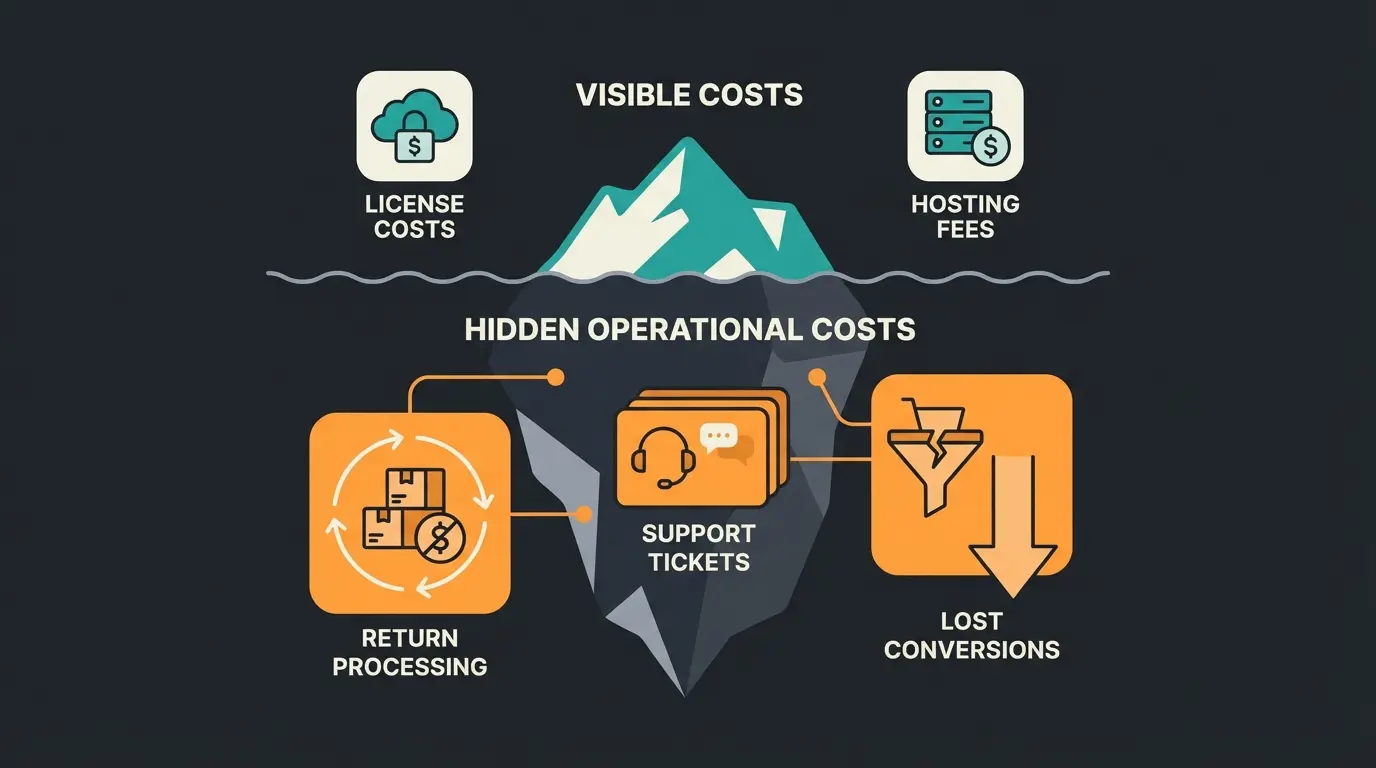
Executive Summary: Rethinking Shopware TCO
When e-commerce decision-makers think about the costs of a new shop system, they quickly end up with Excel spreadsheets full of license fees, hosting packages, and agency hourly rates. This is understandable but dangerously shortsighted. An analysis of the current search landscape and market data for 2025 reveals that most Total Cost of Ownership (TCO) calculations for Shopware 6 fall short of the complete picture.
The obvious costs for Shopware typically range between €30,000 (basic setup) and €150,000+ (enterprise solutions) in the first year, according to data from vierpunkt-commerce.de and w3work.de. However, the largest cost block doesn't appear on any invoice from Shopware AG or your agency. It hides within your operational inefficiency: high return rates, manual customer consultation, and lost revenue due to missing purchase guidance.
This article provides you not only with the most current figures on the Shopware license models for 2025 (Rise, Evolve, Beyond), but also expands the calculation to include Operational TCO. We'll demonstrate how you can drastically reduce the most expensive items on your balance sheet—returns and service—through the use of intelligent AI consultation, thereby optimizing the net TCO of your shop. For a deeper understanding of how different editions compare, check out our comprehensive Shopware editions comparison.
The Tip of the Iceberg: Technical Shopware 6 TCO
To create a reliable cost-benefit analysis, we must first clarify the baseline data. Shopware has significantly adjusted its pricing model in recent years. Since discontinuing one-time purchase licenses (Professional/Enterprise), the company has shifted to monthly subscription models (SaaS or Self-Hosted with Subscription).
Here is the current status quo for 2025 that you need for your budget planning.
License Costs: Rise, Evolve, and Beyond Explained
Shopware currently distinguishes between three main commercial plans that are based on Gross Merchandise Volume (GMV) and feature scope. The free Community Edition still exists, but for serious B2B or scaling B2C projects, it's often not a long-term option due to the lack of manufacturer support, as noted by erock-marketing.de and tikal.de.
| Edition | Price (Monthly) | Target Group & Key Features | Suitable For |
|---|---|---|---|
| Community Edition | €0 | Open Source, no manufacturer guarantee, no support | Startups, developers, micro-shops with extensive self-service |
| Shopware Rise | From €600 | Entry into professional e-commerce. Incl. Flow Builder, Rule Builder, basic support (8h response time) | Growing B2C shops needing standard features |
| Shopware Evolve | From €2,400 | Extended B2B features, CMS rules, Advanced Search, phone support (4h response time) | Ambitious mid-sized businesses, B2B merchants |
| Shopware Beyond | From €6,500 | High-end Enterprise. Multi-Inventory, Subscriptions, 24/7 support (1h response time), Customer-Specific Pricing | Corporations, international players, complex business models |
When comparing platforms, many businesses also evaluate Shopware vs Shopify or consider alternatives like Shopware vs WooCommerce and Shopware vs Magento. Each platform has distinct TCO implications that extend far beyond the initial license fee.
Initial Setup and Agency Costs
The license is only the rent for the tool. For the tool to work, it must be set up, customized, and integrated into your IT landscape. The hourly rates for certified Shopware agencies in Germany typically range between €100 and €150 in 2025, with specialized enterprise agencies also charging up to €200, according to feedbax.de.
Here is a realistic assessment of project budgets:
- Small Project (Basic Setup): Standard theme, minimal customization, basic plugins (Payment/Shipping). Costs: €10,000 – €25,000
- Medium Project (Professional): Individual screen design, interfaces to ERP (e.g., Pickware, Xentral, SAP Business One), marketing features. Costs: €30,000 – €70,000
- Enterprise Project (High-End): Headless architecture, complex B2B logic, PIM integration, international rollouts. Costs: €100,000 – €500,000+
Working with a Shopware full service agency can help streamline these costs, though the real savings come from optimizing operational efficiency rather than cutting corners on implementation.
Hosting and Maintenance: Ongoing Operational Costs
In addition to the license, monthly operational costs apply. Here you have the choice between Shopware Cloud (SaaS) and a self-hosted variant (PaaS/On-Premise).
- Shopware Cloud: Hosting is included in the license price. Advantage: Less technical effort. Disadvantage: Limited flexibility for deep backend customizations, as noted by uptain.de.
- Self-Hosted / Partner Hosting: You need specialized Shopware hosting (e.g., Timme, Maxcluster, Profihost). Costs: €50 – €500 per month depending on traffic and performance requirements, according to hosttest.de and dmsolutions.de.
- Maintenance Contracts: Agencies charge for updates, security patches, and monitoring, often as flat rates. Expect €300 to €1,000 monthly for solid support, as outlined by shopwareagentur.info.
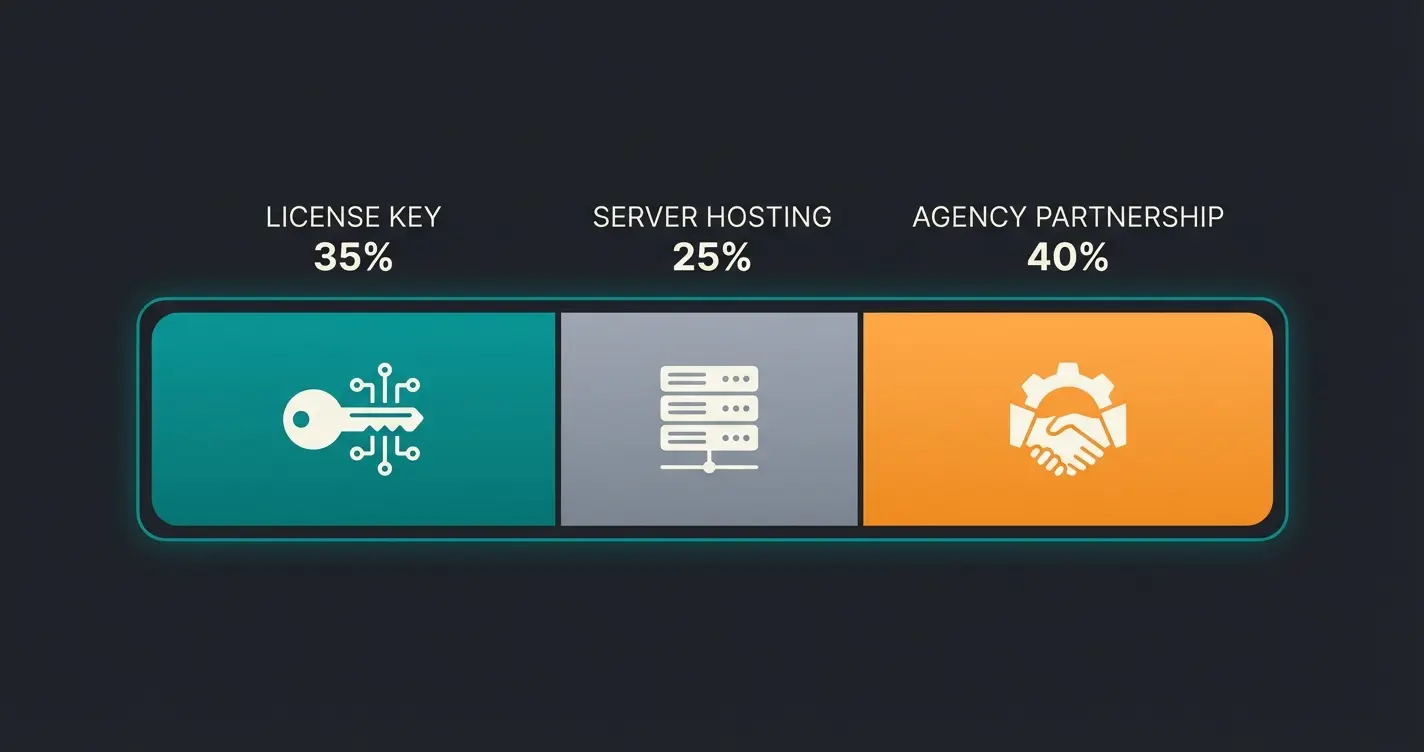
Hidden Operational TCO: Where You Really Lose Money
Up to this point, we've examined the classic TCO calculation. These figures appear in every proposal. However, if we understand TCO as 'Total Cost to Operate,' the biggest cost drivers are missing: inefficiency in customer service and the returns cost trap.
In Germany, this topic is more pressing than anywhere else. The country is the 'European champion of returns.' If you ignore these operational costs, your TCO calculation isn't worth the paper it's written on. Understanding how to optimize Shopware customer service becomes crucial for managing these hidden expenses.
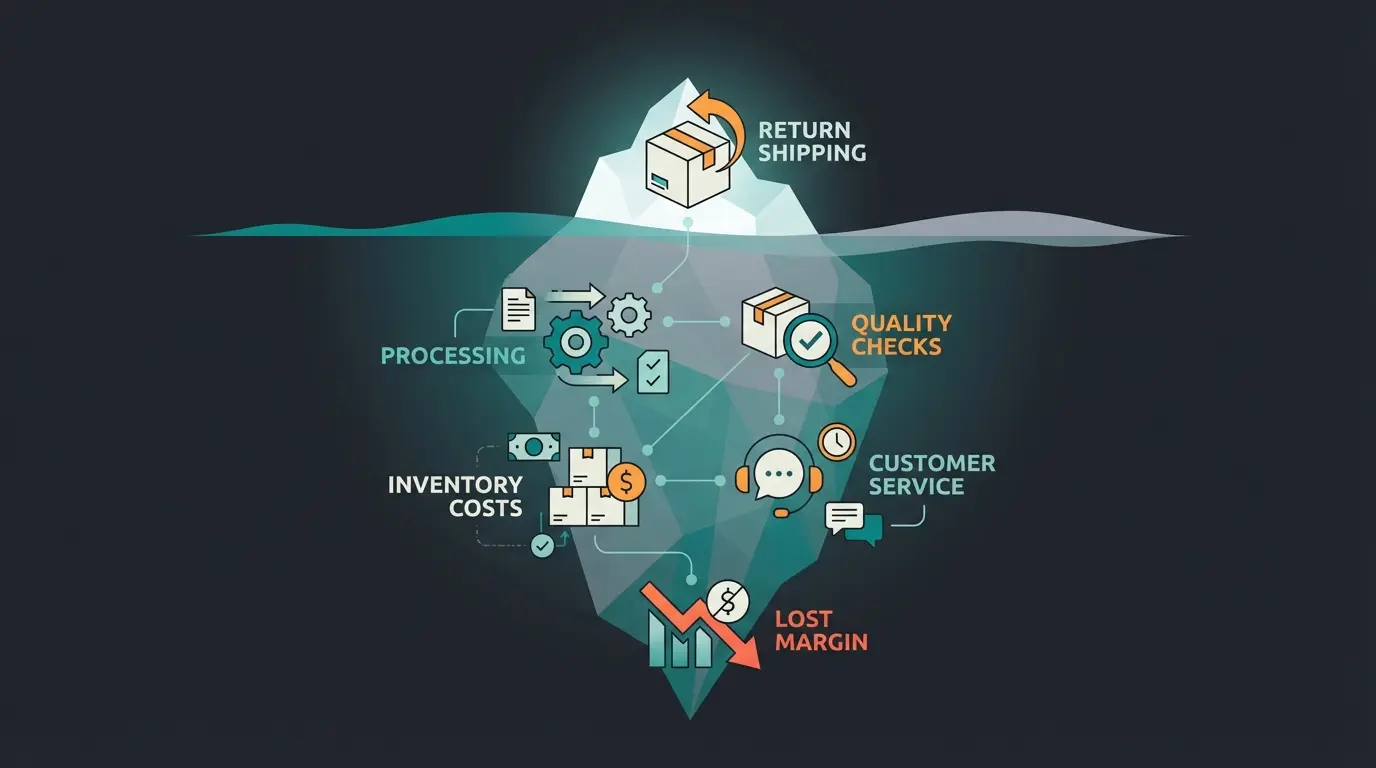
The True Cost of Returns: The Iceberg Below Water
Many merchants calculate returns merely as 'lost revenue.' This is incorrect. A return generates massive process costs that extend far beyond the refunded purchase price.
Across all German e-commerce sectors
Germany leads Europe in fashion returns
Processing, inspection, and restocking per item
Furniture and home goods cost significantly more
Research from the EHI Retail Institute and the University of Bamberg quantifies the process costs (receiving, inspection, refurbishment) at an average of €5 to €10 per item. For bulky goods (furniture/home), these costs quickly rise to €10 to €20, as reported by Spiegel and FashionUnited.
Calculating the TCO Impact of Returns
Let's assume a mid-sized Shopware shop with the following metrics:
- Monthly orders: 5,000
- Average order value: €80
- Return rate: 15% (conservatively averaged)
- Process costs per return: €10 (including value loss/B-stock)
Calculation: 5,000 orders × 15% = 750 returns per month. Costs: 750 × €10 = €7,500 per month. Annual burden: €90,000.
Analysis: These €90,000 don't appear on any software license, yet they are direct operating costs that are influenced by the shop system and user experience. A shop that poorly advises customers and allows 'wrong' purchases drives this TCO higher. Implementing proper Shopware returns management becomes essential for controlling these costs.
The Support Trap: Human Resources vs Scaling
Another massive block in operational TCO is personnel costs for customer service (first-level support).
- Salary Structure: A customer support employee in German e-commerce earns approximately €30,000 to €40,000 gross annually. Including employer contributions, the full costs are around €45,000 to €50,000 per head, according to Gehalt.de and Stepstone.
- The Problem: A large portion of this expensive work time flows into repetitive questions ('Where is my package?', 'Does Part A fit Part B?').
- The Inefficiency: Conventional FAQ bots or simple search functions (even good ones like Doofinder or Elasticsearch, as reviewed by Shopware and signundsinn.de) often don't solve complex consultation queries. The customer either doesn't buy at all (churn) or buys the wrong item (return).
This is where AI in customer service becomes a game-changer. By implementing intelligent automation, you can handle repetitive queries while your team focuses on complex issues that require human expertise.
Plugin Fatigue: The Cost of Technical Complexity
To solve operational problems, shop operators tend to build 'plugin towers.'
- A plugin for search (e.g., Doofinder, from ~€30-50/month according to OMR)
- A plugin for returns management (e.g., Pickware WMS, from ~€149/month as listed by Pickware)
- A plugin for ERP connectors (e.g., to SAP or Xentral, often setup costs + monthly fees as noted by Shopware and nxtgen-easykaufmann.de)
The TCO Risk: Each plugin increases maintenance costs during updates. When Shopware jumps from version 6.6 to 6.7, all 20 plugins must be compatible. The 'maintenance TCO' increases exponentially with the number of extensions.
Strategic TCO Calculation: The Consultation Model
Here lies your opportunity for differentiation and cost optimization. Instead of reducing TCO only through 'cheaper hosting' (which often comes at the expense of performance), you should apply leverage where it's greatest: preventing wrong purchases through AI-powered consultation.
Let's compare two scenarios over a 3-year period.
Scenario A: The Standard Shop Approach
- Setup: Shopware Rise + Standard theme
- Consultation: Static FAQs, simple chatbot (rule-based), human support (Mon-Fri, 9am-5pm)
- Return rate: 15% (industry average)
Scenario B: The Intelligent Shop with AI Consultation
- Setup: Shopware Rise + Integration of a specialized Consultation AI (AI sales consultant)
- Consultation: 24/7 interactive product consultation that analyzes customer needs and suggests matching products (not just keyword matching)
- Effect: Studies show that AI-powered consultation (e.g., size guidance, compatibility checks) can reduce return rates by up to 35%, according to godofprompt.ai. Simultaneously, the conversion rate when using AI chats often increases by 4x, as reported by hellorep.ai and agentiveaiq.com.
TCO Comparison Calculation Over 3 Years
| Cost Position | Scenario A (Standard) | Scenario B (With AI) | Difference |
|---|---|---|---|
| Software & Hosting (3 Years) | ~€45,000 | ~€45,000 | €0 |
| Additional AI Tool Cost | €0 | ~€18,000 (assumed €500/mo) | + €18,000 |
| Return Costs (€90k/year) | €270,000 | €175,500 (-35% through AI) | - €94,500 |
| Support Personnel (1 FTE) | €150,000 | €105,000 (-30% relief) | - €45,000 |
| TOTAL TCO (3 Years) | €465,000 | €343,500 | You Save €121,500 |
The Result: Although Scenario B has higher technology costs (through the AI license), the total operating cost calculation (TCO) is over €120,000 lower. Why? Because operational inefficiency (returns & manual support) was drastically reduced.
This is the power of AI product consultation—it's not just a feature, it's a strategic investment that directly impacts your bottom line.
Discover how AI-powered consultation can reduce your return rates by up to 35% and cut support costs by 30%. See your potential savings with our interactive demo.
Start Your Free TrialWhy Shopware's AI Copilot Features Aren't Enough
Shopware has already introduced strong native AI features with the 'AI Copilot' (available from the Rise Edition). These include, as documented by Shopware and exwe.de:
- Content Creation: Generation of product texts and shopping worlds
- Summaries: Reviews are summarized via AI
- Export Assistant: Control CSV exports via natural language
- Image Keywords: Automatic tagging for SEO
The Gap: These tools are excellent for the merchant's productivity (backend efficiency). However, they only partially solve the problem of customer consultation (frontend efficiency). A 'Review Summary' helps the customer read faster, but it doesn't conduct a consultation conversation. It doesn't ask: 'What will you use this product for?' or 'What connections does your existing device have?'
This is exactly where a specialized Consultation AI comes in. It replaces the specialist salesperson in the store who prevents the customer from bringing the wrong product to the checkout. While the Shopware AI Copilot saves your work time, a Consultation AI saves your money on returns and churn.
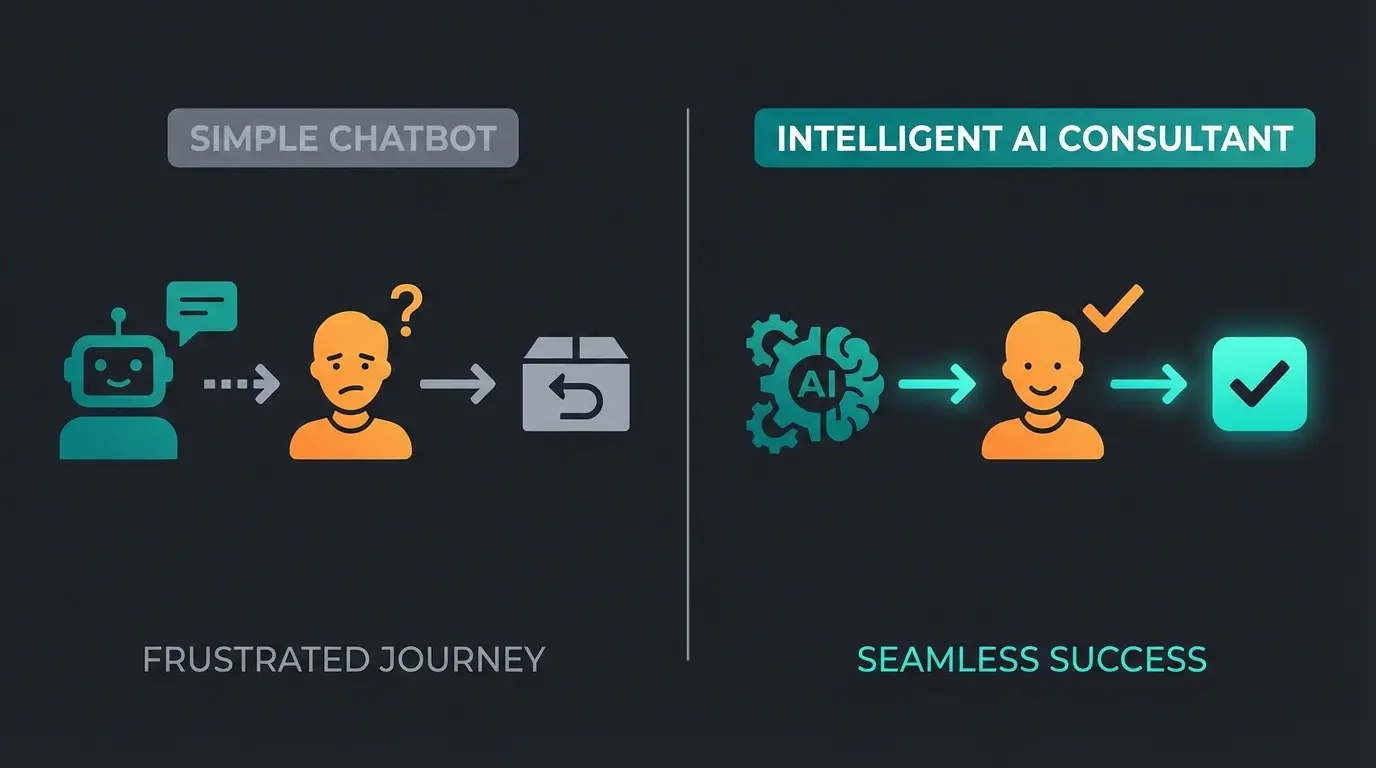
Answers basic questions, matches keywords, provides static links to shipping info—doesn't understand product context or reduce returns
Analyzes customer needs, understands product relationships, guides to the RIGHT purchase, increases AOV, and prevents returns before they happen
FAQ bots save time on basic queries. AI Consultants save €90,000+ annually by preventing wrong purchases and reducing support load
The difference becomes even clearer when you implement AI powered sales consultants that can actively guide customers through complex purchase decisions. This is where AI consultation boosts conversion rates most significantly.
Checklist: How to Sustainably Reduce Shopware TCO
To truly optimize your Total Cost of Ownership in 2025, you should follow these steps:
1. Choose the License Based on Feature Need, Not Prestige
Do you really need the 'Beyond' edition for €6,500/month? Often the 'Evolve' edition (€2,400) is sufficient if you can map specific enterprise features (like Multi-Inventory) more affordably through specialized third-party tools (e.g., Pickware WMS). Carefully examine which features must be 'native.'
For B2B operations specifically, understanding Shopware B2B pricing is essential for making the right edition choice.
2. Automate Consultation, Not Just FAQs
A chatbot that only spits out links to shipping terms doesn't reduce TCO. Invest in AI that understands products.
- Goal: The AI must actively guide the customer ('Are you looking for a mountain bike for beginners or professionals?')
- KPI: Measure the return rate of customers who used the AI vs. customers without AI interaction
This is where AI service consultation makes the difference between a cost center and a profit driver.
3. Use Data for Return Prevention
Connect your return reasons (from the ERP) with your AI.
Example: If Product X is often returned because it 'runs small,' the Consultation AI must warn the next customer before purchase: 'Note: Customers recommend ordering one size larger here.' This is proactive TCO management.
4. Calculate 'Net TCO' Instead of Gross Costs
Stop viewing costs in isolation. Software that costs €500 per month but prevents 50 returns at €10 each is effectively free. Shift budget from 'repair' (returns processing, support tickets) to 'prevention' (better consultation, AI integration).
Conclusion: TCO Is More Than the Sum of Invoices
The question 'What does Shopware cost?' can no longer be answered in 2025 with just a license price list. The technical costs (license, hosting, agency) are indeed the entry price to the market, but they don't determine your profitability.
The real lever for profitable Shopware operations lies in operational excellence. In a market like Germany, where returns are margin killer number one, investing in intelligent consultation technology isn't an 'add-on option'—it's the most effective path to TCO reduction.
Action Recommendation: Review your profit and loss statement not only for IT costs, but place the costs for return logistics and first-level support alongside them. If this sum exceeds your license costs (which it almost always does), you've found your optimization potential. It's time to rethink TCO—away from software administration, toward intelligent sales management.
The typical first-year TCO for Shopware 6 ranges from €30,000 for basic setups to €150,000+ for enterprise solutions. However, this only covers technical costs (license, hosting, agency). When you include operational costs like returns (averaging €90,000/year for mid-sized shops) and customer support personnel (€45,000-50,000 per FTE), the true TCO can be 2-3x higher than the technical costs alone.
Studies show that AI-powered product consultation can reduce return rates by up to 35%. In Germany, where fashion return rates reach 50% and the average return costs €5-10 to process, this translates to significant savings. A mid-sized shop with 5,000 monthly orders and a 15% return rate could save approximately €94,500 over three years by implementing intelligent AI consultation that guides customers to the right purchase the first time.
Shopware's AI Copilot focuses on backend productivity—generating product texts, summarizing reviews, and automating exports. A Consultation AI focuses on frontend customer interaction—actively guiding customers through purchase decisions, checking product compatibility, recommending correct sizes, and preventing wrong purchases. While AI Copilot saves your work time, Consultation AI saves money by reducing returns and support costs.
Use this formula: (Monthly Orders × Return Rate) × Cost per Return. For example: 5,000 orders × 15% = 750 returns. At €10 per return (logistics, inspection, restocking, value loss), that's €7,500 monthly or €90,000 annually. For bulky items, costs can reach €10-20 per return. Add this to your license, hosting, and agency costs for a complete TCO picture.
For most growing businesses, Shopware Evolve (from €2,400/month) offers the best balance. It includes essential B2B features, Advanced Search, and faster support response times. You can supplement specific Enterprise features (like Multi-Inventory) through specialized third-party tools at lower cost than upgrading to Beyond (€6,500+/month). The key is investing your savings into AI consultation tools that reduce operational TCO rather than paying for native features you may not need.
Stop losing money to preventable returns and inefficient support. Our AI consultation solution integrates seamlessly with Shopware to guide customers to the right purchase—reducing returns by 35% and support costs by 30%.
Get Your Free TCO Analysis