Shopware Service Redefined: Why AI Product Consultation is the New Standard for Shopware 6
Discover why Shopware Service in 2025 means more than maintenance. Learn how AI product consultation transforms your shop into an active sales machine.

Introduction: The Misunderstanding Around 'Shopware Service'
When you search for "Shopware Service" today, you'll find an endless list of agencies. The search results are filled with offers for migrations from Shopware 5 to 6, hosting packages, security updates, and emergency support in case your server crashes on Black Friday.
This is understandable, but it represents a dangerous limitation.
In the classic interpretation, "service" in the Shopware ecosystem means: Someone repairs my shop or keeps it running. It's a defensive posture. You pay to ensure nothing breaks. But in 2025, when the e-commerce market in Germany is growing again and Shopware maintains its market leadership for the fourth consecutive time with approximately 11.5% market share among the top 1,000 shops in Germany, "not broken" is no longer enough to win.
The Paradigm Shift: From Maintenance to Value Creation
We need to redefine "Shopware Service." It's no longer just about serving the code, but about serving the customer.
Imagine walking into a physical specialty store. An employee approaches you and says: "Hello, I make sure the lights stay on and the shelves don't fall over." That's nice, but it doesn't sell you a product. What you're looking for is someone who asks: "What exactly are you looking for? Let me show you the perfect model."
This is exactly the gap that exists in 90% of all Shopware online shops. We have excellent technical service providers (the "light-keepers"), but we've forgotten the digital sales advisor. This gap represents a massive opportunity for shops that understand the difference between support ("Where is my package?") and consultation ("Which bike fits my height?").
This article will show you how to transform the concept of "Shopware Service" for your business. We're moving away from pure dependence on hourly developer rates toward scalable, AI-powered consultation systems that sell 24/7. We'll leverage the latest insights from Shopware AI and the Agentic Commerce Alliance to transform your shop from a silent catalog into an active sales machine.
The 3 Types of Shopware Services (The 'Trojan Horse')
To understand where your opportunity lies, we need to categorize the service landscape. Google and most merchants only see the first two levels. Your competitive advantage lies in the third.
1. Technical Service (The Foundation)
This is what most agencies sell under "Shopware Service." It's the foundation without which nothing works.
- Core tasks: Hosting, security patches, updates (e.g., to Shopware 6.7.1), performance monitoring
- Providers: Certified Shopware agencies (like elio, EXWE, signundsinn)
- Cost model: Usually monthly retainers or high hourly rates (often €100 - €150+)
- Goal: Stability and security
- Problem: It's purely reactive. It prevents revenue loss but doesn't generate new revenue
2. Operational Service (The Tools)
Here we're talking about expanding functionality through software.
- Core tasks: Connection to ERP systems (like Xentral or SAP), integration of shipping providers, payment gateways
- Shopware definition: Shopware itself technically defines "Services" as cloud-based extensions exclusively developed by Shopware and connected via API to avoid compromising core updates
- Goal: Efficiency and process automation in the backend
3. Customer Experience Service (Your 'Sweet Spot')
This is where the untapped potential lies. While levels 1 and 2 focus on the merchant ("Make my life easier"), level 3 focuses on the end customer ("Help me buy the right thing").
- Core tasks: Product consultation, curation, answering pre-sales questions, eliminating purchase doubts
- The deficit: Until now, this area has either been ignored or poorly covered by static FAQ pages and basic chatbots ("Where's my package?")
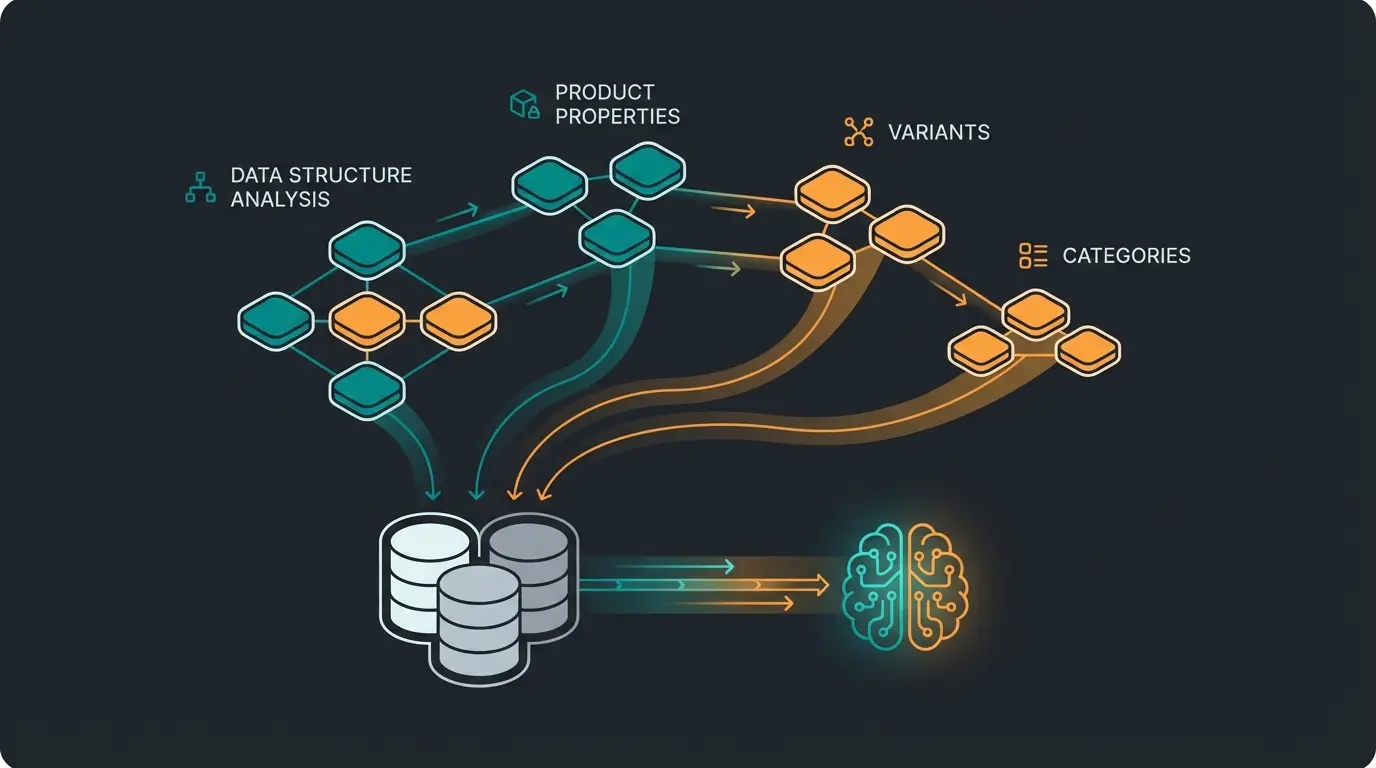
- The solution: AI product consultation. By integrating AI models that deeply tap into Shopware's data structure (product properties, variants), we can automate genuine sales conversations
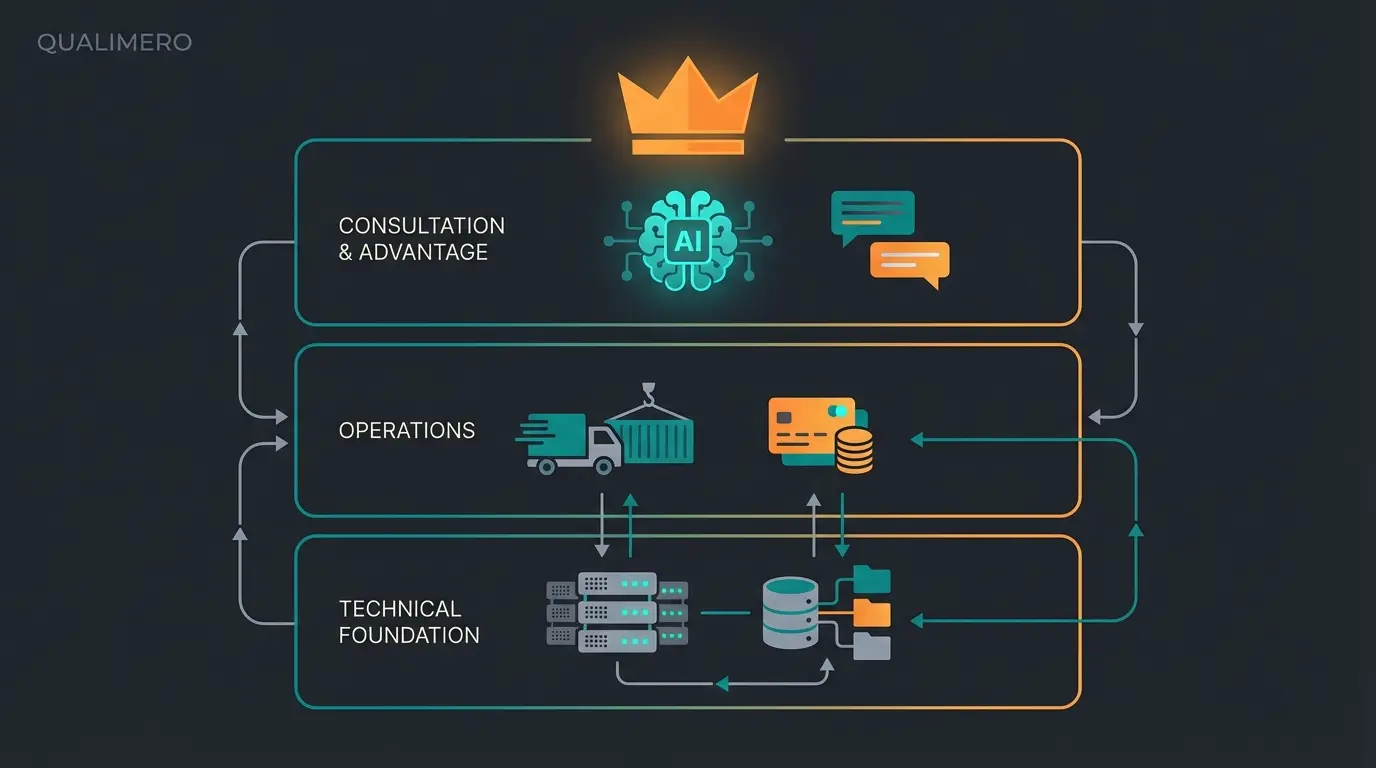
Agency partners handle hosting, updates, and security. Without this, there's no shop.
Plugins and interfaces ensure packages reach customers (ERP, Payment, Shipping).
This is where value creation happens. Differentiate from Amazon through expert advice that's both automated and personal.
Most merchants invest 90% of their budget in the base and middle layers. Tomorrow's market leaders are investing heavily in the top.
Why Standard Bots Fail in Shopware
Many merchants have already tried to automate "service" through chatbots and failed. Why? Because they're using tools that weren't built for the complexity of Shopware 6.
The Problem of 'Dumb' Data
A standard chatbot (or simple FAQ solution) doesn't really know your products. It might scan text snippets, but it doesn't understand the structure of your data. Shopware 6 is extremely powerful in handling structured data:
- Properties: Color, size, material, weight
- Variants: T-shirt in Red/XL vs. Blue/M
- Dynamic Product Streams: Automatic categories based on rules
A generic bot can often only respond to the question "Do you have red bicycles for children?" with a link to the "Bicycles" category. It can't filter. That's not service—that's frustration. Standard AI chatbots for customer service struggle with this complexity because they weren't designed for e-commerce product data structures.
The AI Solution: Context-Based Intelligence
Modern "Shopware Service" tools, especially those built on the Shopware AI (formerly AI Copilot) architecture, leverage this structured data. The new features that Shopware rolled out in 2024 and 2025 point the direction:
- Context-based search: The AI understands not just keywords but sentences and intentions
- Image-based search: Customers can upload a photo, and the AI finds similar products in the Shopware catalog
- AI-generated product properties: The AI can automatically extract and assign properties from descriptions, which creates the data foundation for good consultation
Case Study: The 'Ski Purchase' Scenario
Let's walk through the difference between "Technical Service" (old standard) and "AI Sales Service" (new standard) with a concrete example.
The Shop: A specialized dealer for winter sports equipment based on Shopware 6. The Customer: Michael, 35, intermediate beginner, looking for new skis.
Scenario A: The Classic Shop (Technically Perfect, Service-Poor)
Michael arrives on the site. The shop loads in 0.8 seconds (thanks to good hosting service). The design is responsive (thanks to a good agency). Michael clicks on "Alpine Skis." He sees 450 products.
- Filters: He can filter by brand, price, and length
- The Problem: Michael doesn't know what length he needs. He doesn't know if "rocker" or "camber" is better for him
- Result: He opens 10 tabs, reads technical spec sheets, gets overwhelmed. He leaves the shop to search Google for "What ski length for 180cm height." He lands on a competitor's blog and buys there
- Shopware Service Score: Technical 1.0 (A+). Commercial 6.0 (F)
Scenario B: The Shop with AI Product Consultation
Michael arrives on the site. In the bottom right corner, instead of just a chat window, a "Digital Advisor" opens.
Dialogue:
- AI: "Hello! Are you looking for equipment for the piste, freeride, or touring?"
- Michael: "More piste, but I'm still not that confident on the boards."
- AI: "I understand. How tall are you and how would you rate your skiing ability on a scale of 1-10?"
- Michael: "1.80m, maybe a 4."
- AI (Backend process): The AI analyzes the Shopware database. It filters by category "All-Mountain/Piste." It calculates the ideal length (body height minus 10-15cm for beginners -> approx. 165-170cm). It filters by "Forgiving" (property in Shopware).
- AI (Response): "For your level and height, I recommend a ski around 168cm that's forgiving. Here are three models from our warehouse that are a perfect fit:" Product card 1: Atomic Vantage (with "Add to Cart" button) Product card 2: Rossignol Experience
- Michael: "What's the difference between the two?"
- AI: "The Atomic is a bit lighter and more maneuverable, ideal for saving energy. The Rossignol is more stable at higher speeds."
- Result: Michael feels advised. He adds the Atomic to his cart.
That is Shopware Service in 2025. It's the automation of consultation expertise. This is exactly what AI-powered product consultation enables for modern e-commerce businesses.
Stop losing customers to information overload. Our AI product consultation integrates seamlessly with Shopware 6 to deliver personalized advice 24/7.
Start Your Free TrialThe 'Agentic Commerce' Revolution: Why You Must Act Now
You might be thinking: "This sounds like future music." But development is faster than many merchants realize.
In July 2025, Shopware founded the Agentic Commerce Alliance together with partners. The vision: In the future, not only humans will shop in your store, but autonomous AI agents.
What Does This Mean for Your Service?
Analysts expect that by 2030, nearly a third of all e-commerce transactions will be conducted by AI agents. A customer says to their personal AI assistant (e.g., on their smartphone): "Buy me a pair of red running shoes, size 43, under 150 euros, that are well-cushioned." This agent visits your Shopware shop.
If your "service" only consists of pretty pictures, the agent cannot assess the relevance of your product. But if you have an AI Service Layer that provides structured data and consultation information, your shop can "negotiate" with the customer's agent.
Shopware is preparing the platform for "service" to also mean machine-to-machine interaction. Anyone who still neglects their product data today and doesn't build an intelligent service layer will be invisible in the "Bot Economy." Understanding Conversational AI technology is becoming essential for future-proofing your e-commerce business.
Nearly one-third of e-commerce transactions expected to be conducted by autonomous AI agents
Leading position among top 1,000 shops in Germany for four consecutive years
AI consultation never sleeps—serving customers at 3 AM when agencies are closed
Implementation Guide: How to Integrate AI Service in Shopware 6
How do you get from theory to practice? Here's a roadmap to modernize your Shopware Service.
Step 1: Data Hygiene (The Foundation)
No AI can fix bad data. Use Shopware 6's built-in tools.
- Maintain properties: Ensure attributes like material, size, target group, season, etc. are maintained in the "Properties," not just in the body text
- Tip: Use the AI Copilot | Product Properties, which has been available since the 2024/2025 versions. It scans your product texts and automatically suggests the appropriate properties. This saves hundreds of hours of manual work
Step 2: Choose the Right 'Service' App
Shopware technically distinguishes between plugins (installed in the core) and apps/services (cloud-based). For AI solutions, you should opt for cloud services since they don't put the computational load on your server.
- Search the Shopware Store for solutions offering "Conversational Commerce" or "Guided Selling"
- Pay attention to integration with Shopware AI features
- Consider solutions that support digital AI assistants for comprehensive customer engagement
Step 3: Utilize the 'Digital Sales Room'
For B2B merchants, Shopware offers the "Digital Sales Rooms" feature. Here, sales representatives can create interactive presentations.
- Upgrade: Connect this with AI. Let the AI handle the initial customer qualification in chat before a human representative is invited into the "Sales Room"
- This approach combines the efficiency of AI chatbot automation with the personal touch of human expertise
Step 4: Generate Content for Consultation
An AI needs to know how to talk about a product.
- Use the AI Copilot | Review Summary. It summarizes hundreds of customer reviews. These summaries are gold for your consultation bot. If 50 customers write "Runs small," your service bot must advise the customer: "Better take a size larger."
- This capability transforms AI chatbots for FAQ automation into genuine sales advisors
Comparison: Agency Support vs. AI Sales Service
To free up budget for these new tools, you need to clearly communicate the difference internally. This table will help you do that.
| Feature | Classic Agency Service (Technical) | AI Sales Service (Customer Experience) |
|---|---|---|
| Focus | "The shop should run" (Infrastructure) | "The customer should buy" (Conversion) |
| Availability | Mon-Fri 9-17 (24/7 emergency at extra cost) | 24/7/365 without wait time |
| Cost Model | High hourly rates / Retainers | Fixed SaaS fee / Performance-based |
| Scalability | Linear (More problems = More hours) | Infinite (1 or 10,000 customers simultaneously) |
| Response Time | Hours to days (Ticket system) | Milliseconds (Real-time dialogue) |
| Data Base | Log files, server metrics | Product catalog, customer history, behavior |
| Role | Life insurance for the shop | Top salesperson of the month |
The Service Layer Architecture for Modern Shopware Shops
Understanding how to position AI consultation within your existing service infrastructure is crucial. The most successful Shopware shops in 2025 are building a layered approach that complements rather than replaces traditional services.
Why the Pyramid Model Works
Think of your Shopware service ecosystem as a pyramid representing the maturity level of your e-commerce service:
- Base (Necessary): Technical Hosting & Maintenance — This is where your agency partners operate. Without this, there's no shop. (Hosting, Updates, Security).
- Middle (Functional): Operations & Logistics — This is where plugins and interfaces ensure the package reaches the customer. (ERP, Payment, Shipping).
- Top (Competitive Advantage): AI Product Consultation — This is where value creation happens. This is where you differentiate yourself from Amazon and competitors through expert advice that is both automated and personal.
The strategic insight here is that most merchants invest 90% of their budget in the base and middle. The market leaders of tomorrow are investing massively in the top. This is where the AI employee concept becomes transformative—an always-available digital team member that handles consultation.
The 24/7 Sales Agent Advantage
While agencies sell "Emergency Support" (fixing bugs at 3 AM), you can sell "Sales Support" (selling products at 3 AM). This represents a fundamental shift in what "service" means:
- Agency services are limited by human hours — billed hourly, constrained by time zones and working hours
- AI service is infinitely scalable — contrast "Waiting for an email reply" with "Instant AI product advice"
- The competitive moat widens over time — AI learns from every interaction, continuously improving its consultation quality
Shopware 6 Compatibility: The Technical Foundation
For merchants evaluating AI consultation solutions, Shopware 6 compatibility is non-negotiable. Shopware 6 is built for automation and "composable commerce," positioning AI as the modern "Service Layer" that outdated agency-focused approaches overlook.
When evaluating solutions for Shopware 6 support, ensure they leverage:
- Native Shopware 6 data structures — Properties, variants, dynamic product streams
- API-first architecture — Cloud-based services that don't compromise core updates
- AI Copilot integration — Building on Shopware's native AI capabilities
- Headless compatibility — Supporting modern frontend frameworks and PWA approaches
From Chat to Checkout: The AI Consultation Journey
The power of AI product consultation lies in its seamless integration with the shopping experience. Unlike generic chatbots that simply redirect users to category pages, true AI consultation creates a guided path from question to purchase.
The Three-Step Conversion Process
Here's how a properly implemented AI consultation system works within Shopware:
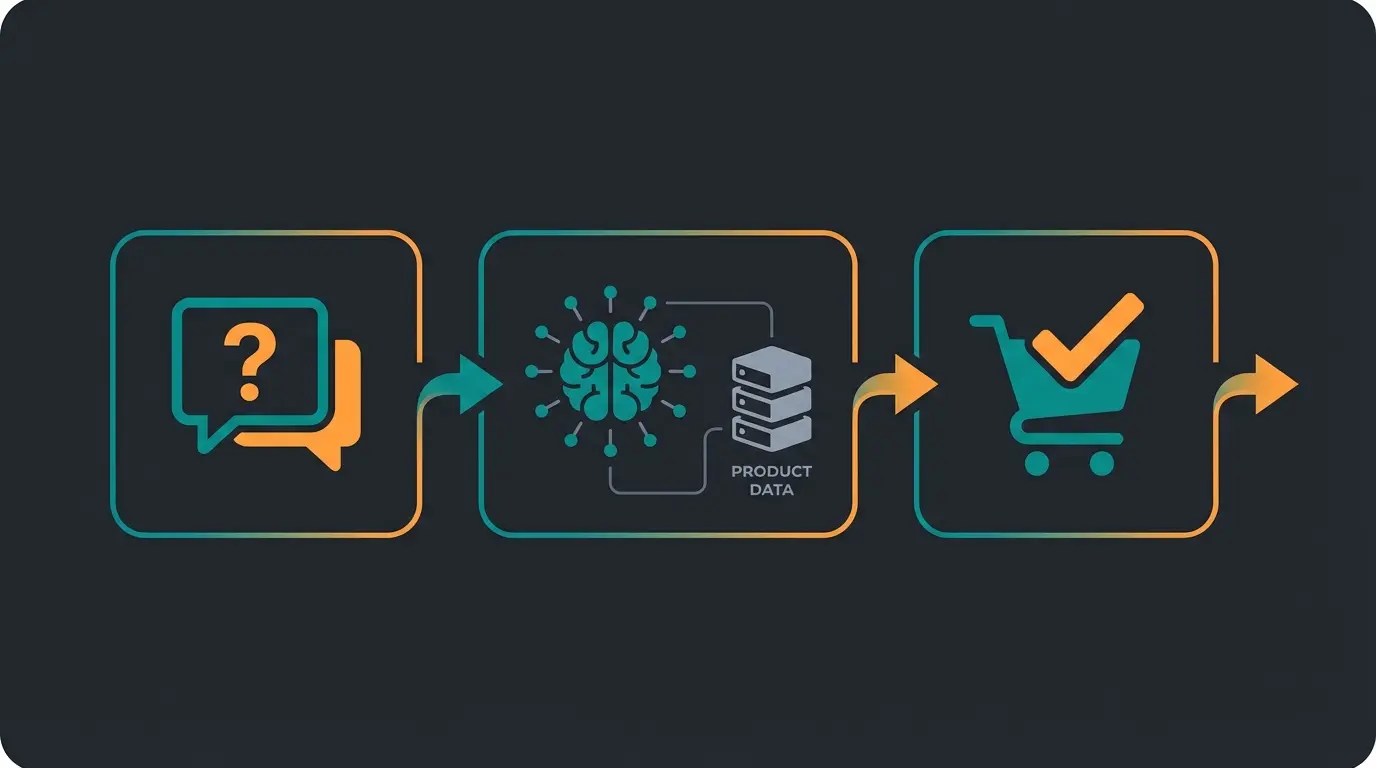
- User asks a complex question — "I need running shoes for marathon training, I overpronate, and I prefer lightweight shoes under €150"
- AI analyzes Shopware product data — The system queries properties (pronation support, weight, category), price ranges, and inventory status in real-time
- AI recommends specific products with direct action — Products appear with "Add to Cart" buttons directly in the chat interface, eliminating friction
This deep integration with Shopware sets professional solutions apart from generic chatbots. It's the difference between AI consulting for e-commerce and simple FAQ automation.
Frequently Asked Questions About Shopware Service
Traditionally, 'Shopware Service' has referred to technical maintenance provided by agencies—including hosting, security updates, migrations from Shopware 5 to 6, and emergency support. However, in 2025, the definition is expanding to include 'Customer Experience Service,' which focuses on helping shoppers make purchase decisions through AI-powered product consultation. This shift recognizes that technical stability is a baseline expectation, while active sales assistance is the new competitive differentiator.
Standard chatbots in Shopware typically operate on simple FAQ logic—they can answer questions like 'Where is my package?' but cannot provide genuine product advice. AI product consultation, on the other hand, deeply integrates with Shopware 6's structured data (properties, variants, dynamic product streams) to understand product attributes. This enables the AI to ask qualifying questions, filter products based on customer needs, and recommend specific items—essentially automating the expertise of a trained sales associate.
The Agentic Commerce Alliance was founded by Shopware and partners in July 2025 to prepare for a future where autonomous AI agents conduct e-commerce transactions. Analysts predict that by 2030, nearly one-third of all e-commerce transactions will be performed by AI agents acting on behalf of consumers. For merchants, this means their 'service' layer must provide structured data and consultation information that AI agents can process—shops without this capability risk becoming invisible in the 'Bot Economy.'
No—AI consultation complements rather than replaces agency services. Your agency remains essential for the technical foundation (Level 1): hosting, security patches, updates, and infrastructure. AI consultation operates at Level 3 (Customer Experience Service), focusing on helping customers make purchase decisions. The key insight is not to allocate 100% of your 'service' budget to technical maintenance; a portion should invest in customer-facing AI to drive conversion and sales.
Start with data hygiene: ensure product attributes like material, size, target group, and features are properly maintained in Shopware's Properties system rather than buried in description text. Utilize Shopware's AI Copilot features to automatically extract and assign properties from product descriptions. Then evaluate cloud-based AI consultation apps in the Shopware Store that offer 'Conversational Commerce' or 'Guided Selling' capabilities with native Shopware AI integration.
Conclusion: From Administrator to Creator
The term "Shopware Service" has evolved. For a long time, it was synonymous with the fear of outages and the necessity of technical maintenance. Today, in an era when Shopware is the leading platform and AI technologies are being democratized, service must be thought of offensively.
Summary of Action Recommendations
- Change your mindset: View service not as a cost center for repairs but as an investment in sales
- Structure your data: Use Shopware AI tools to make your product data fit for consultation
- Automate: Implement tools that don't just deflect customer questions ("Check the FAQ") but solve them ("Here's the product you're looking for")
- Prepare: Keep an eye on the "Agentic Commerce Alliance." Your shop must be ready for the customers (and bots) of the future
Stop paying for traffic that doesn't convert because consultation is missing. Upgrade your "Shopware Service" from maintenance to active sales promotion. The shops that understand this distinction—that invest in the crown of the service pyramid rather than just the foundation—will be the market leaders of tomorrow.
According to the EHI study 2025, Shopware maintains market leadership with approximately 11.5% share among Germany's top 1,000 shops. To leverage this platform strength, merchants must go beyond pure technology and embrace AI-powered customer experience as the new service standard.
Join the shops already transforming from silent catalogs into AI-powered sales machines. Our solution integrates seamlessly with Shopware 6 to deliver the consultation experience your customers expect.
Get Started Today