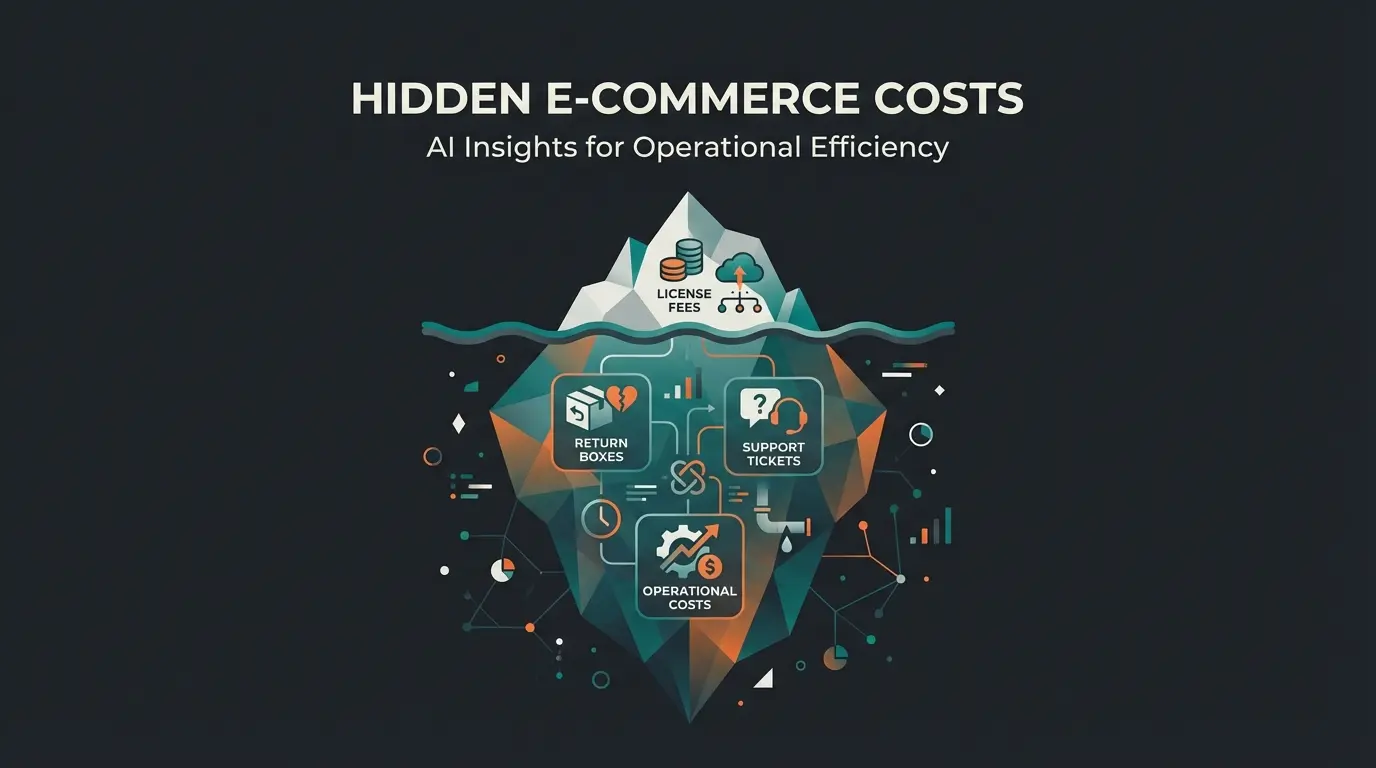
Introduction: The Iceberg Model of Shopware Costs
When e-commerce merchants search for ways to save Shopware costs, they typically end up comparing hosting providers or debating whether to use the free Community Edition instead of a paid plan. This approach is understandable but falls short in 2025.
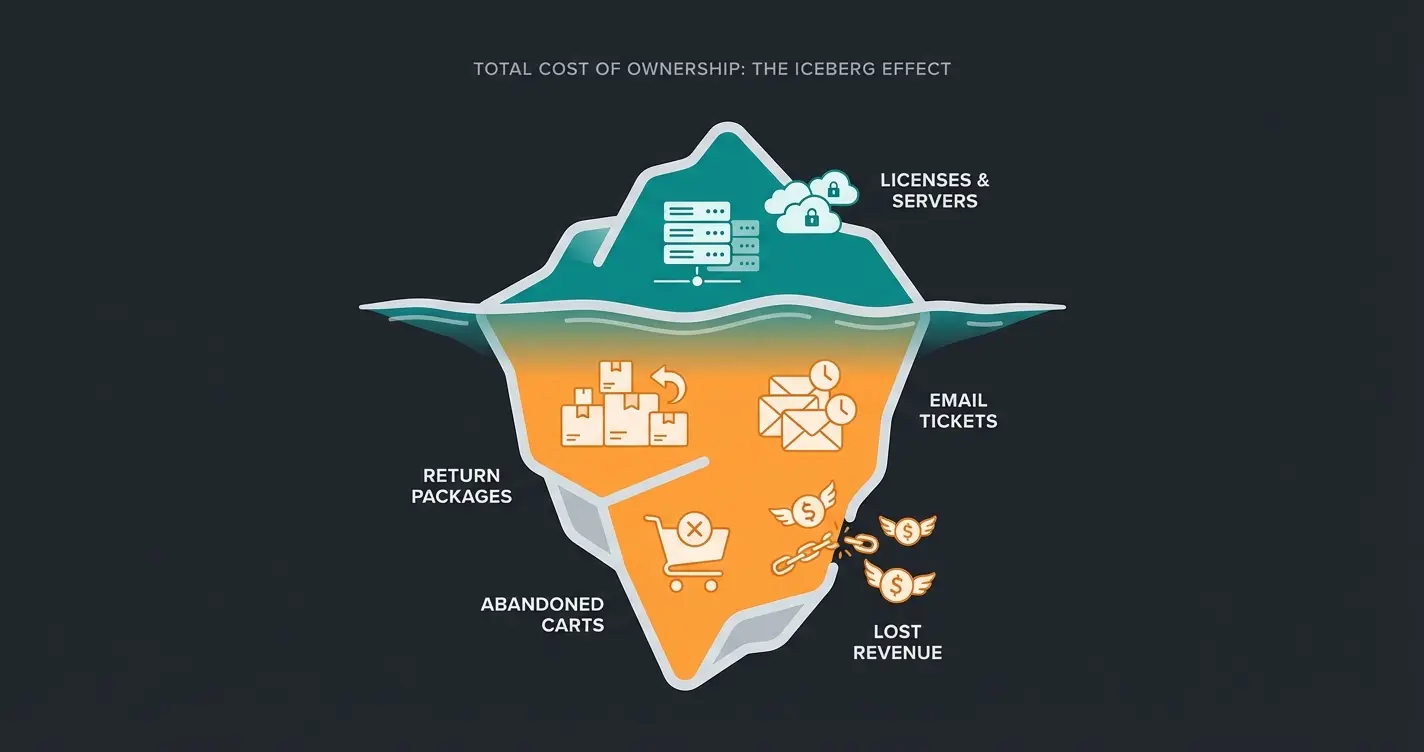
The obvious costs—licenses, hosting, agency hourly rates—represent only the tip of the iceberg. The massive block beneath the waterline that truly threatens your shop's profitability consists of operational inefficiencies: unnecessary support tickets, avoidable returns, and lost conversions due to missing guidance.
In this comprehensive guide, we radically re-analyze the cost structure of a Shopware shop. We examine the Total Cost of Ownership (TCO) and demonstrate why deploying intelligent AI product consultation tools is often a greater savings lever than switching hosting providers. According to Shopware, understanding TCO is essential for making informed platform decisions that impact long-term profitability.
The Must-Haves: Optimizing Technical Base Costs
Before we address the major operational levers, we need to handle the basics. The technical foundation must be solid, or you'll burn money before the first customer enters your shop. Here's the current status for 2025.
Choosing the Right Edition: Watch the Fair Usage Policy 2025
For a long time, the Shopware 6 Community Edition (CE) was the standard recommendation for cost-conscious merchants. It's open source and license-free. However, starting March 24, 2025, the landscape changes fundamentally due to Shopware's new Fair Usage Policy, as reported by themeware.design.
- Under €1M GMV (Gross Merchandise Value): The Community Edition remains free to use. You continue to have access to the Shopware Store and Account.
- Over €1M GMV: Merchants generating more than one million euros in annual revenue must switch to a paid plan (Rise, Evolve, or Beyond) to maintain access to updates, the Store, and security features via Account.
For a detailed breakdown of what each tier offers, check our comprehensive Shopware editions comparison. Understanding these differences is crucial for making the right investment decision.
Current Shopware Plans Overview (2025)
| Plan | Price (approx.) | Target Audience | Savings Potential |
|---|---|---|---|
| Community Edition | €0 (up to €1M GMV) | Startups, small shops | No license costs, but high self-effort for maintenance/hosting |
| Shopware Rise | from €600/month | Growing merchants | Includes support & cloud hosting options. Often saves external agency costs for updates |
| Shopware Evolve | from €2,400/month | B2B & mid-market | Contains B2B Suite & Advanced Search. Saves costs for expensive third-party plugins |
| Shopware Beyond | from €6,500/month | Enterprise | 24/7 support & Multi-Inventory. Often replaces complex ERP middleware |
According to Tikal and Datrycs, understanding the full license cost structure helps merchants plan their budgets effectively and avoid unexpected expenses.
For B2B merchants specifically, our Shopware B2B pricing guide provides detailed ROI calculations and edition recommendations.
Standard vs. Custom Development: The Vanilla Approach
The biggest cost driver during creation (and later maintenance) is custom modifications. Every intervention in Shopware's core code complicates updates and increases technical debt.
- Use the Standard: Shopware 6 is extremely powerful. For every requirement, ask: 'Can this be done with built-in features?'
- Flow Builder & Rule Builder: Use these no-code tools to automate processes instead of hiring a developer at €150/hour to program custom logic. Learn more in our comprehensive Shopware Flow Builder guide.
- Plugin Before Custom Development: A plugin at €20/month is almost always cheaper than two days of developer work (approximately €1,600). But beware: too many plugins slow down your shop (performance costs).
As noted by pure-media-solutions.de, maintaining a standard-compliant installation significantly reduces long-term maintenance costs and simplifies the upgrade path to newer Shopware versions.
Hosting: Performance Equals Revenue
Don't cut corners on hosting. A slow shop kills conversions and drives customers to competitors who provide faster experiences.
- Self-Hosted (Community): Affordable (from €20-50/month), but you're responsible for server updates, PHP versions, and caching (Varnish/Redis) yourself.
- PaaS/SaaS (Rise/Evolve): Higher monthly cost, but you save internal IT resources or agency hours for server maintenance.
The Hidden Cost Block: Where Money Really Burns
Once technical costs are optimized, we look below the iceberg's waterline. Here lie the operational costs (OPEX). Studies show these cost blocks often amount to multiples of license fees, yet most merchants overlook them entirely.
Processing costs per returned package according to EHI Retail Institute 2024/2025
Average cost per email support interaction including agent time and overhead
Cost per phone support interaction, significantly higher than digital channels
Percentage of support tickets that are product questions solvable before purchase
The Returns Trap: €10 to €20 Per Package
Returns are the number one profit killer in e-commerce. According to a current study by the EHI Retail Institute (2024/2025), as reported by fashionunited.de, processing costs per return range between €10 and €20 for the majority of merchants.
- Logistics Costs: Outbound and return shipping fees that eat into margins
- Processing Costs: Unpacking, inspecting, refurbishing (ironing, repackaging), and restocking
- Value Loss: B-stock often cannot be sold at full price, leading to margin erosion
Why do returns happen? Often not due to product defects, but because of false expectations or uncertainty. Customers order two sizes or two variants because they don't know which fits. This isn't a product problem—it's a consultation problem. Implementing an AI product finder can dramatically reduce uncertainty-based returns.
Support Overload: The Expensive Ticket Ping-Pong
Every email, every call costs money. According to eDesk and their comprehensive e-commerce customer service statistics for 2025, support costs break down as follows:
- Email Support: Costs on average $8 to $15 USD per interaction (agent time, tools, overhead)
- Phone Support: Hits even harder at $15 to $25 USD per interaction
- Live Chat (Human): Runs approximately $4 to $8 USD per conversation
If your support team spends all day answering questions like 'Does replacement part A fit machine B?' or 'What size do I need?', you're burning budget on questions that should actually be resolved before purchase. This is exactly where you can automate Shopware support effectively.
As LiveAgent confirms in their cost-per-contact benchmarks, the disparity between human and automated support costs represents a massive optimization opportunity for growing e-commerce businesses.
The Consultation Deficit: Lost Conversions
Perhaps the most expensive line item is the money you don't earn—the invisible revenue leak that compounds daily.
In a physical store, a salesperson approaches a confused customer and guides them to the right product. In an online shop, the customer stares at a filter sidebar with 50 options, becomes overwhelmed, and clicks away to a competitor.
- Confusion costs money: Bewilderment leads to cart abandonment and lost sales
- CAC (Customer Acquisition Cost): You've paid dearly for the click (Google Ads, SEO), but the traffic doesn't convert because consultation is missing
Improving your Shopware customer service experience and reducing wait times directly impacts conversion rates and customer lifetime value.
See how AI-powered product consultation can reduce your support tickets and return rates while increasing conversions. Get a personalized TCO analysis for your Shopware store.
Calculate Your SavingsThe New Way to Save: AI-Powered Product Consultation
Here lies the greatest potential for saving Shopware costs in 2025. It's not about making the server €5 cheaper, but about drastically reducing the cost-to-serve and increasing net margin.
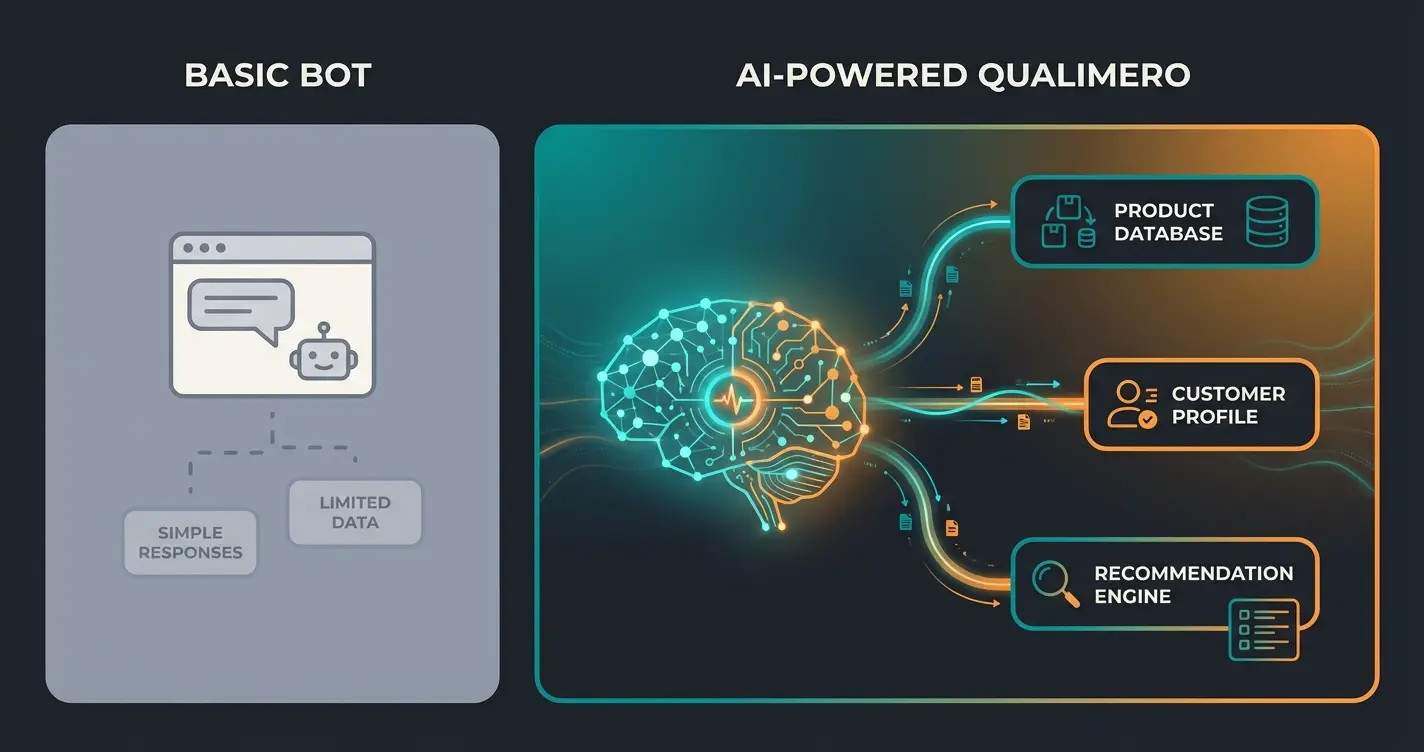
The solution is a specialized AI product consultation (not just a generic chatbot) that's deeply integrated with your Shopware data. This represents the evolution of AI E-Commerce that leading merchants are already implementing.
The Shift Left Approach in E-Commerce
In IT, 'Shift Left' means finding errors early in the process. In e-commerce, it means: Clarify questions before they become support tickets or returns.
An AI acting as a proactive sales consultant transforms the customer journey:
- Intercepts the customer: 'Are you looking for a replacement part for a specific model?'
- Qualifies the need: Asks targeted follow-up questions (like a good salesperson would)
- Recommends precisely: Suggests exactly the product that fits the customer's requirements
This approach is central to effective AI-powered product consultation that replaces the need for extensive human intervention.
Cost Reduction Through Precision: Lowering Return Rates
When a customer knows through AI consultation that the replacement part fits or the jacket runs true to size, they don't order selection shipments with multiple variants.
Implementing AI-powered product consultation for conversion optimization directly addresses the root cause of consultation-based returns.
Scalability Without Headcount Growth
Classic support cost-cutting measures often mean: longer wait times, worse accessibility, and frustrated customers who leave negative reviews. AI automation costs only a fraction of human interaction (approximately $0.50 to $2.00 USD vs. $15 USD for humans).
- Black Friday & Peak Seasons: Your traffic increases tenfold? Your support team can't be increased tenfold overnight. An AI scales infinitely without you needing to train temporary workers.
- 24/7 Availability: The AI advises even on Sunday evening when purchase decisions are made but no employee is in the office.
For technical issues that do require human intervention, having AI product consultation as a first line of defense ensures your human agents focus on complex cases.
Differentiation: Specialized AI vs. Generic Chatbots
Why isn't a simple 'FAQ bot' enough? The difference between rule-based and intelligent systems determines whether you save costs or just add another tool to manage.
| Feature | Generic Chatbot | Specialized AI Consultation |
|---|---|---|
| Setup Complexity | Low (template-based) | Medium (requires product data integration) |
| Understanding Capability | Keyword matching only | Contextual understanding of customer needs |
| Product Knowledge | Static FAQ responses | Dynamic product attribute analysis |
| Sales Ability | Redirect to pages | Active selling with recommendations |
| Impact on Returns | Minimal | Significant reduction through precision |
| Cost per Interaction | $0.10-0.50 | $0.50-2.00 |
| ROI Timeline | Unclear | Measurable within 30 days |
LLM-based product consultants (like modern Shopware integrations offer) understand context. They can interpret technical datasheets and actually 'advise' rather than just redirect.
Example: A customer asks: 'I need a quiet vacuum cleaner for hardwood floors.' The AI doesn't just filter by 'Category: Vacuum Cleaners'—it checks decibel values and floor compatibility in the product attributes. Discover how AI consultation conversions can improve your category page performance.
Visitor lands on your shop with a general need but uncertainty about which product fits
Proactive AI assistant initiates conversation, asking qualifying questions about specific requirements
AI processes responses against product database, analyzing attributes, compatibility, and specifications
AI presents curated product selection with confidence ratings and explanation of fit
Customer buys with confidence, leading to higher satisfaction and lower return probability
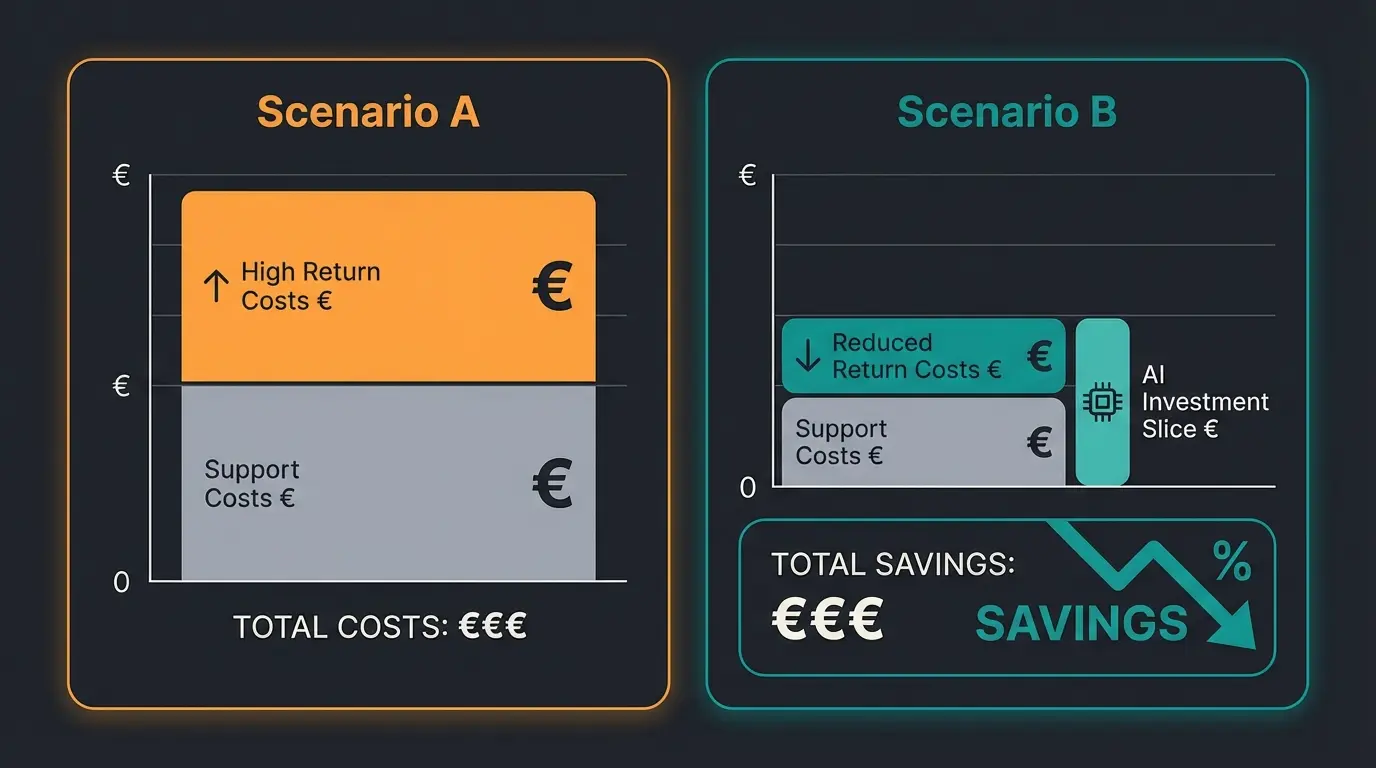
Calculation Example: The Aha Moment (TCO Calculation)
Let's compare two scenarios. We'll assume a medium-sized Shopware shop with the following baseline metrics:
- Orders: 2,000 per month
- Average Cart Value: €100
- Return Rate: 15% (300 returns)
- Support Volume: 400 tickets/month (product-related inquiries)
Scenario A: The Cost Cutter (Focus on Technical Costs)
This merchant uses the Community Edition (self-hosted), saves on plugins, and uses no AI consultant. They've optimized every visible cost line item but ignored operational efficiency.
- Shopware License: €0 (assumed under €1M GMV)
- Hosting: €50
- Return Costs: 300 returns × €15 = €4,500
- Support Costs: 400 tickets × €8 (conservative, email) = €3,200
- Total Monthly Costs: €7,750 (of which €7,700 is operational waste)
Scenario B: The Smart Scaler (Focus on TCO & AI)
This merchant uses Shopware Rise (for stability and support) and invests in an AI sales solution. They've prioritized reducing operational costs over minimizing license fees.
- Shopware License (Rise): €600
- AI Solution License: approx. €300 (representative value for professional SaaS)
- Return Effect: Better consultation reduces rate to 12% (240 returns) → Costs: 240 × €15 = €3,600 (Savings: €900)
- Support Effect: AI handles 50% of 'Which product fits?' questions. Only 200 tickets remain → Costs: 200 × €8 = €1,600 (Savings: €1,600)
- Total Monthly Costs: €6,100
The Bottom Line Result
Although Merchant B spends €900 more on software (Shopware Rise + AI), they have €1,650 more profit at the end of the month than Merchant A.
Calculated annually, that's a savings of €19,800.
For cross-selling opportunities that further improve these numbers, explore our AI product consultation guide.
Practical Checklist: How to Reduce Your TCO Today
To implement this strategy effectively, follow these phased steps that build on each other for maximum impact.
Phase 1: Technical Hygiene (Immediate Actions)
- Check your GMV: Are you over €1M? Budget for Shopware Rise/Evolve starting March 2025.
- Hosting Check: Are you paying for performance you don't need, or losing customers through slow load times?
- Standardization: Successively replace expensive custom developments with standard features (e.g., Flow Builder) or established plugins.
Phase 2: Operational Analysis (Week 1-2)
- Returns Audit: Why do customers send items back? Filter by 'Don't like it' / 'Doesn't fit.' These are consultation failures that AI can prevent.
- Ticket Analysis: Categorize your support inquiries. What percentage are pure product questions ('pre-sales') that could be automated?
Phase 3: Automation & AI Implementation (Month 1)
- AI Pilot Project: Implement a specialized product consultant (not a basic chatbot). Consider solutions that integrate directly with your Shopware product data.
- Data Quality: An AI is only as good as your data. Maintain clean attributes and properties in Shopware.
- Measure & Optimize: Compare conversion rate and return rate of customers who used the AI versus those who didn't.
FAQ: Common Questions About Shopware Cost Savings
The Fair Usage Policy, effective March 24, 2025, requires Shopware shops generating over €1 million GMV annually to switch to a paid plan (Rise, Evolve, or Beyond) to maintain access to updates, the plugin store, and security features. Shops under this threshold can continue using the Community Edition for free.
AI consultation costs approximately $0.50-2.00 per interaction compared to $8-15 for email support and $15-25 for phone support. With 400 monthly tickets, redirecting just 50% to AI can save €1,600+ monthly in support costs alone, not counting the additional savings from reduced returns.
Generic chatbots only match keywords and redirect to static pages. Specialized AI consultation understands context, analyzes product attributes, and provides precise recommendations—leading to measurable reductions in returns and support tickets. The ROI difference is significant within the first 30 days.
For most growing Shopware shops, operational costs (returns, support, lost conversions) far exceed license costs. A shop spending €50/month on hosting but €7,700 on operational inefficiencies should prioritize reducing the latter through AI automation rather than seeking cheaper hosting.
Most merchants see measurable improvements within 30 days of implementation. The combination of reduced support tickets (immediate), lower return rates (1-2 billing cycles), and improved conversion rates (immediate) typically delivers positive ROI within the first month.
Conclusion: The True Meaning of Shopware Cost Savings
Saving Shopware costs in 2025 is no longer a question of finding the cheapest hosting. The introduction of the Fair Usage Policy forces merchants to rethink their license models anyway—making this the perfect time to reconsider your entire cost structure.
The real lever lies in operational excellence. Those who succeed in reducing expensive manual touchpoints (support, returns) through intelligent, automated consultation will massively lower their Total Cost of Ownership. Invest in intelligence rather than manual processing—your bottom line will thank you.
The iceberg model of Shopware costs reveals a simple truth: what you see (licenses, hosting) is far less important than what lies beneath (returns, support overload, lost conversions). By shifting your focus from visible to hidden costs, you unlock savings potential that most competitors completely overlook.
Join forward-thinking merchants who save thousands monthly through AI-powered product consultation. Get started with a free trial and see the impact on your support costs and return rates within 30 days.
Start Free Trial Now