Why Does One Shopware Plugin Cost €20 and Another €20,000?
Anyone searching for Shopware plugin costs in 2025 finds themselves in an impenetrable jungle. On one side stand the seemingly affordable extensions in the Shopware Store, often available for the price of a lunch. On the other side stand agency quotes for custom development that quickly reach the price of a small car.
But the biggest change in pricing is happening in the "middle ground": With the advent of Artificial Intelligence (AI), value creation is shifting. It's no longer just about functions (e.g., "Export CSV"), but about results (e.g., "Sell more products through consultation"). This transformation is reshaping how smart shop operators think about plugin investments.
This article isn't a simple price list comparison. It's a strategic guide for e-commerce managers and shop operators who want to understand how Shopware 6 costs break down, where the hidden price drivers lurk, and why investing in specialized AI SaaS solutions is often more economical than classic custom development. We analyze the Total Cost of Ownership (TCO) of static product advisors compared to modern AI sales agents and uncover what agencies often conceal. According to operun.de, custom plugin development can range dramatically based on complexity and requirements.
The 3 Cost Categories: A Market Overview
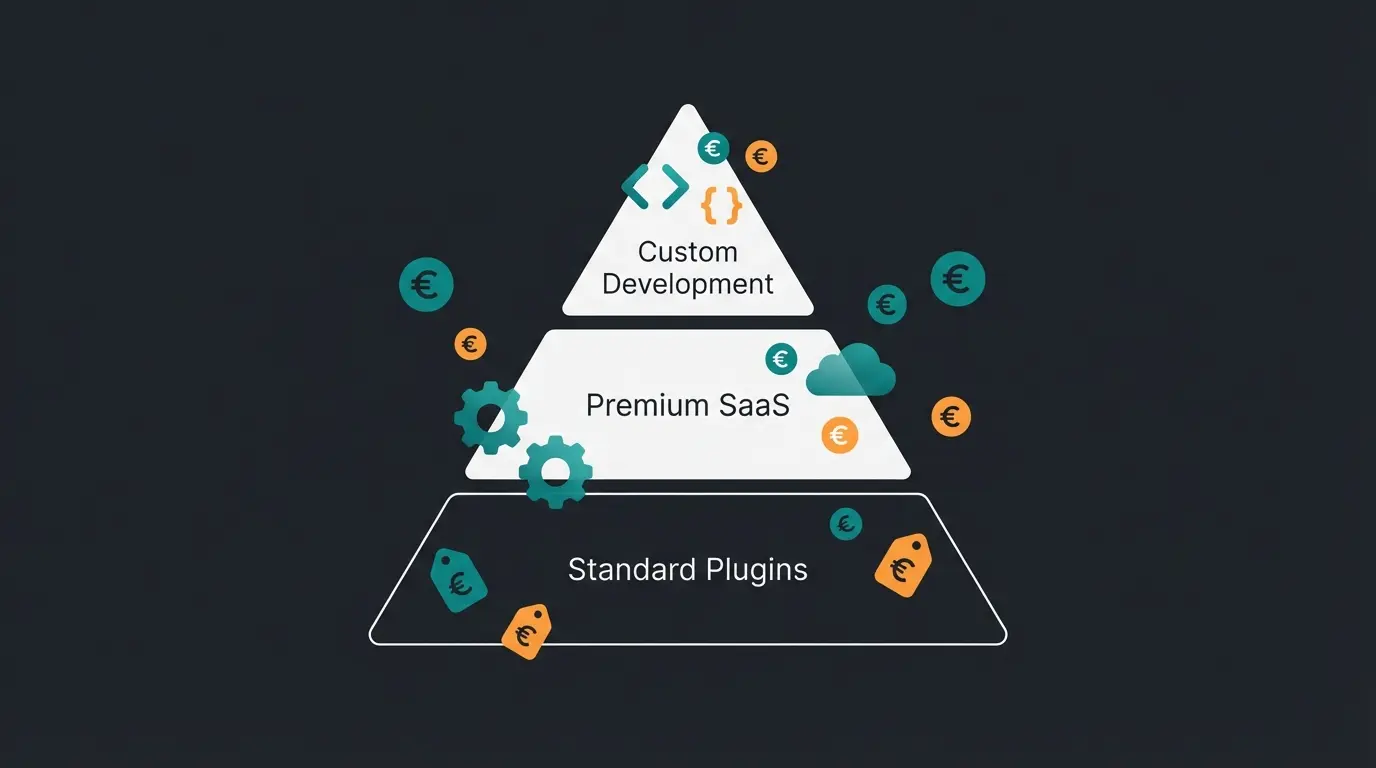
To realistically assess Shopware plugin costs, we need to divide the market into three clear segments. The days when you could purchase software once ("Lifetime License") are largely over in the Shopware ecosystem. The rental model (subscription) is the new standard, as documented by SafeFive in their analysis of Shopware 5 plugin purchasing versus renting.
| Category | Typical Costs (License) | One-time Costs (Setup/Dev) | Target Group & Use Case |
|---|---|---|---|
| Standard Plugins | €0 – €50/month | €0 – €500 (Installation) | Basic functions (e.g., DHL Adapter, Cookie Banner, simple filters) |
| Premium / SaaS Apps | €50 – €500/month | €0 – €2,000 (Onboarding) | Revenue drivers & complex logic (e.g., AI product consulting, ERP connectors, personalization) |
| Custom Development | Maintenance: ~€200/month | €5,000 – €25,000+ | Tailored solutions that don't exist off the shelf |
Standard Plugins: The Commodity Market
The Shopware Store contains thousands of extensions for standard problems. Prices are kept low through competition. You'll often find a free basic version ("Freemium") or rentals between €10 and €50. As noted by Shopware, the marketplace offers diverse pricing models for different business needs.
The advantage is immediate availability with minimal financial risk. The disadvantage? "Take it or leave it" – customizations are barely possible. If the plugin doesn't fit exactly, you'll need a developer anyway, which negates the cost savings entirely.
Premium & Specialized SaaS: The Value Market
Here you'll find solutions that directly impact revenue (ROI). These include intelligent search functions (e.g., Doofinder), marketing automation, or AI-powered product consultation. The monthly fees are higher because cloud computing power or external APIs (OpenAI, DeepL) are often included.
These tools are continuously developed without you paying for updates. They solve complex business problems and represent the growing segment of AI features in Shopware that modern shops are adopting.
Custom Plugin Development: The Agency Market
When no standard solution fits, the path leads to an agency. According to Shopware Agentur, a reputable hourly rate for Shopware developers in 2025 lies between €125 and €160.
A simple custom plugin requires conception, development, testing, and documentation. Even small projects rarely start under €5,000. You own the code, but you must also pay for every update (e.g., to Shopware 6.7) yourself – a hidden long-term cost many shop operators overlook.
Shopware Editions and Their Impact on Plugin Costs
Before investing in plugins, you must consider your base license. Shopware has radically restructured its pricing model to the Rise, Evolve, and Beyond plans. This massively influences your budget for extensions. For a complete breakdown, check our Shopware Editions comparison.
The Fair Usage Policy Trap
The free Community Edition is tempting, but Shopware pushes merchants into paid plans once they reach a certain revenue (GMV) or need specific features. According to Webwirkung, understanding these thresholds is critical for cost planning.
- Shopware Rise (from €600/month): Already includes the Rule Builder and Flow Builder. Check whether you even need a plugin for certain automations – these functions are often already native here.
- Shopware Evolve (from ~€2,400/month): B2B features and extended search are included. If you use Evolve, you often save expensive B2B suite plugins but pay a high base fee.
- Shopware Beyond (from €6,500/month): Full enterprise features including Guided Shopping – but the price tag is substantial.
Deep Dive: The Product Consultation Cost Trap
Here lies the biggest lever for your shop – and the biggest misunderstanding regarding Shopware plugin costs. Many merchants search for a "product advisor" to increase conversion rates. Yet the pricing models differ fundamentally in terms of money and time. Understanding AI in e-commerce is essential for making the right choice.
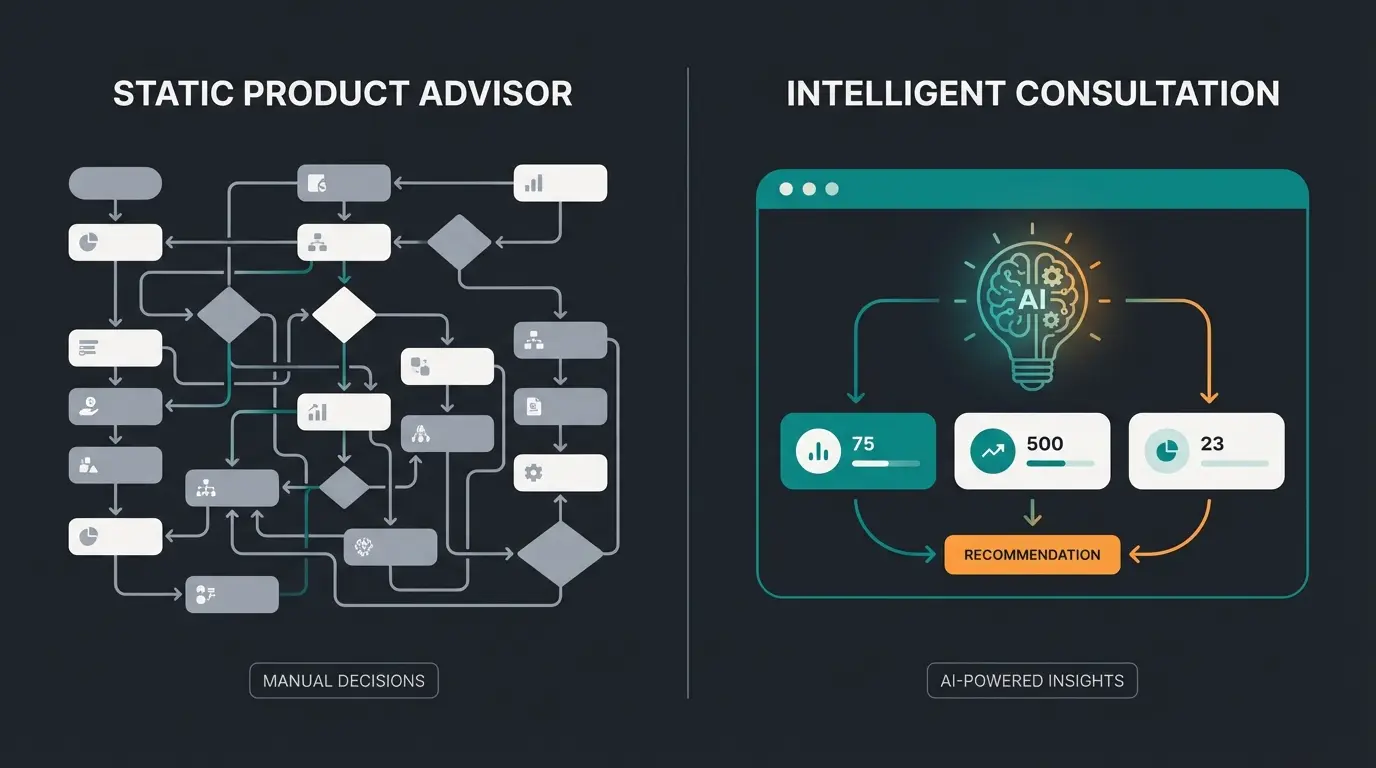
Option A: The Classic Decision Tree (Static Plugin)
These are plugins you'll find in the store for approximately €20 to €40 per month. The functionality works like this: You manually build a questionnaire – "Do you ride on roads or off-road?" If "off-road," show the "MTB" category.
The license is cheap. But the setup is extremely expensive. To build a good advisor for 500 products, you need approximately 20-40 working hours for logic creation. Calculate this: 30 hours × €50 (internal hourly rate) = €1,500 setup costs – hidden in your internal budget. When new products arrive, you must manually adjust the logic. Cheap to acquire, expensive to operate, rigid in application.
Option B: Custom AI Development (Agency Route)
You commission an agency to integrate a "ChatGPT bot" into your shop. As analyzed by YouTube development tutorials, building custom AI solutions requires significant technical expertise.
Project costs typically break down as: Concept & UX Design (3 days), Backend Development in Python/PHP (10 days), Frontend Integration (5 days). Total: approximately 18 days × €1,000 = €18,000. Add ongoing costs for LLM backend hosting, maintenance, and OpenAI API expenses. Maximum flexibility, but extremely high investment (CapEx) and long time-to-market (3-6 months).
Option C: Specialized AI Sales SaaS (The Modern Solution)
Here you rent a finished AI solution specifically trained for e-commerce. Costs typically range from €100 – €300 per month. The hidden benefit? Zero hours of logic building. The AI automatically scans your product feed, and the advisor is live in 30 minutes. This is where digital sales consultants truly shine.
€400 license + €1,500 hidden setup costs (with inferior performance)
€2,400 license + €0 setup costs (with massively higher conversion)
Marginal cost difference for dramatically better performance
Hidden Costs Nobody Tells You About
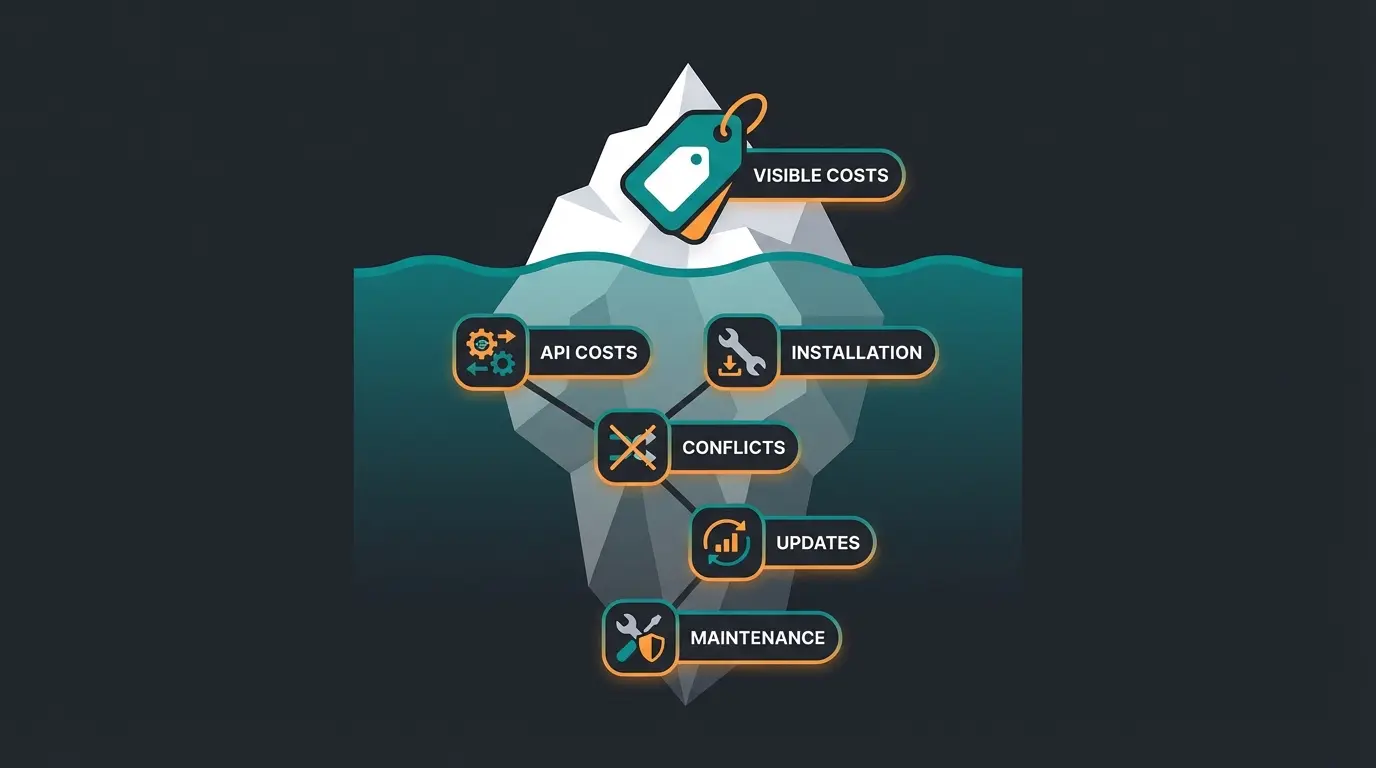
When approving budgets for Shopware plugin costs, watch for these positions missing from standard price lists. These hidden expenses often exceed the license fee itself.
1. API Token Costs (OpenAI / DeepL)
Many "cheap" AI plugins in the store (e.g., for €19) are only "wrappers." This means you must deposit your own OpenAI API key. According to Cursor IDE, understanding token costs is essential for budgeting.
The risk: If your shop has heavy traffic, costs explode on your credit card at OpenAI. 2025 Pricing: GPT-4o costs approximately $5.00 per 1 million input tokens and $15.00 per 1 million output tokens. An intensive sales conversation can quickly consume 2,000 tokens. With 10,000 consultations per month, these are variable costs you bear in addition to plugin rent. As noted by Analytics Vidhya, API costs are often the largest hidden expense in AI implementations.
2. Installation & Conflict Costs
"Plug & Play" is rarely reality in the Shopware universe. Theme compatibility issues often break frontend design, requiring an agency to adjust CSS (costs: 2-4 hours at €125 = approximately €500). Plugin conflicts arise when Plugin A (Checkout) doesn't get along with Plugin B (Payment). Troubleshooting is expensive and time-consuming. Working with a Shopware full-service agency can help navigate these challenges.
3. Update Enforcement (Subscription Model)
Previously, you could simply use a purchased plugin for years. In the rental model (SaaS), the plugin shuts off or no longer receives security updates if you don't pay. You're permanently bound to OpEx costs – a significant shift from the old licensing paradigm.
Discover how AI-powered product consultation eliminates setup costs while maximizing conversion rates. Get instant ROI with zero configuration time.
Start Your Free TrialROI Calculator: When Does the Investment Pay Off?
Let's stop talking about "costs" and start discussing "investment." A plugin that costs €200 but generates €2,000 in additional revenue is essentially "free." Understanding this mindset shift is crucial for modern e-commerce success.
Scenario: Bicycle Online Shop
Consider this real-world calculation: A shop with 50,000 visitors per month faces high abandonment rates on e-bikes (which require explanation). The solution? Deploying an AI employee in e-commerce for product consultation.
Without AI: 1% conversion rate = 500 sales per month
Conservative improvement to 1.1% conversion rate (+10% uplift)
50 extra e-bikes × €2,000 = €100,000 additional revenue
€300/month = €3,600 per year for the AI solution
€100,000 revenue - €3,600 cost = €96,400 net gain
Even with minimal conversion improvement, a high-quality AI plugin often pays for itself within the first week. Compare this with a static filter plugin: It improves usability (customers find products faster) but doesn't conduct sales conversations. The uplift is usually significantly lower. Modern Shopware 6 chatbots can bridge this gap effectively.
Decision Checklist: Finding the Right Solution
Before deciding on a solution, work through these points systematically. The right choice depends on your specific use case and business requirements.
For Standard Functions (Shipping, Legal, Filters)
- Is there a free plugin in the store that meets your needs?
- Is the function already included in your Shopware plan (Rise/Evolve)?
- How often is the plugin updated? (Check the changelog for recent activity)
- What do user reviews say about compatibility and support?
For Revenue Drivers (Product Consulting, Search, Personalization)
- Build vs. Buy: Can you risk €15,000+ and 3-6 months for custom development?
- Setup Effort: Must you maintain decision trees for weeks (static plugin) or does the system start immediately (AI)?
- Variable Costs: Are API costs (OpenAI) included or do they come on top?
- Support Quality: Is it pure tech support (ticket system) or a Customer Success Manager who helps increase your revenue?
- Integration Complexity: How well does it work with your existing digital sales consultant infrastructure?
Comparison: Static Product Advisor vs. AI Consultant
To make the distinction crystal clear, let's compare the two primary approaches side by side. This comparison helps illustrate why AI product consultation providers are gaining market share rapidly.
| Criteria | Static Product Advisor | AI Sales Consultant |
|---|---|---|
| License Cost | €20-40/month | €100-300/month |
| Setup Time | 20-40 hours manual work | 0 hours (automatic) |
| Time to Live | 2-4 weeks | 30 minutes |
| Maintenance Effort | Ongoing (new products) | Automatic sync |
| Personalization Level | None (fixed paths) | High (dynamic responses) |
| Objection Handling | Not possible | Built-in capability |
| Upselling Ability | Manual rules only | AI-driven recommendations |
| Total Year 1 Cost | €1,900+ | €2,400 |
The table reveals a crucial insight: While the license cost appears lower for static advisors, the true Total Cost of Ownership tells a different story. Specialized AI product consultation for Shopware delivers substantially better value when all factors are considered.
The Future: AI is Changing Plugin Economics
The plugin market is experiencing a fundamental transformation. Traditional pricing models based on one-time licenses are giving way to performance-based and usage-based models. AI capabilities that once required €20,000+ custom development are now available as affordable SaaS subscriptions.
According to Intuition Labs, the AI market for e-commerce is growing exponentially, with specialized solutions increasingly replacing custom development projects.
Frequently Asked Questions About Shopware Plugin Costs
Standard static product advisor plugins cost between €20-40 per month in license fees. However, the true cost includes 20-40 hours of manual setup time (worth €1,000-2,000 in internal costs) plus ongoing maintenance. AI-powered alternatives cost €100-300 per month but require zero setup time, often making them more economical overall.
This varies significantly between providers. Many budget AI plugins (€19-29/month) are merely 'wrappers' requiring your own OpenAI API key, which can add €50-500+ monthly depending on usage. Premium AI SaaS solutions typically include API costs in their flat rate ('Fair Use Policy'), making costs predictable.
Custom development (€5,000-25,000+) only makes sense when no suitable standard solution exists. For common use cases like product consultation, specialized SaaS solutions offer faster time-to-value, lower risk, and continuous updates. Custom development requires ongoing maintenance costs and update responsibility that many businesses underestimate.
Shopware Rise (€600/month) includes Rule Builder and Flow Builder, potentially eliminating the need for some automation plugins. Evolve (€2,400/month) includes B2B features and extended search. Before buying plugins, check whether your Shopware plan already includes the functionality you need.
Key hidden costs include: Installation and configuration (€200-500), theme compatibility fixes (€200-500), plugin conflict resolution (variable), ongoing API token costs for AI plugins (€50-500/month), and mandatory update maintenance. Always request a complete TCO estimate before committing.
Conclusion: The Era of Dumb Plugins is Over
The question of Shopware plugin costs can no longer be answered generically in 2025. While standard extensions become cheap rental commodities, a new class of software is emerging in the area of sales promotion.
The most expensive solution today is often not the one with the highest monthly fee, but rather the one that consumes your time and leaves revenue opportunities on the table.
- Avoid: Expensive agency custom developments for functions that exist as SaaS
- Avoid: Cheap "building block plugins" that require hundreds of hours of manual maintenance
- Invest in: Intelligent systems that relieve your employees and actively sell
The future belongs to dynamic consultation – and it's more affordable than you think. Whether you're exploring conversational commerce or evaluating specific solutions, the key is understanding true Total Cost of Ownership rather than focusing solely on license fees.
Stop investing hours in manual decision trees. Experience how AI-powered product consultation delivers instant ROI with zero configuration time. Join hundreds of Shopware merchants already benefiting from intelligent sales automation.
Start Free AI Consultation Trial