Introduction: AI Chatbots as Digital Conversation Partners
AI chatbots have evolved into indispensable tools in modern digital communication. These intelligent systems are more than just automated response machines—they represent a new era of human-machine interaction. But here's the real question: Are you using them to their full potential, or are you missing the biggest opportunity? Sales.
The importance of AI chatbots continues to grow, particularly for companies looking to optimize their customer care and be available around the clock. According to a recent study, 84% of businesses believe that AI chatbots will become increasingly important for customer communication. This underscores the relevance of this technology in today's business world.
For consumers, AI chatbots offer fast and efficient solutions to their concerns. They enable immediate responses to customer inquiries, which is particularly valuable at a time when 53% of respondents consider long wait times the most frustrating aspect of business communication.
The acceptance of AI chatbots is continuously rising. Nearly 9 out of 10 customers had at least one conversation with a chatbot in 2022, demonstrating the increasing integration of this technology into our daily lives. However, most companies are still using chatbots as glorified FAQ pages—missing the real opportunity to transform these digital assistants into revenue-generating consultation experts.
What Exactly Is an AI Chatbot? Definition and Distinction
Chatbot Definition: From Simple Programs to AI
An AI chatbot is a computer-based system that simulates human conversations and responds to natural language. Unlike simple, rule-based chatbots, AI chatbots use advanced technologies such as machine learning and natural language processing to conduct complex dialogues and continuously improve themselves.
The evolution of chatbots began with simple, pre-programmed responses to specific inputs. Think of them as digital answering machines—capable of only playing back what was recorded. Modern AI chatbots, on the other hand, can understand contexts, recognize nuances in language, and even interpret emotions in texts. These capabilities enable them to conduct far more natural and personalized conversations, making them more like digital employees than simple scripts.
Rule-Based vs. AI-Powered Chatbots: Key Differences
The main difference between rule-based and AI-powered chatbots lies in their flexibility and learning capability:
- Rule-based chatbots: Function according to predefined if-then rules. They can only respond to specific, pre-programmed queries. When a user asks something outside the script, they fail.
- AI-powered chatbots: Use artificial intelligence to recognize patterns in data and learn from interactions. They can understand complex queries and respond flexibly to them, even when encountering new situations.
AI chatbots are capable of grasping contexts and adapting to new situations. They can combine information from various sources and independently generate solutions. These capabilities make them particularly valuable for companies striving for high-quality, personalized customer care—and increasingly, for sales consultation.
| Feature | Rule-Based Bot | AI-Powered Bot |
|---|---|---|
| Response Method | Pre-programmed scripts | Dynamic, context-aware responses |
| Learning Ability | None - static | Continuous improvement |
| Complexity Handling | Simple, linear queries only | Complex, multi-turn conversations |
| Personalization | Limited to basic variables | Deep personalization based on behavior |
| Best Analogy | Digital answering machine | Digital employee |
The Role of AI in Modern Chatbots
Artificial intelligence plays a central role in how modern chatbots function. It enables them to conduct human-like conversations and handle complex tasks. AI chatbots revolutionize customer interaction by:
- Understanding and processing natural language
- Generating context-related and personalized responses
- Learning from every interaction and continuously improving
- Recognizing emotions in texts and responding appropriately
- Analyzing complex problems and proposing solutions
These capabilities enable AI chatbots to take on a variety of tasks, from simple information provision to complex product consultation. They can work around the clock and thus offer a consistent and reliable service that can significantly increase customer satisfaction—and more importantly, drive sales.
The integration of AI into chatbots has the potential to fundamentally change the way companies interact with their customers. It enables more efficient, personalized, and scalable communication that benefits both businesses and customers. But the real revolution isn't in support—it's in consultation.
The Critical Difference: Support Bot vs. Consultation Bot
Here's where most companies miss the mark. The top-ranking content about AI chatbots focuses almost exclusively on cost savings and support automation. But the biggest opportunity lies in revenue generation through intelligent consultation.
Support Bot: The Standard Approach
Traditional support bots are reactive. They wait for customers to ask questions and then provide answers from a knowledge base. They're essentially smart FAQ systems—valuable for deflecting support tickets, but limited in their business impact:
- Answers static questions: "Where is my package?"
- Reduces support costs through automation
- Handles simple, repetitive inquiries
- Focused on problem resolution, not revenue
Consultation Bot: The Revenue-Generating Approach
A consultation bot takes a fundamentally different approach. It's proactive, asking questions to understand customer needs before making recommendations. Think of it as your best salesperson, available 24/7:
- Performs needs analysis: "What do you want to achieve?"
- Increases revenue through guided product discovery
- Handles complex purchasing decisions
- Focused on conversion and customer satisfaction
Qualimero's approach to AI-powered product consultation demonstrates how chatbots can optimize the sales process by understanding customer needs before recommending solutions.
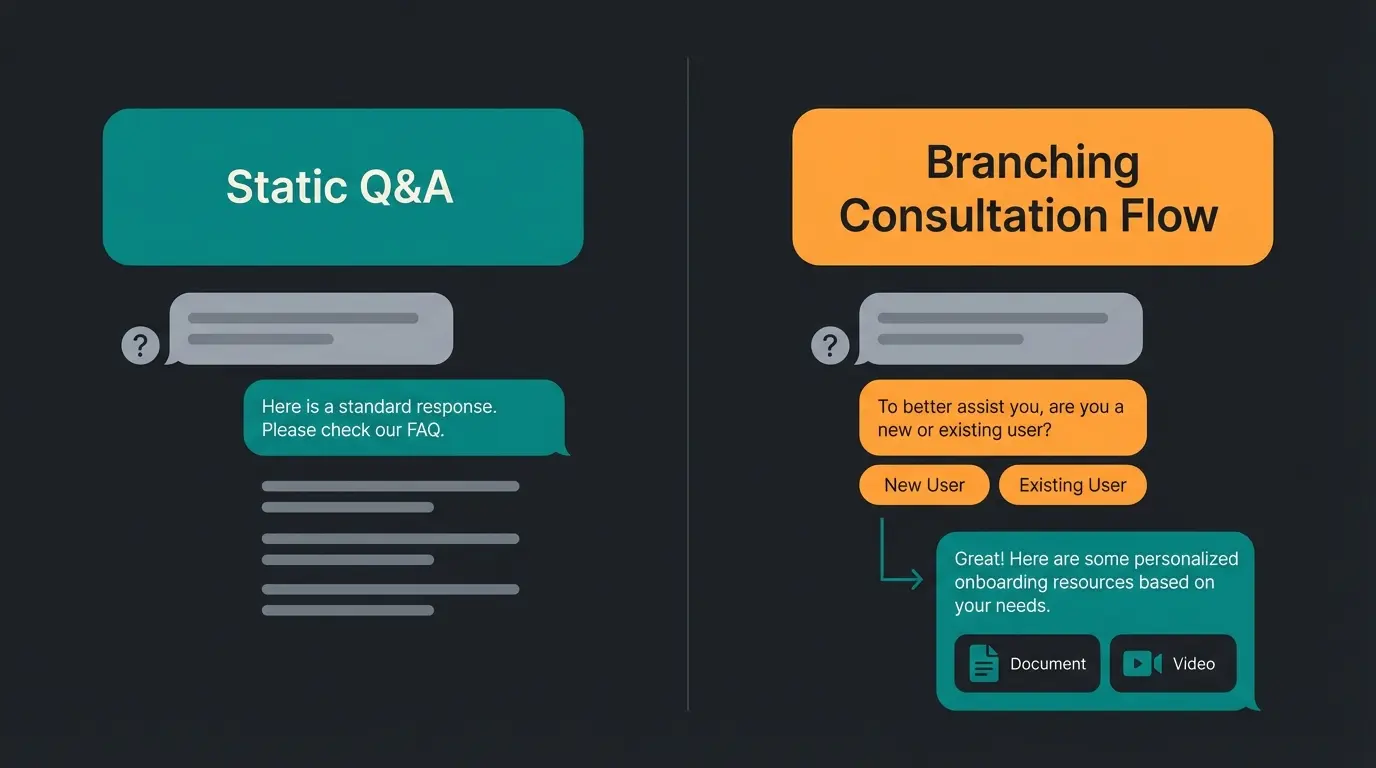
Real Conversation Example: Support vs. Consultation
Let's illustrate this with a concrete example. A customer visits an electronics store looking for a camera:
| Scenario | Support Bot Response | Consultation Bot Response |
|---|---|---|
| Customer: "I need a camera" | "Here's a link to all our cameras. Is there anything else I can help you with?" | "Great! I'd love to help you find the perfect camera. What will you primarily be photographing—portraits, landscapes, sports, or something else?" |
| Follow-up | Waits for next question | "And what's your experience level with photography?" |
| Result | Customer overwhelmed by 200+ options | Bot recommends 2-3 perfect matches with explanations |
The consultation bot doesn't just answer—it leads the conversation. It performs the same needs analysis (Bedarfsanalyse) that a skilled salesperson would, resulting in better product matches, higher conversion rates, and fewer returns.
Technology Behind AI Chatbots: How Do They Work?
AI chatbots have made enormous progress in recent years and are now capable of conducting complex conversations and delivering precise answers. To understand how these digital assistants work, let's take a look at the underlying technology.
Fundamentals of Natural Language Processing (NLP)
Natural Language Processing (NLP) forms the foundation for how AI chatbots function. This technology enables computers to understand, interpret, and respond to human language. NLP encompasses various components:
- Tokenization: The process of breaking sentences into individual words or phrases.
- Syntax Analysis: The examination of the grammatical structure of a sentence.
- Semantic Analysis: Understanding the meaning and context of words.
- Sentiment Analysis: Recognizing the mood or emotion in a text.
Through these techniques, AI chatbots can recognize user intent and generate relevant responses. According to a study by ServiceBell, 23% of customer service companies are already able to deploy AI chatbots for complex conversations. But the real breakthrough comes when NLP is combined with consultation logic—understanding not just what customers are asking, but what they actually need.
Machine Learning and Deep Learning in Chatbots
Machine learning and deep learning play a decisive role in improving the performance of AI chatbots. These technologies enable bots to learn from data and continuously improve their capabilities:
- Training Data: Large amounts of conversational data are used to train the AI.
- Neural Networks: Complex algorithms that mimic human brain structures to recognize patterns in data.
- Self-Optimization: The system's ability to learn from interactions and adapt.
These advanced technologies enable AI chatbots to conduct more natural and context-related conversations. Qualimero reports that modern AI chatbots are capable of handling complex queries and providing personalized communication—essential for effective product consultation.
Bot greets customer and identifies the general area of interest
Asking qualifying questions to understand specific requirements
AI logic matches needs to product features and specifications
Presenting best-fit options with personalized reasoning
Suggesting complementary products and accessories
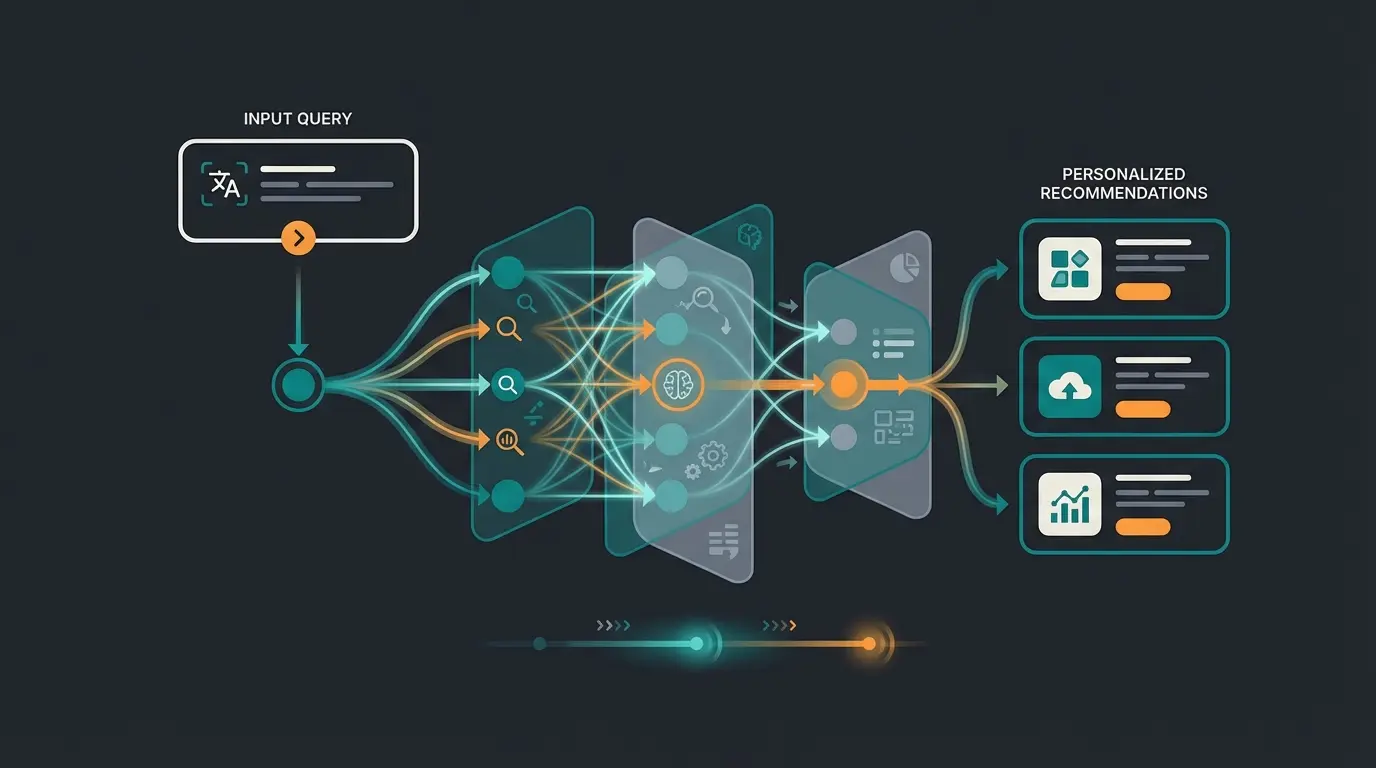
Processing User Inputs and Generating Responses
The process of processing user inputs and generating responses by AI chatbots involves several steps:
- Input Analysis: The chatbot analyzes the user's input using NLP techniques.
- Intent Recognition: The system identifies the intention behind the user's query.
- Context Analysis: The chatbot considers the previous conversation flow and other relevant information.
- Response Generation: Based on the recognized intent and context, an appropriate response is generated.
- Output Optimization: The generated response is checked for naturalness and relevance and optimized if necessary.
Thanks to these advanced processing procedures, AI chatbots can deliver precise and context-related responses. According to Outgrow, 69% of consumers were satisfied with their last interaction with a chatbot, which underscores the effectiveness of this technology.
How AI Technology Revolutionizes Product Consultation
Modern Large Language Models (LLMs) understand context, not just keywords. This is the fundamental shift that makes true consultation possible. When a customer says "I need something for my graphic design work," the AI doesn't just search for "graphic design" in a database—it understands the underlying need for color accuracy, processing power, and creative workflow support.
Beyond Keyword Matching
Traditional e-commerce search works on keyword matching: search for "laptop" and you get all laptops. An AI consultation bot works differently:
- Understands implicit needs: "Something fast" means different things for gaming vs. video editing
- Remembers context: Carries information across the entire conversation
- Asks clarifying questions: Proactively seeks information needed for good recommendations
- Explains reasoning: Tells customers why a specific product fits their needs
AI Chatbots as Part of Conversational AI
AI chatbots are an essential component of the broader field of Conversational AI. They represent an advanced form of human-machine interaction that uses natural language to perform complex tasks and provide personalized experiences.
Position in the Conversational AI Ecosystem
Conversational AI encompasses various technologies and applications that enable computers to conduct human-like conversations. AI chatbots play a central role in this ecosystem:
- Text-Based Interaction: AI chatbots specialize in written communication across various channels.
- Voice Assistants: Systems like Siri or Alexa complement the ecosystem through voice-based interaction.
- Dialog Systems: Complex systems that can conduct longer conversations and retain contexts across multiple interactions.
The integration of AI chatbots into this ecosystem enables companies to offer seamless and consistent communication across various channels. Qualimero demonstrates how AI chatbots can be used in customer service to increase efficiency and improve customer satisfaction.
Interplay with Other AI-Powered Communication Channels
AI chatbots work closely with other AI-powered communication channels to create a holistic customer experience:
- Omnichannel Integration: Chatbots can work seamlessly with other channels such as email, social media, or telephone systems.
- Data Synchronization: Information from chatbot interactions can be synchronized with CRM systems and other databases.
- Escalation Management: For complex inquiries, chatbots can seamlessly hand over to human employees.
This interplay enables companies to offer consistent and personalized communication across all channels. As Qualimero reports, AI chatbots can be used in product consultation to support customers in their selection while seamlessly interacting with other systems.
Stop leaving revenue on the table with basic FAQ automation. See how Qualimero's consultation-first AI chatbot can guide your customers from 'I have a problem' to 'Add to cart.'
Start Your Free TrialBenefits of Consultation-First AI Chatbots
While traditional chatbot benefits focus on cost savings, consultation-first AI chatbots unlock an entirely different category of value: revenue generation. Let's explore both dimensions.
Revenue Increase Through Guided Discovery
When an AI chatbot guides customers through a structured needs analysis, conversion rates increase dramatically. Instead of overwhelming customers with hundreds of options, the bot presents 2-3 perfect matches with clear reasoning. This consultative approach mirrors what happens in the best retail experiences—but available 24/7 and infinitely scalable.
Return Reduction Through Better Advice
Poor product choices lead to returns. Returns cost money and damage customer relationships. A consultation bot that helps customers find the right product the first time directly impacts the bottom line by reducing return rates and associated logistics costs.
24/7 Availability and Scalability
A decisive advantage of AI chatbots is their uninterrupted availability. They work around the clock and offer customers support at any time. This constant accessibility is particularly important since 53% of respondents find long wait times the most frustrating aspect of interacting with businesses. AI chatbots solve this problem by delivering immediate responses and increasing customer satisfaction. But now imagine your best salesperson—available 24/7, never tired, always consistent.
Typical customer service cost savings from chatbot implementation
Total cost savings through chatbot use in 2022 globally
Customers satisfied with their last chatbot interaction
Companies believing chatbots are increasingly important
Efficiency Gains and Cost Savings
For businesses, AI chatbots offer significant economic advantages. They can save up to 30% of customer service costs and enable human employees to focus on more complex tasks. In 2022, cost savings through the use of chatbots reached approximately 11 billion dollars. These figures illustrate the enormous potential of AI chatbots for efficiency improvement and cost optimization.
Personalization and Data Analysis
AI chatbots use advanced algorithms to analyze customer data and provide personalized recommendations. They can recognize customer preferences, evaluate purchase histories, and offer customized solutions. This ability to personalize leads to improved customer loyalty and a higher conversion rate. According to a study by Qualimero, 64% of businesses trust that chatbots can provide personalized customer service.
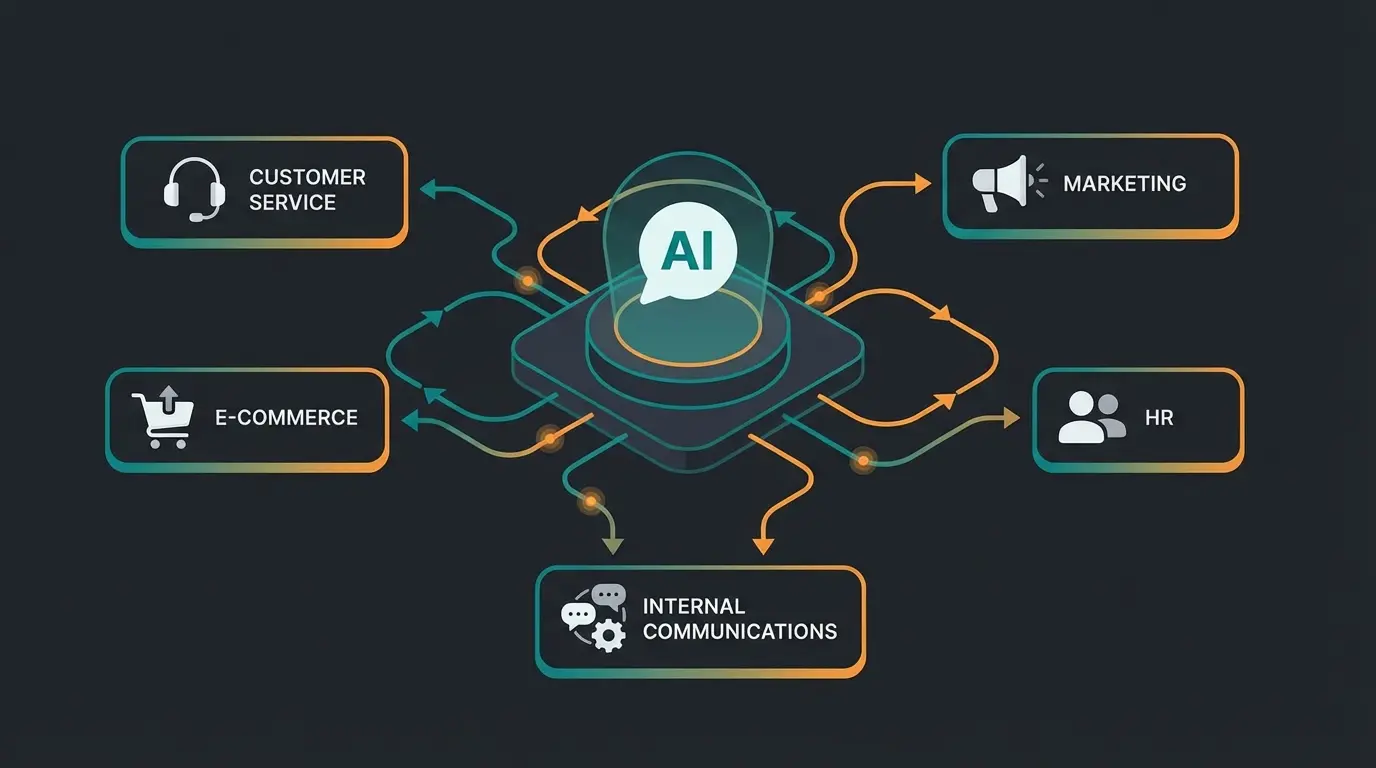
Application Areas of AI Chatbots
AI chatbots find application in various areas and are revolutionizing the way companies interact with their customers. While support remains important, the real innovation is happening in sales-oriented applications.
Customer Service and Support
In customer service, AI chatbots play a central role. They can handle a variety of customer inquiries, from simple questions to more complex problems. AI chatbots are able to deliver quick and precise answers, which increases customer satisfaction and reduces the workload on human employees. Qualimero shows how AI chatbots can optimize customer service and increase efficiency.
E-Commerce and Product Consultation
In the e-commerce sector, AI chatbots support customers in product selection and provide personalized recommendations. They can answer questions about product features, make comparisons, and accompany the entire purchasing process. This support leads to an improved customer experience and can increase conversion rates. Qualimero's approach to AI-powered product consultation demonstrates how chatbots can optimize the sales process.
This is where the consultation bot truly shines. Complex products—electronics, insurance, fashion with fit considerations—require guidance that static product pages can't provide. A consultation AI walks customers through their specific needs and matches them to the right solution.
Information Provision and FAQ Response
AI chatbots are excellently suited for the quick provision of information and answering frequently asked questions. They can process large amounts of data and extract relevant information in seconds. This not only relieves the customer service team but also enables customers to quickly and easily access the information they need.
Lead Generation and Marketing
In marketing and lead generation, AI chatbots can provide valuable services. They can identify, qualify, and forward potential customers to the sales team. Through personalized conversations and targeted questions, they collect important information about prospects and thus support the sales process. Qualimero's approach to AI-powered lead generation shows how chatbots can be effectively used to acquire new customers.
Internal Corporate Communication
Beyond customer contact, AI chatbots also find application in internal corporate communication. They can support employees in searching for information, automate HR processes, and function as virtual assistants for various departments. This leads to improved efficiency and a smoother flow of information within the company.
Distinction from Other Conversational AI Technologies
AI chatbots are only part of the broad spectrum of Conversational AI. To better understand their specific role and significance, it's helpful to distinguish them from related technologies.
AI Chatbots vs. Voice Assistants
AI chatbots and voice assistants like Siri or Alexa have some similarities but differ in essential points:
- Interaction Form: Chatbots communicate primarily text-based, while voice assistants are designed for voice input.
- Application Area: Chatbots are often optimized for specific tasks or industries, voice assistants are more broadly applicable.
- Complexity: AI chatbots can often conduct more complex conversations and provide more specific information.
According to a study by Techreport, 88% of customers had at least one interaction with a chatbot in the last year, which underscores the growing importance of this technology.
Comparison with Email Automation
Email automation and AI chatbots both aim to optimize customer communication but differ in their functionality:
- Response Time: Chatbots offer immediate answers, while email automation often responds with a delay.
- Interactivity: Chatbots enable direct dialogue, emails are more suitable for one-sided communication.
- Personalization: AI chatbots can personalize conversations in real-time, email automation is usually less flexible.
The efficiency of chatbots is evident in the fact that approximately 90% of customer inquiries can be resolved in 10 or fewer messages.
Chatbots and Social Media Bots
Although both technologies can be used on social platforms, there are important differences:
- Purpose: Chatbots are focused on customer service and interaction, social media bots often on content distribution.
- Intelligence: AI chatbots have advanced understanding and response capabilities, social media bots are often simpler in structure.
- Deployment Area: Chatbots are frequently used on corporate websites or in messaging apps, social media bots primarily on social networks.
The versatility of AI chatbots is evident in their use across various industries. The leading countries in chatbot deployment are the United States, India, Germany, the United Kingdom, and Brazil.
Step-by-Step: Implementing a Consultation AI
Moving beyond basic chatbot implementation requires a different approach. You're not just uploading FAQs—you're encoding sales logic and brand voice.
Define Your Consultation Logic
Start by mapping out the decision tree your best salesperson uses. What questions do they ask? In what order? What product attributes matter most for different customer segments? This consultation logic becomes the backbone of your AI.
Train on Product Knowledge and Sales Psychology
Your AI needs more than product specs—it needs to understand why certain features matter to certain customers. Train it on successful sales conversations, not just support tickets. Include objection handling and benefit articulation.
Integrate with Your Product Catalog
Connect your chatbot to real-time inventory and product data. The AI should know what's available, what's popular, and what's on sale. Dynamic recommendations beat static suggestions.
Test with Real Scenarios
Before launch, test your consultation AI with realistic customer scenarios. Can it handle ambiguous requests? Does it ask the right qualifying questions? Does it recommend products that actually fit the stated needs?
Future Perspectives: Where Are AI Chatbots Headed?
The future of AI chatbots promises exciting developments and new possibilities. Two main trends are particularly apparent:
Advanced Technologies Like GPT and Their Influence
Modern AI models like GPT (Generative Pre-trained Transformer) are revolutionizing the capabilities of chatbots:
- Naturalness: Chatbots will be able to conduct even more human-like and context-sensitive conversations.
- Understanding: Improved capabilities in understanding nuances and implicit meanings in human language.
- Generation: Creation of more creative and situationally adapted responses.
These advances will further improve the interaction between humans and machines and open up new application areas—particularly in complex consultation scenarios where understanding nuance is critical.
Integration into Comprehensive Conversational AI Platforms
AI chatbots are developing into an integral part of larger Conversational AI ecosystems:
- Omnichannel Integration: Seamless integration into various communication channels like WhatsApp, websites, and apps.
- Data Analysis: Improved capabilities for evaluating customer data for personalized experiences.
- AI Synergies: Interplay with other AI technologies such as voice and image recognition for holistic solutions.
These developments will enable companies to offer their customers an even more comprehensive and personalized experience.
Looking to the future, the global chatbot market is expected to grow to over 994 million dollars by 2024. This underscores the enormous potential and growing importance of this technology in digital communication—and increasingly, in digital sales.
Frequently Asked Questions About AI Chatbots
Rule-based chatbots follow pre-programmed if-then rules and can only respond to specific, anticipated queries—like a digital answering machine. AI chatbots use machine learning and NLP to understand context, learn from interactions, and handle complex, unexpected conversations—more like a digital employee who improves over time.
While traditional chatbots focus on support cost reduction, consultation-first AI chatbots drive revenue by performing needs analysis, guiding product discovery, and providing personalized recommendations. They act as 24/7 sales consultants, increasing conversion rates and reducing returns through better product matching.
NLP is the technology that enables AI to understand, interpret, and respond to human language. It includes tokenization, syntax analysis, semantic analysis, and sentiment analysis. NLP allows chatbots to recognize user intent and generate contextually relevant responses, making conversations feel natural rather than scripted.
Yes, modern AI chatbots powered by Large Language Models can perform sophisticated needs analysis, understand implicit requirements, maintain conversation context, and provide reasoned product recommendations. They can handle the same consultation process as skilled salespeople—asking qualifying questions, matching needs to features, and explaining why specific products fit.
Industries with complex products requiring guidance see the greatest benefit: electronics, insurance, fashion (fit considerations), home improvement, automotive, and B2B services. Any sector where customers need help navigating options rather than just finding information can transform their conversion rates with consultation AI.
Join the companies already using AI consultation to increase conversions, reduce returns, and scale their best salesperson to 24/7 availability. See the difference consultation-first makes.
Get Started Free
Lasse is CEO and co-founder of Qualimero. After completing his MBA at WHU and scaling a company to seven-figure revenue, he founded Qualimero to build AI-powered digital employees for e-commerce. His focus: helping businesses measurably improve customer interaction through intelligent automation.