Executive Summary
The Shopware relaunch in 2025 exists at the intersection of technical necessity and strategic realignment. While the End-of-Life (EOL) of Shopware 5 (July 2024) and new legal requirements like the European Accessibility Act (EAA) (June 2025) dictate the timeline, the switch to Shopware 6 offers a historic opportunity: The transformation from a static catalog shop to an interactive, AI-powered sales platform.
This guide is not an ordinary migration manual. It combines the essential technical checklist for a secure transition with a forward-looking strategy for Conversational Commerce. We analyze why standard filters have become obsolete, how to make your data 'AI-Ready,' and why the relaunch is the perfect moment to close the 'consultation gap' in e-commerce. Whether you're comparing Shopware vs Shopify or evaluating Shopware vs JTL, understanding the AI integration potential is crucial.
The key insights upfront:
- Urgency: Shopware 5 no longer receives bug fixes; security updates continue through external partners like Safefive, but the technological gap is widening rapidly.
- Technology: Shopware 6.6 and the upcoming 6.7 (May 2025) leverage asynchronous JavaScript and Vite, massively improving performance for frontend AI according to Shopware documentation.
- Costs: The licensing model has radically changed (Rise, Evolve, Beyond). The free Community Edition is limited to €1M GMV from March 2025.
- Innovation: The true ROI of the relaunch lies not in new software, but in integrating AI product consultants that increase conversion rates through genuine consultation.
Introduction: Why Just Migrating Isn't Enough in 2025
For many e-commerce managers, the term 'Shopware relaunch' initially feels like an annoying mandatory exercise. The proven Shopware 5 system runs, revenues are good—so why start a massive IT project? The answer lies in the changed expectations of consumers and technological reality.
The year 2025 marks a turning point. We're moving away from 'search and find' toward 'ask and consult.' While Shopware 5 was an excellent system for the desktop search era, Shopware 6 as an API-First platform is the foundation for the age of Artificial Intelligence. Understanding what Shopware is and its evolution helps contextualize why this transition matters so much.
The Problem: The Consultation Gap
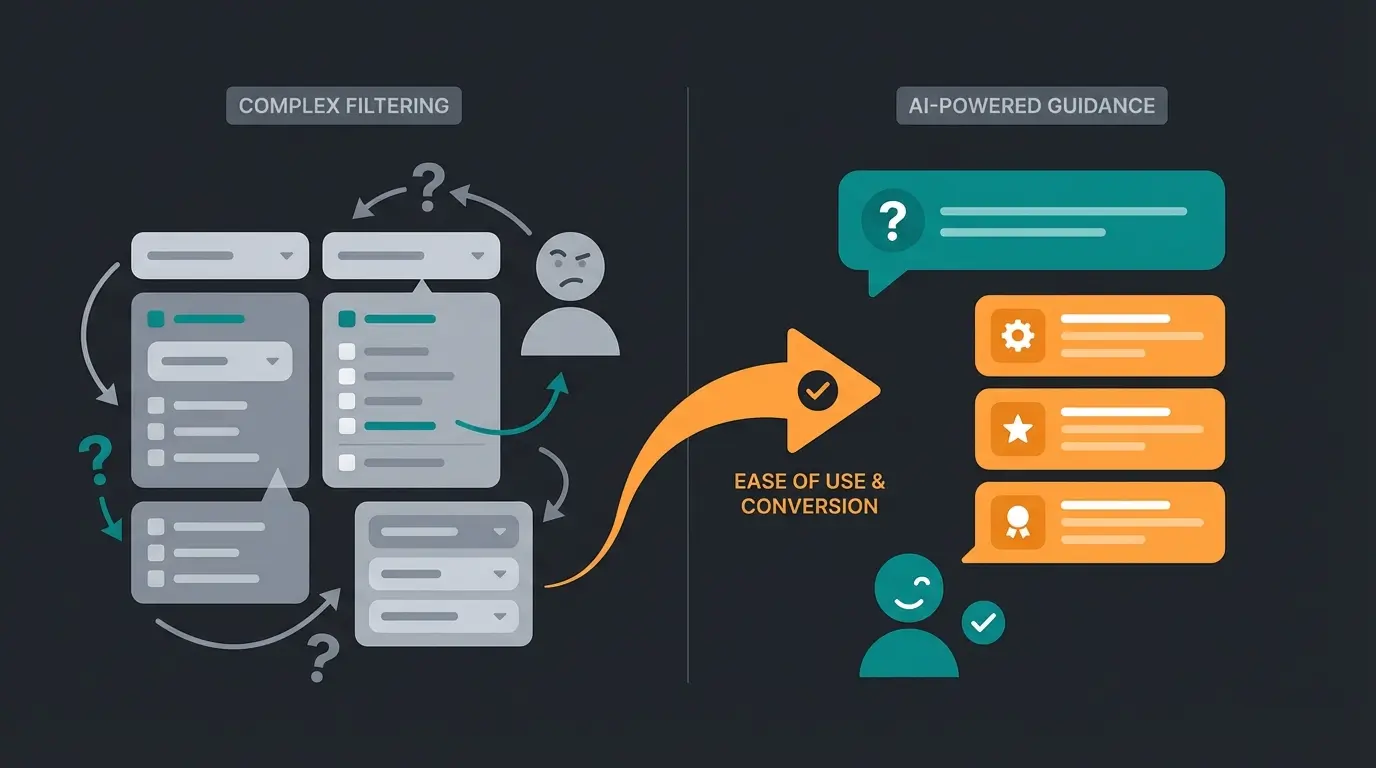
In a physical store, a customer approaches the salesperson and says: 'I'm looking for running shoes for asphalt, but I have knee problems.' The salesperson immediately recommends two suitable models. In the classic online shop, the customer faces a wall of 500 shoes and must operate complex filters (Cushioning: high/medium/low? Drop: 4mm/8mm?).
The relaunch is your chance to close this gap. Instead of just moving data from A to B, with Shopware 6 and modern AI tools you can create a Conversational Commerce Experience that doesn't just serve your customers—it advises them. This is where an AI product finder becomes essential.
Why Relaunch? The Hard Facts and Strategic Opportunity
Before we dive into implementation, we need to clarify the motivation. A relaunch project requires budget and buy-in from management. Here are the arguments, divided into 'Duty' (risk minimization) and 'Opportunity' (revenue growth).
1. The Duty: Security and Compliance
- Shopware 5 End-of-Life (EOL): Since July 2024, Shopware 5 is no longer being developed. There are no more official bug fixes. While providers like Safefive still offer security updates until 2029 according to area-net.de, the ecosystem is drying up. Plugin manufacturers focus almost exclusively on Shopware 6. Remaining on SW5 means rising maintenance costs with declining innovation capability.
- European Accessibility Act (EAA): From June 28, 2025, online shops in the EU must be accessible. Shopware 6.7 (Release May 2025) will deliver EAA-compliant templates and semantic HTML by default as noted by iCreative Technologies. An old Shopware 5 shop would require expensive and complex modifications to meet these laws.
- Performance & Core Web Vitals: Google penalizes slow shops. Shopware 6.6 has significantly improved load times and Lighthouse scores through the introduction of asynchronous JavaScript and elimination of unnecessary code according to HulkApps.
2. The Opportunity: From Catalog to AI Sales Room
The technological leap from SW5 to SW6 isn't an update—it's a system change. Understanding Shopware Cloud architecture helps illustrate why this matters.
- API-First Approach: In Shopware 6, everything is accessible via APIs. This is the fundamental requirement to seamlessly connect external AI tools (like ChatGPT-based consultants or Recommendation Engines) without hacking the core code as explained by Coding9.
- Flow Builder & Rule Builder: These tools allow marketing teams to create complex automations (e.g., 'If customer buys product X and has VIP status, send email Y') without programming knowledge. This saves massive agency costs in the long run.
- AI Readiness: Shopware 6 already offers backend tools for text creation and image editing with 'Shopware AI' according to EXWE. But the real potential lies in the frontend: A relaunch enables you to build the data structure so that AI agents can understand and use it.
Shopware 6.6 with async JavaScript vs traditional loading
Community Edition threshold from March 2025
Instant customer consultation without staff limits
European Accessibility Act compliance required
The Ultimate Shopware Relaunch Checklist (With AI Focus)
A relaunch rarely fails due to technology—it usually fails due to poor planning. This checklist extends the classic migration path with the crucial steps for an AI future. Working with a Shopware full service agency can help ensure all phases are properly executed.
Phase 1: Audit and Clean-up (The Foundation)
Before you migrate, you must clean up. Garbage in Shopware 5 becomes chaos in Shopware 6.
- Plugin Inventory: List all SW5 plugins. Do you still need them in SW6? Often, functions that previously required plugins (e.g., CMS extensions) are natively included in Shopware 6 (Shopping Experiences).
- Data Quality Check: AI models are only as good as the data they're fed. Check product attributes. Are 'Color: Blue' and 'Color: Dark Blue' consistently maintained?
- SEO Audit: Crawl your old shop (e.g., with Screaming Frog). Identify top-performing pages and 'zombie pages' (pages without traffic) that don't need to be migrated.
Phase 2: The Technical Migration
This is where it gets operational. The Shopware Migration Assistant takes a lot of work off your hands, but not the thinking.
- Prepare System Environment: Shopware 6.6+ requires PHP 8.2, MySQL 8.0+ or MariaDB 10.11+, and mandatorily Node.js 20 for frontend building according to Shopware system requirements.
- Caching Infrastructure: Plan for Redis (for sessions/cart) and Varnish (for HTTP cache) from day one. Without these services, a Shopware 6 shop will be slow under load. For optimal performance, consider dedicated Shopware cloud hosting.
- Data Mapping: Use the Migration Assistant to transfer customer data, orders, and products. Note: Shopping Worlds from SW5 cannot be automatically migrated. These must be rebuilt in Shopware 6 Experience Worlds. This is good—use it for a UX redesign!
Phase 3: Design and UX (The AI Layer)
Instead of just rebuilding the old theme ('Pixel-Perfect Migration'), integrate the new conversion elements now.
- Mobile First & Async JS: Use the standard theme of Shopware 6.6 as a base since it's already optimized for asynchronous loading according to Shopware release notes. This improves the INP (Interaction to Next Paint) Score with Google.
- Integration of the AI Consultant: Plan space in the layout for the AI advisor. Not as an annoying pop-up in the bottom right, but as a prominent element on category pages ('Not sure? Get advice').
Phase 4: AI Readiness Check (Your USP)
This step is missing from almost all standard guides. To ensure your new shop doesn't just 'look new' but 'acts intelligently,' you must prepare the data structure. This is where exploring Shopware AI features becomes essential.
- Attribute Normalization: An AI can advise better when technical data (e.g., 'Water column: 10,000mm') is enriched with understandable tags (e.g., 'Suitable for: Heavy rain'). Use the relaunch to create these additional fields (Custom Fields) in Shopware 6.
- Making Unstructured Data Usable: Export PDF datasheets and manuals so they can later be loaded into a vector database (for RAG - Retrieval Augmented Generation) as described by Shopware Store API documentation.
Data quality check plus definition of 'AI Persona' - Who advises the customer?
Shopware 6 installation plus connection of vector database and AI API
Migration Assistant plus data enrichment for AI through systematic tagging
Theme development plus integration of chat interface and AI advisor component
Functional testing plus 'Hallucination test' of the AI - Does it give correct answers?
DNS switch plus continuous monitoring of AI interactions and conversion impact
Don't just migrate—innovate. Discover how AI-powered product consultation can turn your relaunch into a revenue driver.
Start Your AI TransformationRedefining Customer Experience: AI Product Consultation
This is where you differentiate yourself from the competition. Most shops optimize their filters. You introduce consultation. Understanding how Shopware AI works is the first step toward implementation.
The Problem with Filters
Filters require expertise. A customer looking for a laptop may not know whether they need an 'Intel i5' or 'i7.' But they do know they want to 'edit videos' and have 'long battery life.' Filters fail at this translation.
The Solution: The AI Sales Agent
With Shopware 6, you can connect external AI services (like OpenAI, Anthropic, or specialized Shopware plugins like the 'AI Product Advisor') via the API. Consider implementing an AI Employee approach for your store.
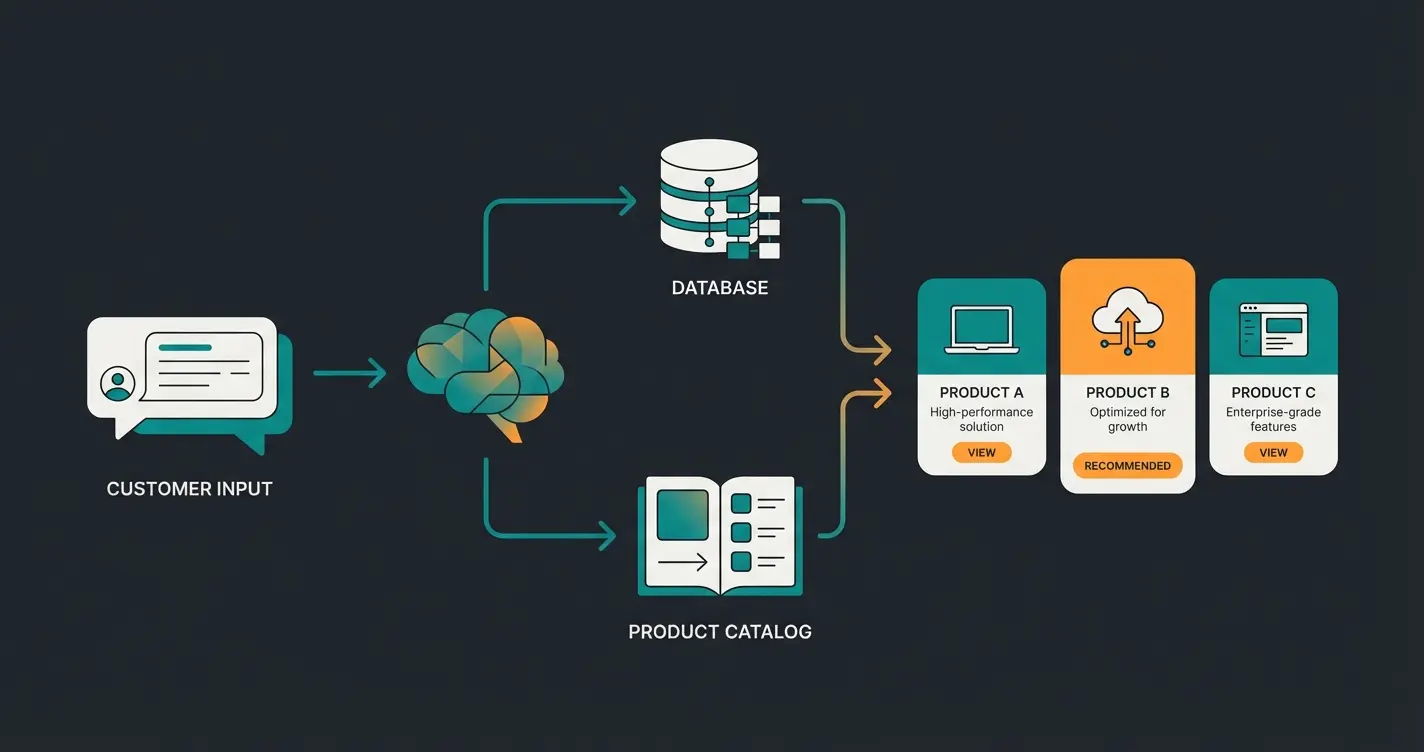
How it works technically:
- Frontend: A chat interface (Vue.js component) in the Shopware Storefront.
- Middleware: The customer's request ('I'm looking for a laptop for video editing') is sent to the AI.
- Context: The AI gets access to your product data (via Shopware API or vector database). Important: You give the AI a 'persona' (e.g., 'You are an experienced tech salesperson').
- Response: The AI responds not only with text but triggers actions in the Shopware frontend—e.g., displaying matching product cards or pre-filling filters.
Standard Relaunch vs AI-Enhanced Relaunch Comparison
| Feature | Standard Shopware 6 Relaunch | AI-Enhanced Relaunch |
|---|---|---|
| Product Search | Keyword search (Elasticsearch) | Semantic search ('Red dress for wedding') |
| Navigation | Static category tree | Dynamic landing pages based on intent |
| Consultation | Static filters (Size, Color) | Interactive dialogue ('What do you need it for?') |
| Support | FAQ page / Contact form | 24/7 instant answers to product questions |
| Data Usage | Historical purchase data | Real-time intent from conversation |
Integration in Shopware 6
Thanks to the App System and Plugin System architecture of Shopware 6, this is easier than ever. The Shopware Headless approach opens even more possibilities for custom AI implementations.
- Backend: Use Shopware's 'AI Copilot' for creating product descriptions and customer classification according to EXWE.
- Frontend: Use plugins that enable 'Conversational Commerce.' Make sure these plugins load asynchronously to not jeopardize performance (a key feature of Shopware 6.6) as noted by HulkApps.
Common Pitfalls During the Relaunch
Even with the best planning, dangers lurk. Here are the mistakes you absolutely must avoid in 2025. Consulting a Shopware agency in Berlin or another specialized partner can help navigate these challenges.
1. The SEO Massacre (Forgotten 301 Redirects)
This is the classic mistake. Shopware 5 URLs look different from Shopware 6 URLs (SEO URLs are technically solved differently in SW6).
- Danger: If you don't redirect old URLs to their new counterparts, you lose your Google rankings overnight.
- Solution: Use the CSV import for redirects in Shopware 6 or plugins like 'SEO Redirects' to test the mapping before go-live according to Shopware documentation.
- Pro Tip: Don't just redirect everything to the homepage. This is treated by Google as a 'Soft 404.' Every old product must point to the exact new product (or its successor).
2. Underestimating Hosting Requirements
Shopware 6 is resource-hungry. A shared hosting package for €5 that was sufficient for Shopware 5 will bring Shopware 6 to its knees.
- Reality: You need dedicated resources for the Message Queue Worker (processes background tasks) and Elasticsearch/Opensearch (for search from approximately 50,000 products) as detailed by Qualimero's hosting guide.
- Recommendation: Budget for at least double to triple the old hosting costs to avoid performance problems.
3. The Community Edition Cost Trap
Many merchants plan with the free Community Edition (CE).
- New Reality 2025: From March 24, 2025, a 'Fair Usage Policy' applies. If your shop generates more than €1 million GMV (gross merchandise value), you must switch to a paid plan (Rise, Evolve) according to Qualimero's cost analysis.
- Strategy: If you're close to this threshold, directly calculate the costs for the Shopware Rise Plan (from €600/month) to have planning security and benefit from manufacturer support SLAs.
Timeline and Cost Framework for Your Relaunch
A relaunch is an investment. Here are realistic benchmarks for 2025. Reviewing the Shopware 6 complete guide provides additional context for budgeting.
Timeline Estimates
- Small Shop (Standard Theme): 3 - 4 months.
- Medium Shop (Custom Design, ERP Integration): 4 - 7 months.
- Enterprise (Headless, Complex B2B Logic): 9 - 15 months according to Qualimero's project estimates.
Important: Plan buffer time for data cleanup. It always takes longer than expected.
Cost Structure Breakdown
Costs consist of three pillars:
1. License Costs:
- Rise: from €600/month (for B2C Standard).
- Evolve: from approximately €2,400/month (for B2B Features & Advanced Search).
- Beyond: from approximately €6,500/month (Enterprise) according to Shopware pricing.
2. Agency / Development:
- Migration & Setup: €15,000 - €50,000.
- Custom Design & Plugins: Open-ended. Hourly rates in 2025 are approximately €125 - €160 according to Qualimero's agency rates.
3. Ongoing Costs (TCO):
- Hosting (High Performance): €300 - €1,000/month.
- AI Tools (API costs): Variable, often very affordable compared to personnel (e.g., €50-200/month for token usage).
Shopware Rise plan starting cost for growing businesses
Typical agency fees for migration and setup
Average timeline for small to medium shops
Increase needed compared to Shopware 5
Frequently Asked Questions About Shopware Relaunch
A typical Shopware relaunch takes 3-4 months for small shops with standard themes, 4-7 months for medium shops with custom designs and ERP integration, and 9-15 months for enterprise projects with headless architecture and complex B2B logic. Always plan additional buffer time for data cleanup, as this phase consistently takes longer than expected.
You will lose rankings if you don't properly implement 301 redirects. Every old URL must redirect to its exact new counterpart—never redirect everything to the homepage, as Google treats this as a 'Soft 404.' Use Shopware 6's CSV import for redirects or specialized SEO plugins to test your redirect mapping before go-live.
The Community Edition remains available but with new limitations. From March 24, 2025, a 'Fair Usage Policy' applies: shops generating more than €1 million GMV must switch to a paid plan. If you're approaching this threshold, budget for the Shopware Rise plan starting at €600/month to ensure planning security.
AI transforms your shop from a static catalog to an interactive sales platform. Instead of forcing customers to use complex filters, AI sales agents engage in natural dialogue ('What do you need it for?'), provide 24/7 instant product advice, and deliver personalized recommendations based on real-time intent. This closes the 'consultation gap' that traditional e-commerce suffers from.
Shopware 6 requires significantly more resources. You need PHP 8.2+, MySQL 8.0+ or MariaDB 10.11+, Node.js 20 for frontend building, plus dedicated resources for the Message Queue Worker and Elasticsearch/Opensearch for shops with 50,000+ products. Budget for 2-3x your previous hosting costs to avoid performance issues.
Conclusion: Don't Just Migrate—Innovate
The Shopware relaunch 2025 is far more than a technical update. It's the farewell to the era of static online catalogs and the entry into the world of intelligent, assisted e-commerce.
Those who view the relaunch merely as a 'mandatory exercise' to escape Shopware 5 EOL are forfeiting massive potential. However, those who use it to modernize their data structure, optimize performance (Shopware 6.6/6.7), and implement AI-powered consultation are building a genuine competitive advantage.
Recommended Actions:
- Start now with the audit (before the EAA deadline in June 2025 creates pressure).
- Rethink your UX: Where can you advise customers instead of making them filter?
- Talk to your agency not just about 'migration' but about 'AI Readiness.'
The best time for the relaunch was yesterday. The second best is today. Make your shop ready for the future.
Stop treating your Shopware relaunch as a technical necessity. Start using it as your opportunity to implement AI-powered product consultation and outpace your competition.
Get Your AI Consultation Now