Executive Summary
Shopware 6 has established itself as the leading e-commerce platform in the DACH region, offering enormous flexibility through its API-first architecture. However, while many merchants master the technical migration, the true potential often remains untapped: the transformation from a static online catalog to an active digital sales consultant. This comprehensive guide illuminates not only the essential features and new pricing structures for 2025 (including the Fair Usage Policy), but also shows how you can use next-generation AI to close a consultation gap that standard shop systems leave open.
According to the EHI study, Shopware has been the market leader among the top 1,000 shops in Germany for the fourth consecutive year. This dominance reflects the platform's maturity and the German market's confidence in its capabilities. Understanding Shopware features costs is essential before diving into implementation. The 2025 pricing transformation means shops exceeding €1M GMV can no longer use the Community Edition for free under the new Fair Usage Policy. Meanwhile, the native Shopware AI Copilot focuses on backend efficiency through text generation and image tags, but the real revenue increase lies in frontend consultation—a gap that must be filled through specialized guided selling AI as explained in the Atwix analysis of AI commerce trends.
Why Shopware 6 Is More Than Just an Update
E-commerce stands at a turning point. The days when it was enough to simply make products available online are over. Customers today expect not just availability, but orientation. This is exactly where Shopware 6 positions itself. It's not merely a version jump from Shopware 5, but a complete architectural realignment that demands a new approach to digital commerce.
With its headless approach and API-first strategy, Shopware 6 provides the technical foundation to enable commerce everywhere—from the classic online shop through social media to IoT devices. But technology alone doesn't sell products. Many companies invest massively in building (hosting, code, design), but forget the selling. The shop is technically brilliant, but 'mute.' It displays products but doesn't explain them. This is where understanding the conversational commerce guide becomes invaluable for modern merchants.
The solution lies in going beyond pure technical implementation. In this article, we'll take you deep into the Shopware 6 ecosystem. We'll cover the critical setup steps, analyze the new license models for 2025, and most importantly show you this: How to use the technical foundation of Shopware 6 to bring the sales conversation into the digital space using consultative AI. Working with a specialized Shopware 6 agency can accelerate this transformation significantly.
What Makes Shopware 6 Different: The Technical Foundation
To evaluate the potential for your business, we first need to look under the hood. Shopware 6 differs fundamentally from monolithic systems of the past, and understanding these differences is crucial for leveraging the platform's full capabilities.
The API-First Approach: Understanding Headless Commerce
In older systems, the frontend (what the customer sees) and backend (the administration) were firmly fused together. Shopware 6 separates these layers completely. Every function of the shop is accessible via an API (interface). The advantage is significant: you can use the standard frontend (Storefront) or build completely custom frontends (for example, a mobile app, a voice skill, or an integration into an ERP system) without changing the core logic.
The relevance for AI is profound: exactly this architecture enables external AI tools to seamlessly access product data and return sales logic. This is why Shopware API automation has become a critical competency for modern e-commerce teams. The flexibility enables businesses to implement sophisticated consultation systems that would be impossible on more rigid platforms.
Rule Builder: The Brain of Your Shop
The Shopware Rule Builder is one of the most powerful tools in the Shopware core. It allows you to create complex business rules without programming knowledge. For example, you can define: 'Customers from Switzerland who have goods worth over 200 CHF in their cart and are shopping on a Sunday receive a 10% discount.' According to IT Delight, these rules form the foundation for personalization and define the 'if-then' framework on which later marketing measures are built.
Flow Builder: The Nervous System of Commerce Automation
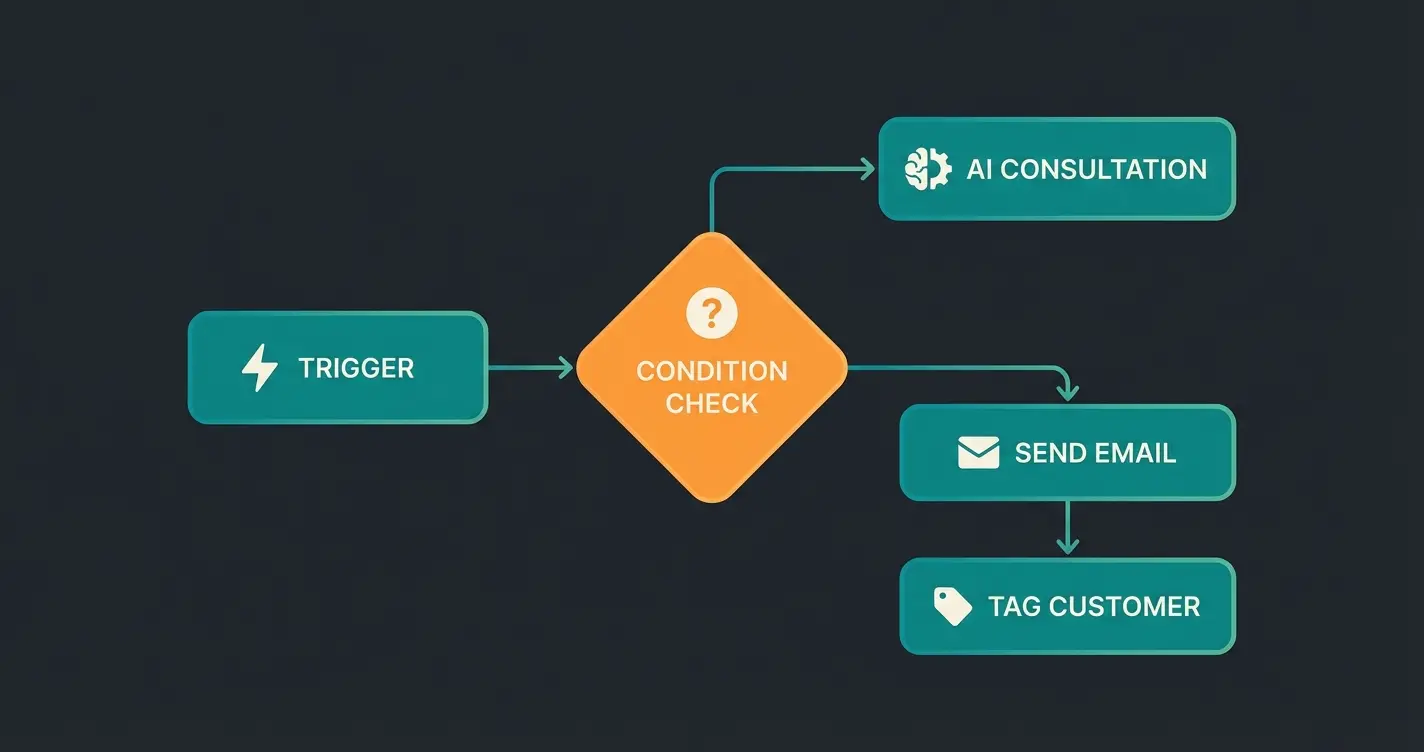
While the Rule Builder defines the conditions, the Flow Builder executes the actions. It automates business processes that previously required expensive plugins. The functionality works like this: Trigger (order received) leads to Condition (Is this a VIP customer?) which leads to Action (Send Slack message to Key Account Manager and send thank-you email). The business value is massive: time savings in daily operations and error reduction that compounds over time.
Shopping Experiences: Merging Content and Commerce
Here, content and commerce merge completely. Unlike Shopware 5, where shopping worlds were often isolated, in Shopware 6 you can seamlessly enrich content pages (landing pages, blog posts) with products. The deficit, however, is that by default these pages are static. The customer reads but must decide for themselves. This is where we'll later apply AI consultation to transform these static pages into interactive consultation zones.
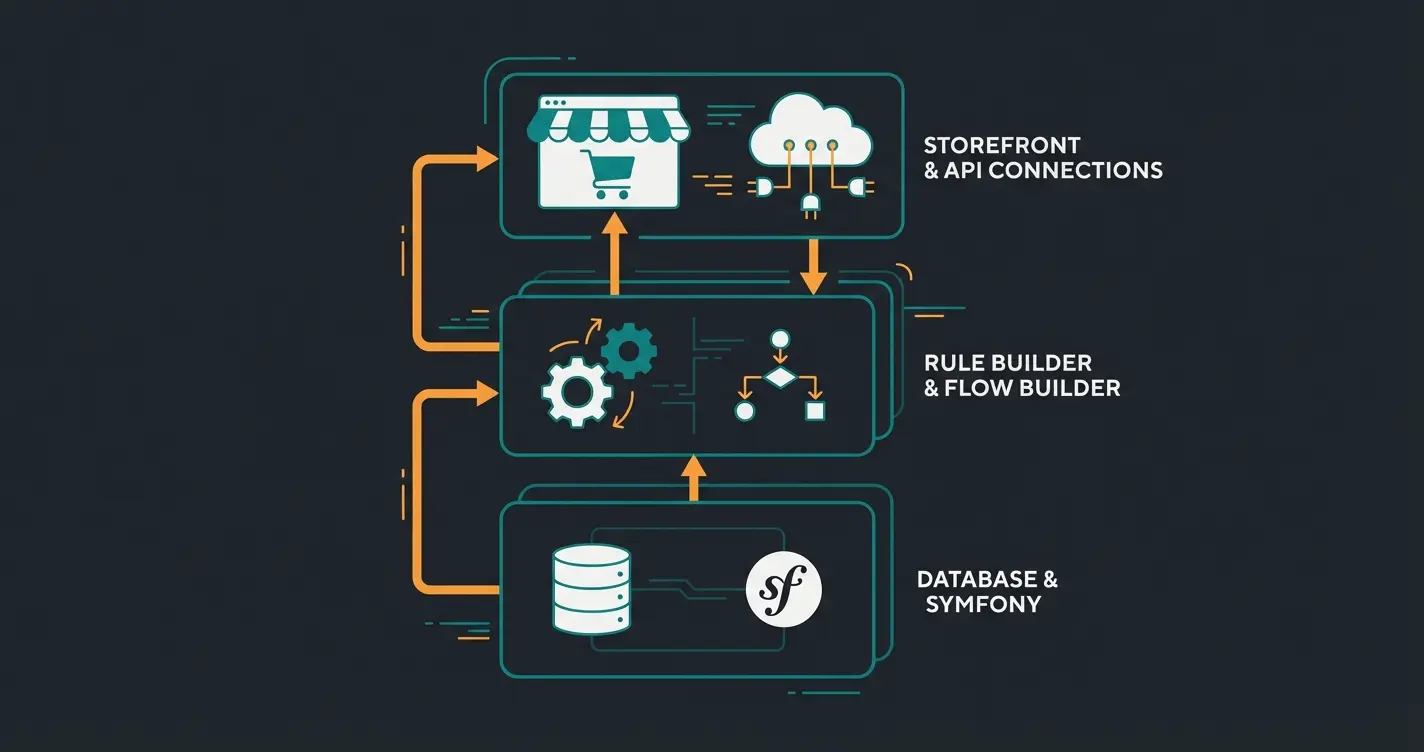
Symfony framework, Vue.js frontend, API-first architecture providing the foundational infrastructure
Rule Builder, Flow Builder, B2B Components enabling business logic automation and customization
AI Product Consultation and Guided Selling transforming passive catalogs into active sales advisors
Setup & Editions: The Critical Comparison for 2025
The license landscape of Shopware has changed dramatically. The old model (one-time purchase of the Professional Edition) is history. For 2025, a pure subscription model applies, and—this is new and critical—a restriction on the free Community Edition. Understanding the Shopware editions comparison is now essential for strategic planning.
The New Fair Usage Policy: What Changes in March 2025
This is the most important point for anyone planning with or using the free version. Shopware introduces the Fair Usage Policy on March 24, 2025, fundamentally changing the landscape. The rule is straightforward: shops with a GMV (Gross Merchandise Volume) of over 1 million euros per year may no longer use the Community Edition without restrictions. As confirmed by themeware.design and 2webpixel.de, the consequence is significant: anyone exceeding this revenue threshold loses access to the Shopware Account and Store (no plugin updates, no new extensions), unless they switch to a paid plan (Rise, Evolve, Beyond). The Community Edition remains safe only for startups and smaller shops under €1M revenue.
Commercial Plans: Rise, Evolve, and Beyond Compared
Here is a strategic overview of which plan suits which business model. This information is based on Shopware's official pricing and analysis from Qualimero:
| Feature / Aspect | Shopware Rise | Shopware Evolve | Shopware Beyond |
|---|---|---|---|
| Target Audience | Ambitious B2C startups & SMEs | B2B merchants & growing brands | Enterprise & market leaders |
| Price (approx.) | from €600/month | from €2,400/month | from €6,500/month |
| Support Level | Standard (8h response time) | Extended (4h response time) | 24/7 Priority Support |
| B2B Features | Basic functionality | B2B Suite/Components (budgets, roles, quotes) | Full Enterprise B2B |
| Key Features | Rule & Flow Builder, Social Shopping | Advanced Search, CMS Rules | Multi-Inventory, Subscriptions |
| AI Copilot | Included | Included | Included |
System Requirements: Quick Performance Check
For Shopware 6 to run performantly, the hosting must be right. Don't skimp here. PHP version 8.1 or higher is critical for security and speed. You'll need MySQL 8.0 or MariaDB 10.11 for your database. Elasticsearch is strongly recommended starting at approximately 10,000 products for your search index. RabbitMQ handles background process execution in the Flow Builder. These requirements form the foundation for everything else you'll build.
The Missing Puzzle Piece: Automated Product Consultation
Most agencies and blogs stop at this point. The shop is installed, the products are imported. But now the real problem begins: the conversion rate stagnates. Why? Because while Shopware 6 excels at presenting products, it doesn't offer standard tools to actually sell them. This is where AI product consultation becomes your competitive advantage.
The Gap: Understanding the 'Mute' Seller Problem
In a physical specialty store, a customer walks up to a shelf with 50 different hiking boots. A salesperson approaches and asks: 'Where do you want to hike? Alps or flatland? Do you have wide feet?' Based on the answers, they recommend one suitable pair. In the online shop, the customer stands before the same 50 shoes. They only have filters (color, size, price). They're overwhelmed. The result: cart abandonment.
This consultation gap represents billions in lost revenue across e-commerce. Traditional approaches like static FAQ sections or basic 'Where is my order?' chatbots don't solve this fundamental problem. What's needed is genuine product expertise delivered at the moment of decision.
Shopware AI Copilot vs. Consultative AI: A Critical Distinction
Shopware heavily promotes its AI features. However, it's crucial to understand what these can do—and what they cannot. The native AI features in Shopware 6 (available from version 6.7 in commercial plans) are productivity tools for the merchant: creating product descriptions and SEO texts, generating keywords for images through the Image Keyword Assistant, summarizing product reviews, and creating personalized checkout messages. In essence, this saves you time in the admin area, but doesn't help the customer decide which product they need.
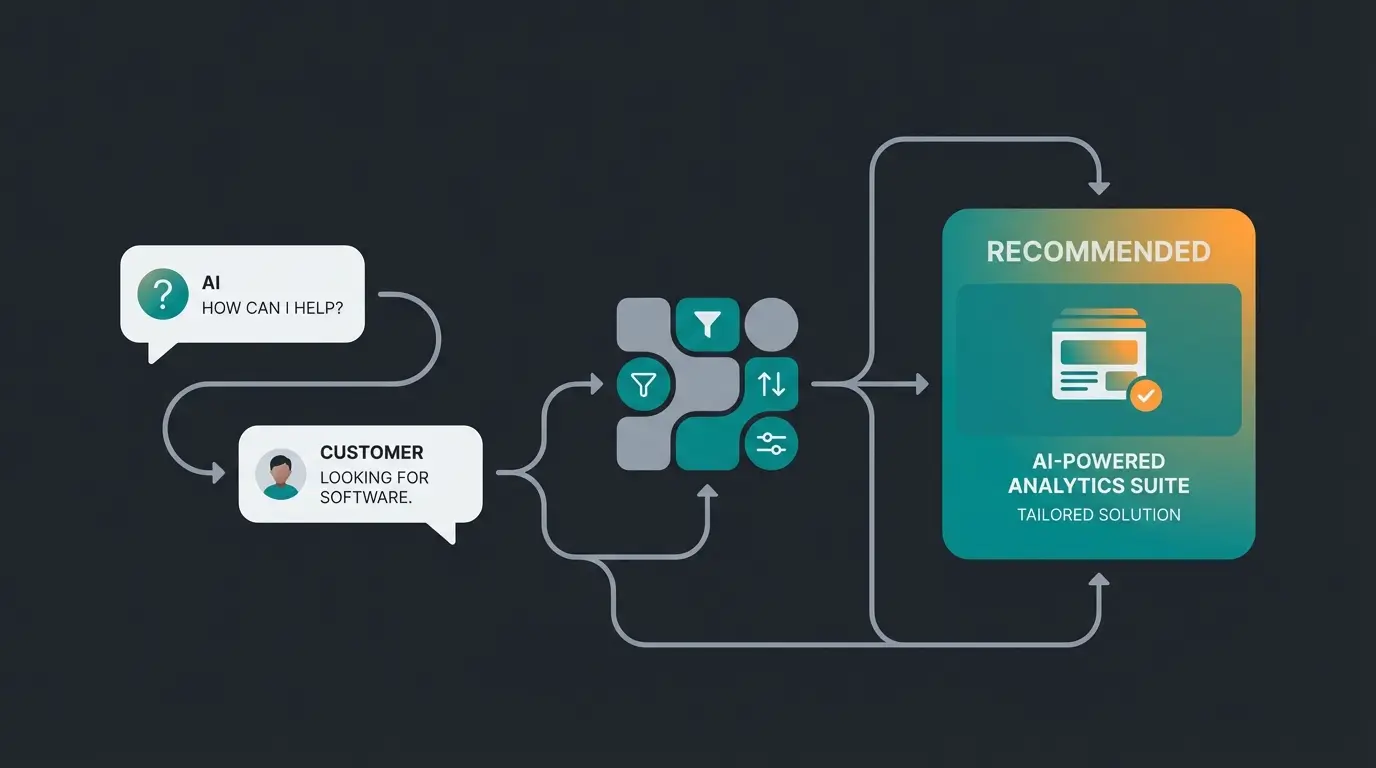
The solution requires implementing Shopware AI chatbots that function as guided selling AI integrated into your Shopping Experiences. A digital assistant conducts a dialogue with the customer. Consider a customer searching for an industrial machine or complex e-bike. The AI asks: 'How often do you use the bike per week?' Customer responds: 'Daily for commuting, about 20km.' AI follows up: 'Do you also ride on unpaved paths?' Customer answers: 'No, only asphalt.' The result: The AI filters the 200 e-bikes in the background via the Shopware API and presents the 3 models that fit exactly, including an explanation of why.
Technical Integration in the Shopware 6 Ecosystem
Thanks to the API-first architecture, such a solution can be elegantly connected. For the data foundation, the AI pulls product data and properties live via the Sales Channel API. The consultation logic takes place in an overlay or embedded element with no page reload required. For completion, the recommended product is placed directly into the Shopware cart via the Cart API. This integration transforms static browsing into dynamic consultation.
Discover how AI-powered product consultation increases conversion rates by guiding customers to their perfect products—just like your best sales consultant, but available 24/7.
Start Your AI Consultation JourneyShopware 6 vs. Competition: Strategic Platform Comparison
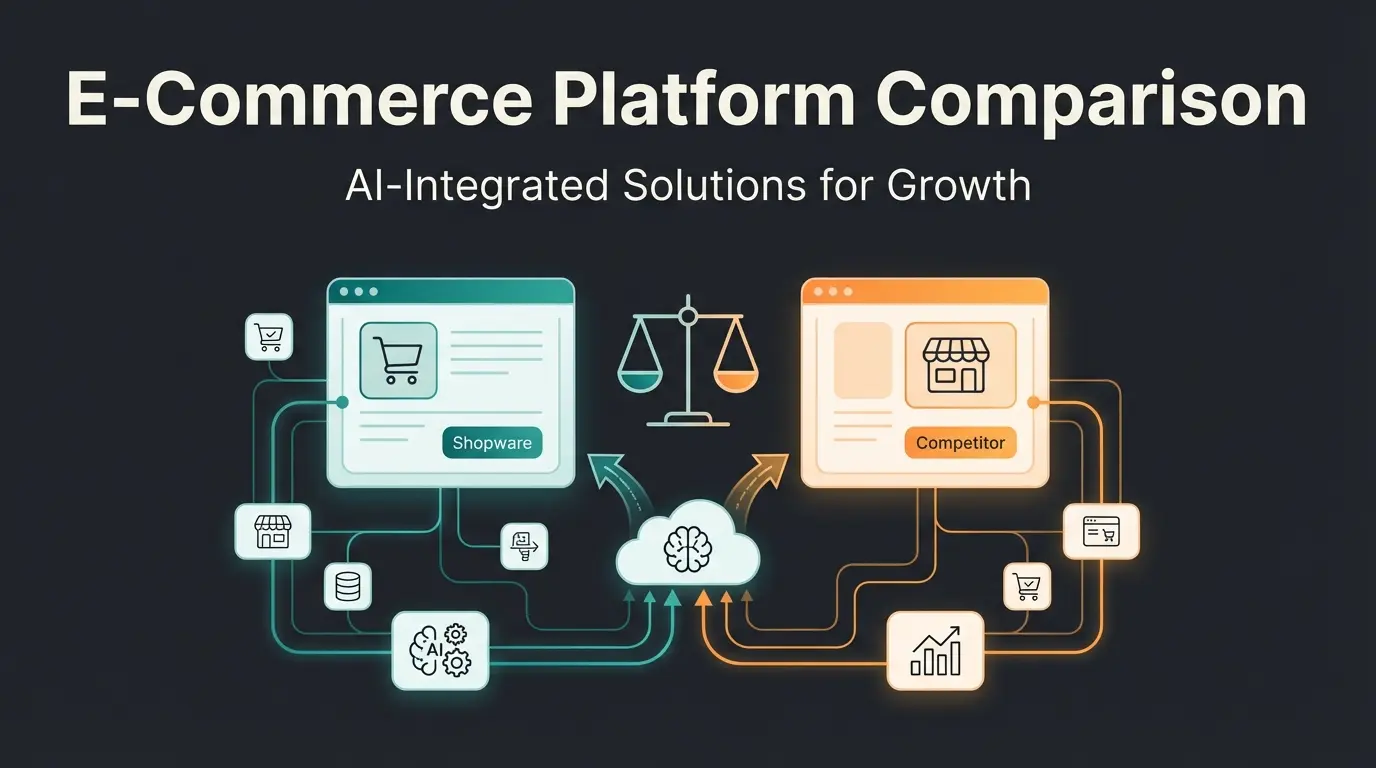
The decision for Shopware 6 often occurs in comparison to the two major competitors. Here's the decision guide from the perspective of customizability and consultation depth. For a detailed analysis, review our complete Shopware vs Shopify comparison and Shopware vs Magento guide.
| Criterion | Shopify | Shopware 6 | Magento (Adobe Commerce) |
|---|---|---|---|
| Platform Type | SaaS (rental solution) | PaaS / Self-Hosted (flexible) | On-Premise / Cloud (monolith) |
| B2B Capability | Weak (only with Plus) | Strong (Native B2B Suite) | Very strong (but complex) |
| Customizability | Limited (apps only) | High (open code + API) | Extremely high |
| Time-to-Market | Very fast | Medium | Slow |
| AI Potential | Many generic apps | Ideal for deep integration | Complex to integrate |
| Data Protection | US servers (often problematic) | GDPR-compliant (DE servers) | Depends on hosting |
Why does Shopware 6 plus specialized AI win? Shopify is often too rigid for complex consultation logic—guided selling requires deep access to product attributes. Magento is 'overkill' for many projects and too expensive in maintenance. Shopware 6 offers the 'sweet spot': enough flexibility for customized AI consultation tools, but modern enough not to sink into maintenance swamps. This makes it ideal for Shopware Amazon integration scenarios where multi-channel complexity demands flexibility.
Market leader among top 1,000 German shops
Fair Usage Policy limit for free Community Edition
Entry price for Rise commercial edition
Enabling seamless AI and multi-channel integration
Implementation Guide: From Setup to First AI Sale
How do you implement this now? Here's a roadmap for e-commerce managers that covers everything from foundation to AI-powered selling.
Phase 1: Building the Foundation with Setup and Hosting
Choose a specialized hoster (such as maxcluster, Timme Hosting, or Profihost). Shopware 6 is performance-hungry; shared hosting doesn't work here. Install the Shopware 6 Commercial Edition (Rise or Evolve) to secure access to support and B2B features. Plan caching (Varnish/Redis) from day one. These foundational decisions will impact everything that follows.
Phase 2: Data Migration and Hygiene
Use the Migration Assistant if you're coming from Shopware 5. Data hygiene is crucial for AI success. Your product attributes (such as 'material,' 'purpose,' 'weight') must be cleanly maintained. An AI can only advise as well as the data is structured. Consider using PIM systems like Akeneo that connect perfectly to Shopware. Don't underestimate this phase—it directly impacts your AI consultation quality.
Phase 3: Activating the Sales Layer Through AI Integration
Instead of just customizing the theme, now integrate the sales intelligence. Start by identifying consultation-intensive categories: Where do customers abandon? Think mattresses, ski equipment, skincare—products where decision complexity is high. Then define the consultation tree: What 3-5 questions would your best salesperson ask? For integration, use a specialized guided selling plugin or external SaaS solution that connects via API to Shopware.
The connection with Flow Builder enables powerful automation. For example: Customer abandons AI consultation triggers Flow Builder to send an email after 1 hour: 'Here's your personal consultation result.' This is where AI employees truly transform the customer experience. Additionally, installing Shopware must have plugins ensures your foundation is solid before adding AI layers.
Future Outlook: Where AI Commerce Is Heading
Shopware 6 is far more than just a shop system; it's a powerful framework for modern commerce. With the transition to the subscription model and the Fair Usage Policy 2025, Shopware clearly positions itself in the professional mid-market and enterprise segment. But technology is only half the battle. Competition in e-commerce is no longer won through the most beautiful design, but through the best consultation.
The key takeaways are clear: Use the foundation of API-first architecture and Flow Builder for automation. Mind the costs by planning budgets for Rise or Evolve when you grow—remember the Fair Usage Policy. Differentiate yourself by focusing not only on backend AI for efficiency, but on frontend AI for effectiveness. Anyone using Shopware 6 as a mere catalog is wasting potential. However, those who use it as a platform to scale their best salespeople's knowledge through AI will define the winning side of digital commerce.
Frequently Asked Questions About Shopware 6
The Community Edition remains free only for shops under €1 million GMV annually. Starting March 24, 2025, the Fair Usage Policy restricts larger shops from using the free version, requiring a switch to Rise, Evolve, or Beyond plans.
Shopware AI Copilot focuses on backend efficiency—generating product descriptions, image keywords, and review summaries. Consultative AI works on the frontend, actively engaging customers in dialogue to guide them to the right products, similar to an in-store sales consultant.
Evolve is the optimal choice for B2B operations, offering the B2B Suite with features like individual price lists, budget management, role-based access, and quote processes. Rise handles basic B2C, while Beyond serves enterprise needs with multi-inventory and 24/7 support.
Shopware 6 offers superior flexibility for complex product consultation through its API-first architecture and deep customization options. Shopify's app-based approach limits the guided selling integration needed for products requiring extensive customer consultation.
Shopware 6 requires PHP 8.1+, MySQL 8.0 or MariaDB 10.11, Elasticsearch for shops with 10,000+ products, and RabbitMQ for background processes. Quality hosting with Varnish/Redis caching is essential—shared hosting is not recommended.
Join leading e-commerce businesses using AI product consultation to increase conversions and customer satisfaction. Our solution integrates seamlessly with Shopware 6's API-first architecture.
Get Started Free Today