
Introduction: Is Your Shopware Store Just a Digital Warehouse?
E-commerce in Germany stands at a turning point in 2025. The technology is more mature than ever, loading times are lightning-fast thanks to updates like Shopware 6.6, and the design possibilities through "Shopping Experiences" (Erlebniswelten) are limitless. But when we honestly look at the landscape of Shopware stores, we often see a fundamental problem: Most online shops are technically brilliant, beautifully designed self-service warehouses.
Imagine walking into a physical specialty bike shop. The store is clean, well-lit, and huge. But not a single salesperson is in sight. Instead, signs hang on the shelves: "Filter by frame height" or "Select the gear type." If you don't know exactly what you need, you're lost. This is exactly what happens daily in thousands of online shops.
In this article, we won't just analyze how to set up a Shopware store technically—that's the baseline requirement. We're dedicating ourselves to the advanced level: How you close the gap between technical infrastructure and human consultation. We'll show how the strategic deployment of AI-powered product consultation (AI Guided Selling) can massively increase conversion rates and why standard filters are yesterday's technology.
Based on current data about the Shopware Fair Usage Policy 2025, the new editions (Rise, Evolve, Beyond), and conversion rate benchmarks in Germany, this is your blueprint for next-generation e-commerce success.
Part 1: The Foundation – What Defines a Shopware Store Today
Before we dive into the AI revolution, we need to understand the foundation. Shopware has evolved from pure shop software into a comprehensive open commerce platform. But what does this mean concretely for your store?
Technology: Headless, API-First and Performance
A modern Shopware store is built on an architecture that prioritizes flexibility above all else. The "API-First" approach means that all shop functions are accessible via interfaces (APIs). According to Shopware, this is crucial for our later strategy of AI integration, as we can seamlessly connect external intelligence without bending the shop's core.
A critical factor for Google ranking and user satisfaction is performance. With the update to Shopware 6.6 (released in March 2024), a massive leap was made here. Through asynchronous JavaScript loading, the shop is no longer blocked by scripts that are only needed later. The result: Faster "First Contentful Paint" (FCP) times and better Core Web Vitals, as documented by Communicode and Hulkapps.
The 2025 Editions: Rise, Evolve, Beyond & Fair Usage Policy
Anyone planning or operating a Shopware store today must know the new rules that take effect from March 2025. The days when the free Community Edition (CE) could be used unlimited for massive revenues are over.
- Community Edition (CE): Remains open source but falls under a Fair Usage Policy from March 24, 2025. Above a gross merchandise volume (GMV) of €1 million per year, merchants must switch to a paid version to maintain access to the Shopware Store (plugins) and account.
- Shopware Rise (from approx. €600/month): The entry point for professional B2C shops. Includes the "Flow Builder" for automations and extended support.
- Shopware Evolve (from approx. €2,400/month): Focus on B2B. This is where powerful "B2B Components" (rights, roles, budgets) are included.
- Shopware Beyond (from approx. €6,500/month): For enterprise customers with complex requirements like Multi-Inventory and 24/7 support.
As noted by Qualimero, if you want to scale, plan the license costs early. A Shopware store that breaks the €1 million mark is a success—but from 2025 onwards, it requires a commercial plan upgrade. The Themeware Design community and Gerrick AI have extensively covered these policy changes and their implications for store owners.
Monthly starting price for professional B2C shops with Flow Builder
Monthly price for B2B focus with comprehensive component access
Enterprise tier with Multi-Inventory and round-the-clock support
Annual GMV limit before requiring paid license upgrade
Shopping Experiences: Where Design Meets Commerce
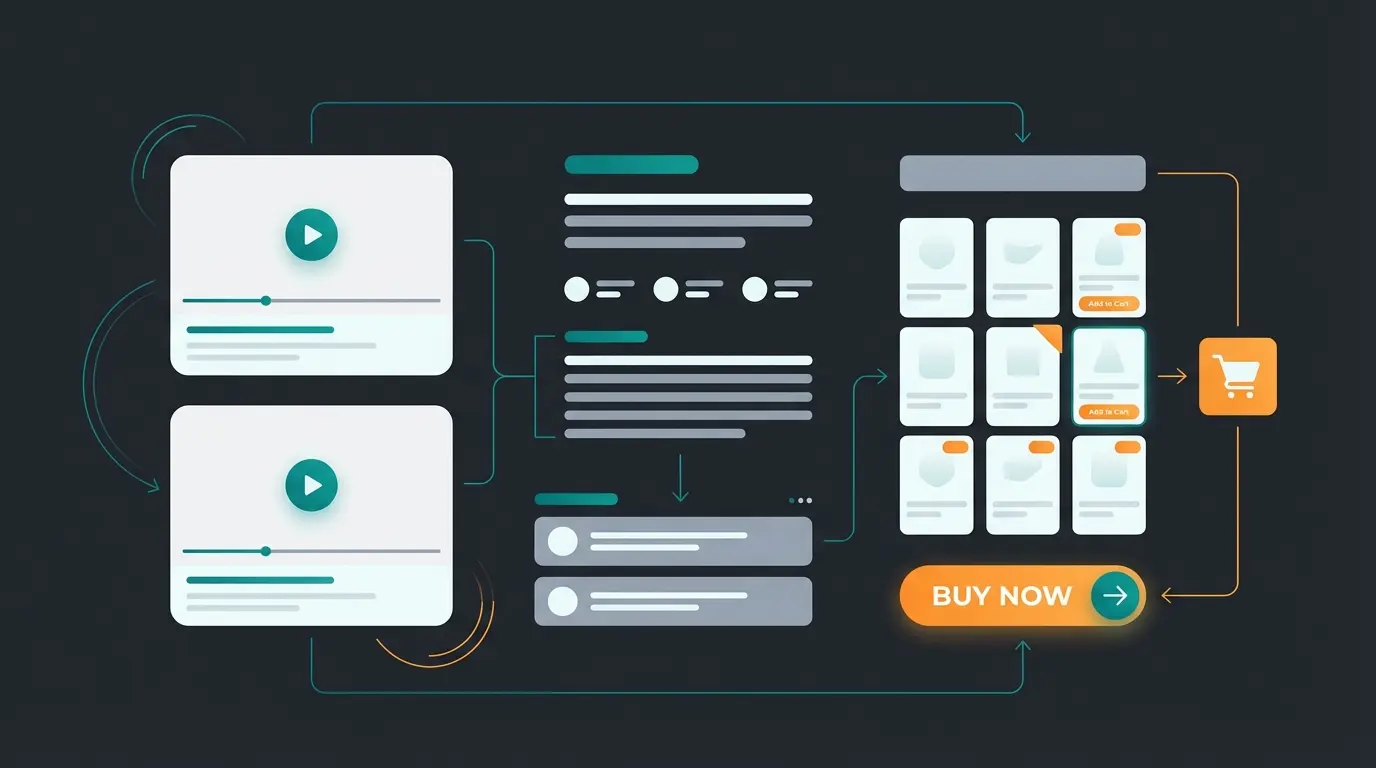
Shopware calls its CMS (Content Management System) "Shopping Experiences" (Erlebniswelten). This enables mixing content (texts, images, videos) and commerce (products) on a single page. A Shopware store today no longer needs to separate "blog" from "shop."
Example: On a category page for "hiking boots," you can show an emotional video at the top, below it a consultant text, and then the products. The Problem: As beautiful as these worlds are—they're static. They show every visitor the same thing until they start filtering. This is where AI-readiness becomes essential for modern store operators.
Part 2: The Evolution – From Searching to Consulting
Here lies the core of your differentiation opportunity. Most Shopware stores rely on two mechanisms for customers to find products: The search bar (the customer must know the product name) and Faceted search (filters) (the customer must know the technical attributes like "lumens," "torque," or "shaft width").
The Consultation Gap in E-Commerce
When we analyze the top search results for "Shopware store," we find many guides on setting up filters. But filters are unintelligent. A filter doesn't know that a customer has "back pain." It only knows "mattress firmness level: H3." A filter doesn't know that a customer is attending "a summer wedding in Tuscany." It only knows "Material: Linen" and "Color: Beige."
This discrepancy between customer needs (problem/occasion) and product data (technical specs) is what we call the "Consultation Gap." In a physical store, the salesperson closes this gap. In the online shop, it often gapes wide open and leads to cart abandonment. This is precisely where AI product consultation transforms the shopping experience.
Why Standard Filters Kill Conversions
Data from Landmark Global shows that the average e-commerce conversion rate in Germany is approximately 2.22%. That's good by European comparison (Italy is at 0.99%), but it still means: 98 out of 100 visitors don't buy.
A main reason is choice overload. When a customer sees 500 bicycles and must operate filters like "suspension travel in mm" without knowing what they need, they abandon the site. Implementing AI-powered product consultation addresses this exact challenge.
The Solution: AI Product Consultation (Guided Selling)
This is where artificial intelligence comes into play—but not the way it's often sold. Many agencies and Shopware itself promote the "AI Copilot." It's a great tool, but it's primarily a backend helper for merchants. It generates product descriptions, summarizes reviews, or creates keywords for images, as detailed by Agiqon Shopware, Scope01, and official Shopware documentation. This saves you time but only marginally helps the customer at the moment of decision.
What we need is a frontend AI, a "Digital Sales Consultant." This is the difference between a Shopware store that lists products and one that sells products. Leveraging AI sales assistants creates this crucial differentiation.
| Feature | Standard Shopware Filters | AI Product Consultation (Guided Selling) |
|---|---|---|
| Input | Checkboxes (e.g., "Cotton", "Blue", "Size L") | Natural language / Dialogue (e.g., "I'm looking for a gift for my wife who loves hiking") |
| User Prerequisite | Must know technical specifications | Only needs to know their need or problem |
| Interaction | Static, technical, frustrating with uncertainty | Dynamic, empathetic, guiding |
| Result | List of products that technically match | Recommendation + Explanation of why this product solves the problem |
| Conversion Lever | Low (serves only for narrowing down) | High (builds trust and decision confidence) |
Part 3: Step-by-Step Guide to a High-Converting Store
Let's get practical. How do you build this modern store that unites technology and consultation?
Step 1: Setup & Hosting – The Foundation
Choose hosting that specializes in Shopware (e.g., Profihost, Timme Hosting, or Shopware Cloud). Ensure that Redis and Elasticsearch (or OpenSearch) are configured. Without these technologies, your Shopware store will become slow with many products and simultaneous accesses, no matter how good your AI is.
Step 2: Theme & Layout – The Storefront
Use Shopware Shopping Experiences to build landing pages. But don't overload the category pages (Product Listing Pages - PLP). The layout should be "clean" with large images and clear typography. Many shops pack the filter sidebar so full that it takes up half the screen on mobile devices. Hide complex filters in an "off-canvas" menu instead.
Step 3: Integration of the AI Sales Layer – The Brain
This is the crucial step for differentiation. Instead of relying solely on standard search, integrate an AI product finder solution.
How does this work technically in Shopware? Since Shopware is API-First, you can easily connect external AI services (SaaS). According to Shopware and Qualimero, there are now plugins in the Shopware Store (e.g., "AI Product Advisor" or specialized Guided Selling plugins) that do exactly this.
On homepage or category page, display a teaser: "Not sure which product fits? Start the product advisor."
A chat window or quiz overlay opens. AI asks: "What will you mainly use the bike for? (Commuting, terrain, tours)"
Customer responds: "Commuting, but also forest trails sometimes." AI follows up: "Do you have any physical issues we should consider?"
AI matches answers with context understanding, not just tags. Recommends a trekking bike with suspended seatpost and upright position.
AI writes: "We recommend this model because the geometry relieves your back and the tire width is ideal for both asphalt and forest trails."
Why This Works: Studies from SuperOffice, Amasty, and WowRevenue show that the probability of selling to an existing customer (or someone who feels consulted) is 60-70%, while for unattended new customers it's only 5-20%. The consultation builds exactly that trust that otherwise only regular customers have. Using AI sales agents creates this trusted advisor experience at scale.
Step 4: Optimizing the User Journey (Before & After)
To visualize the added value, let's look at the visitor's flow through your Shopware store.
Scenario A: The Classic Shopware Store (Without AI) — Visitor lands on "Running Shoes" category → Sees 200 models → Filters by "Brand: Adidas" and "Size: 42" → Still sees 50 models (Ultraboost, Adizero, Solar, etc.) → Reads technical data ("10mm drop"), doesn't understand it → Opens Google, searches for reviews, leaves the shop. (Churn)
Scenario B: The Modern Shopware Store (With AI Consultation) — Visitor lands on "Running Shoes" category → Clicks "Start running shoe advisor" → Answers 3 questions: "Surface? (Asphalt)", "Running style? (Beginner)", "Goals? (Marathon preparation)" → AI recommends exactly 3 models → Explanation: "Model A offers maximum cushioning for long asphalt distances, ideal for protecting joints during preparation" → Visitor feels understood, adds to cart. (Conversion)
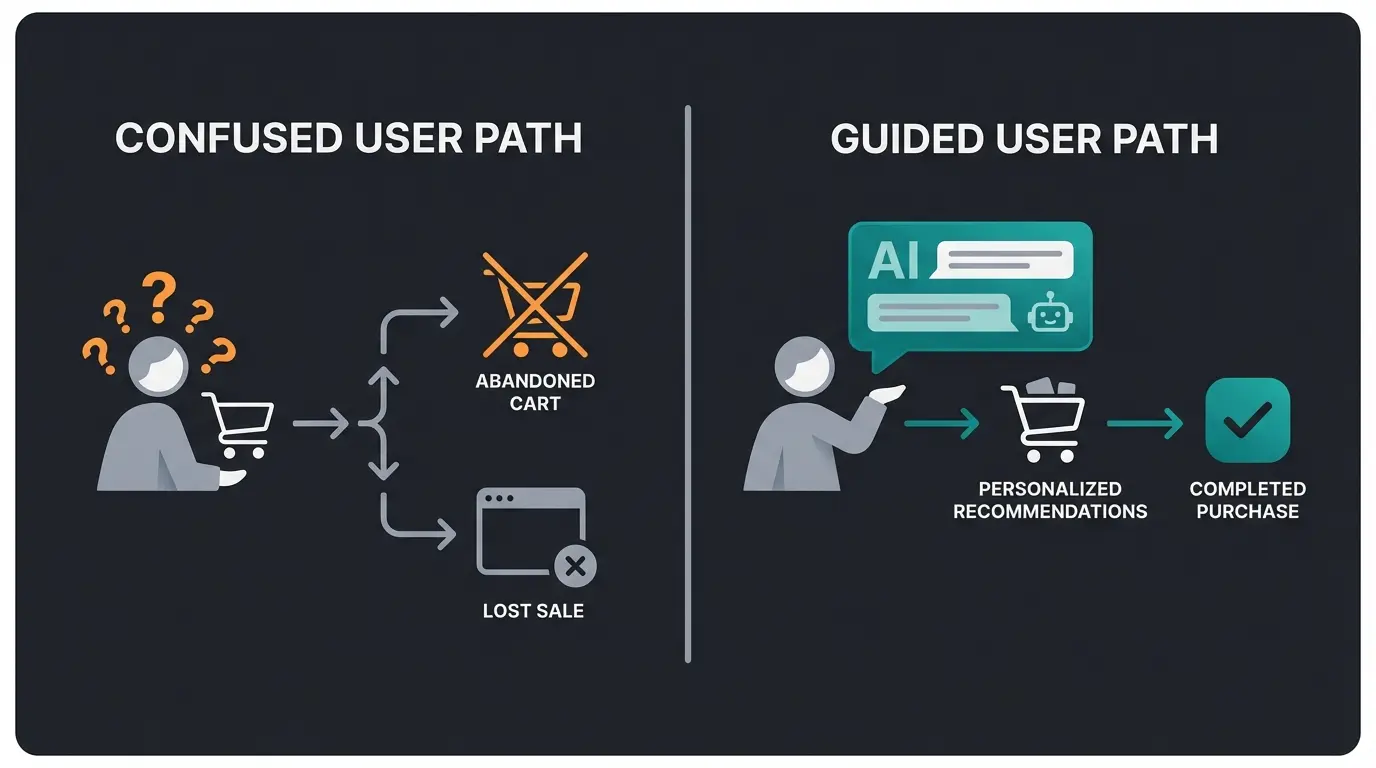
See how AI-powered product consultation turns confused browsers into confident buyers—with personalized recommendations that close the consultation gap.
Start Your Free TrialPart 4: Real Examples of Smart Shopware Stores
Theory is good, practice is better. Who's already doing it right?
STABILO: Where Content Meets Commerce
The writing supplies manufacturer STABILO uses Shopware 6 to create a colorful, emotional brand world. What they do well: They use "Shopping Experiences" extremely effectively. It's not pure selling, but inspiration (coloring templates, tutorials).
According to Shopware, through the API-First approach, STABILO has seamlessly connected PIM and ERP. The shop serves not only B2C sales but strengthens the brand globally. Visibility on Google increased by 15% after the relaunch. Lesson: A Shopware store must inspire before it sells.
DOUGLAS: The Marketplace Giant
Douglas has evolved from a perfumery to a premium beauty platform. What they do well: They use Shopware's scalability (in parts of their architecture and partner integrations) to manage huge assortments. Douglas relies heavily on personalization and omnichannel (connecting physical stores and online), as reported by Parfümerienachrichten. The new app and shop are designed to transport the premium feeling digitally. Lesson: Even with enormous assortments (300,000 products), performance must be right.
The Hidden Champion Example: B2B Industrial Parts
Imagine a B2B dealer for industrial components (e.g., screws or seals). The Problem: The buyer searches "seal for high-temperature system." The AI Solution: A Shopware store with AI-driven consultation asks: "What temperature? What pressure? What medium (oil, water)?" and filters from 50,000 articles to find the one that fits.
Result: This massively reduces ordering errors and returns. In B2B, guided selling is often even more powerful than in B2C, as wrong purchases can cause expensive production stoppages. Implementing AI product consultation in technical product categories delivers exceptional ROI.
Part 5: Essential Extensions for Your Shopware Store
The Shopware Store (Marketplace) offers thousands of plugins. But which ones do you really need for the "Modern Store"? Here's a curated list focused on performance and consultation.
The Essentials: Basic Requirements
- SEO Professional: Even though Shopware 6 is technically good for SEO (SEO URLs, meta data), plugins like "SEO Professional" help better control the fine details (canonical tags, robots.txt).
- Mollie or PayPal: For smooth payments. A checkout abandonment due to missing payment options is avoidable.
- ERP Integration (e.g., Pickware): If you don't have an external ERP, Pickware turns your Shopware store into a merchandise management system.
The Advanced Level: AI & Consultation
- AI Product Advisor / Guided Selling Plugins: Search the store for solutions that can ask dynamic questions. Ensure these aren't just static decision trees (If A, then B), but ideally use LLMs (Large Language Models) to understand free text, as recommended by Qualimero and Rhiem Intermedia.
- Intelligent Search (Doofinder or Algolia): The Shopware search is solid, but specialized search engines often offer better error tolerance and AI-powered rankings.
- Shopware AI Copilot (Native Features): Use the integrated features for summary of reviews (helps customers decide faster) and personalized checkout messages (a small touch that strengthens customer loyalty: "Thanks for buying the running shoes, here's a care tip").
For stores requiring advanced automation, AI-powered product consultation can be integrated with your email marketing workflows to continue the consultation experience post-purchase.
Part 6: Practical Tips for Implementation & ROI
The integration of AI consultation into your Shopware store sounds expensive? It doesn't have to be.
Start Small with an MVP Approach
You don't have to consult the entire assortment with AI immediately. Tip: Identify the category with the highest return rate or highest abandonment rate (often consultation-intensive products like technology, sports equipment, or cosmetics). Build a "Digital Advisor" only for this category. Measure the uplift in conversion rate.
Leverage Your Existing Data
An AI advisor is only as good as the data it has. Maintain your product attributes in Shopware cleanly. If the "Material" attribute is missing, the AI cannot filter by it. Use the Shopware AI Copilot to automatically generate missing product properties from the description texts, as detailed by Shopware and Rhiem Intermedia. This saves weeks of manual data maintenance.
Calculating the ROI of AI Consultation
Let's do a quick calculation for a typical Shopware store:
Starting point for calculation
Industry average resulting in 2,000 orders
Conservative estimate (3-4% possible for advisor users)
At €100 average order value, from 500 additional conversions
Through Guided Selling, the conversion rate increases to 2.5% (conservatively estimated, often jumps to 3-4% are possible for users of the advisor). New orders: 2,500. New revenue: €250,000. Additional revenue: €50,000 per month. The costs for an AI tool are often only in the three-digit range per month. The ROI is therefore extremely high. Understanding AI product consultation cost structures helps with business case development.

Conclusion: The Future Belongs to Consulting Shops
A Shopware store in 2025 is more than just software. It's an ecosystem of performance (Shopware 6.6), flexibility (API-First), and—this is the new standard—intelligence.
While competitors are still busy uploading prettier images or tweaking the color of the "Buy" button, you have the chance to solve the actual problem of e-commerce: The speechlessness between shop and customer.
By equipping your Shopware store with an AI-powered product consultation layer (Guided Selling), you transform visitors who are "just looking" into customers who feel understood and buy. You close the gap between the comfort of online shopping and the quality of expert advice.
The best Shopware store isn't the one with the most products. It's the one that best helps the customer find the right product. With AI product consultation capabilities, your store becomes that trusted advisor customers are looking for.
Frequently Asked Questions About Shopware Stores
A Shopware store is an e-commerce solution built on Shopware's open-source platform, featuring an API-first architecture, headless capabilities, and the Shopping Experiences CMS. Unlike platforms like Shopify, Shopware offers greater customization flexibility, is particularly popular in the German-speaking market, and provides both self-hosted and cloud options. The platform excels at handling complex B2B requirements and allows deep integration with external systems including AI consultation tools.
Costs vary significantly based on your edition choice. The Community Edition remains free but falls under the Fair Usage Policy above €1M GMV from March 2025. Rise edition starts at approximately €600/month for professional B2C shops, Evolve at €2,400/month for B2B focus, and Beyond at €6,500/month for enterprise needs. Additional costs include hosting (€50-500/month), plugins, agency development work, and any AI consultation tools you integrate.
AI Guided Selling is a frontend consultation layer that replaces or supplements traditional filter-based product discovery. Instead of requiring customers to know technical specifications, it asks natural language questions about their needs, problems, and preferences. The AI then recommends specific products with explanations of why they fit. This approach can increase conversion rates from the average 2.2% to 3-4% among users who engage with the advisor, as it replicates the trusted guidance of an in-store expert.
Shopware 6.6, released in March 2024, introduced asynchronous JavaScript loading that prevents scripts from blocking page rendering until needed. This results in faster First Contentful Paint (FCP) times and improved Core Web Vitals scores. These improvements benefit both SEO rankings (Google rewards fast sites) and user experience, while also creating a better foundation for adding AI consultation layers without impacting perceived performance.
Yes, Shopware's API-first architecture makes AI integration straightforward. You can connect external AI services (SaaS) via APIs or use dedicated plugins from the Shopware Store marketplace. Look for AI Product Advisor or Guided Selling plugins that support dynamic questioning and LLM (Large Language Model) capabilities for understanding natural language queries. The integration typically involves embedding a chat widget or quiz interface on category pages and connecting it to your product data.
Stop losing 98% of visitors to the consultation gap. Discover how AI-powered product guidance transforms browsers into buyers with personalized recommendations that build trust and drive conversions.
Get Started Free