
The Elephant in the Room: Shopware vs Magento
Anyone discussing e-commerce platforms in the DACH region (Germany, Austria, Switzerland) in 2026 cannot avoid one question: Why should we use Magento when everyone talks about Shopware?
It's a fair point. According to hosttest.de, Shopware has rightfully captured market share with its modern architecture and strong focus on the German mid-market. As noted by Shopware, the platform has made significant strides in the German market. Yet the 'Shopware vs Magento' discussion is often too superficial. It typically reduces to license costs or simple feature lists. This overlooks the most important shift in e-commerce: The transition from transaction to interaction.
Until 2025, an online shop's goal was making products findable. If you knew what you wanted (e.g., 'running shoes size 10 red'), you used search. If you wanted to browse, you used categories. But what about customers who don't know what they need? The customer who would ask in a store: 'I'm just starting marathon training and have knee problems—what do you recommend?' For a detailed Magento comparison, check our comprehensive analysis.
This is where classic Magento shop systems and competitors fail. Standard filters ('color', 'size', 'price') cannot provide consultation. This represents a massive opportunity for Magento in 2026. Through its open architecture and enormous flexibility, Magento is predestined to function not just as a catalog, but as an intelligent consultation platform.
This article isn't an ordinary comparison. We look deep under the hood of the Magento platform in 2026. We analyze why the system is more performant than ever thanks to technologies like Hyvä, how to build a legally compliant German 'tech stack' (keyword: cancellation button 2026), and how AI-driven consultation generates revenue that standard shops leave on the table.
Part 1: Magento Basics – Status Quo 2026
Before diving into the AI revolution, we must clarify the foundation. Magento has transformed significantly under Adobe's leadership. For decision-makers, understanding the nuances between editions is essential, as these often determine budgets in the five to six-figure range.
Magento Open Source vs Adobe Commerce
Many myths surround the costs. Is Magento free? Yes and no. The software itself is license-free in the Open Source variant, but 'free' is relative in the enterprise environment. According to YouTube resources discussing Adobe Commerce pricing, license costs start at approximately $22,000 per year and scale based on revenue.
| Feature / Aspect | Magento Open Source (formerly Community) | Adobe Commerce (formerly Enterprise) |
|---|---|---|
| Target Audience | SMBs, startups with tech expertise, developers | Large mid-sized companies, corporations, B2B enterprise |
| License Costs | $0 (License-free) | From approx. $22,000/year (Revenue-dependent) |
| Hosting | Self-hosted (On-premise / Cloud by choice) | Adobe Cloud or On-premise possible |
| B2B Features | Basic functionality (often needs extension) | Native B2B Suite (company accounts, quotes, price lists) |
| Support | Community support, agency required | 24/7 Adobe support, SLA included |
| Marketing & AI | Basic SEO, extensions required | Adobe Sensei (AI), Live Search, Advanced Page Builder |
| Performance | Depends heavily on hosting/optimization | Scalable cloud infrastructure, Fastly CDN included |
Is Magento Dead? A Look at Current Versions
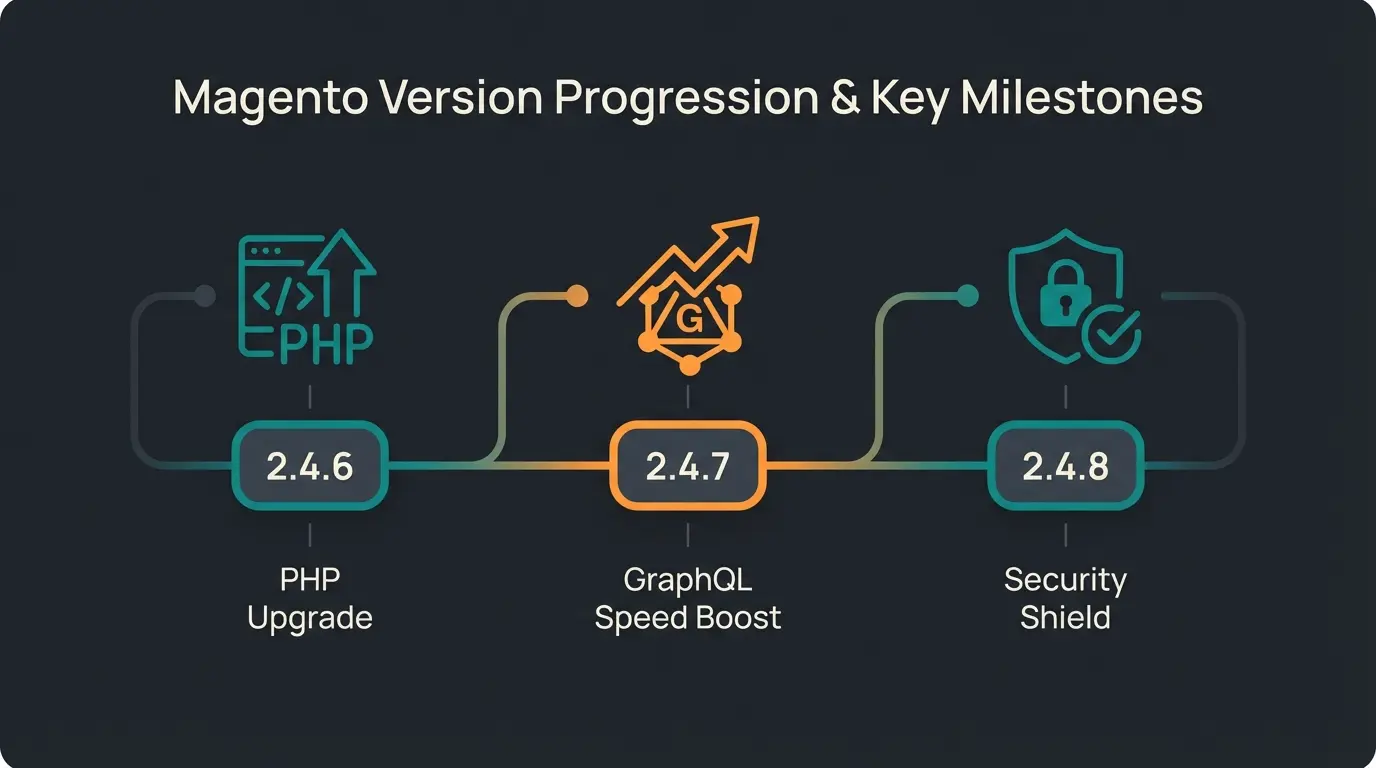
Contrary to some rumors, the ecosystem is alive and thriving. As reported by MGT Commerce and Meetanshi, the release of Magento 2.4.8 in April 2025 made the platform fit for the future:
- PHP 8.4 Support: Essential for security and speed
- GraphQL Performance: API interfaces were massively accelerated, critical for headless approaches and app integrations
- Security: Regular security patches (e.g., 2.4.7-p5) demonstrate that Adobe takes responsibility seriously
Part 2: The German Context – Requirements for DACH
Operating a Magento shop system in the USA is one thing. Running it legally compliant and customer-friendly in Germany is entirely different. The German market is one of the most demanding worldwide—both legally and regarding customer expectations.
1. Legal Compliance: More Than Just Cookies
GDPR is standard by now, but 2026 brings new hurdles for shop operators. Understanding these requirements is crucial for any AI consulting ecommerce strategy.
The Mandatory Cancellation Button (Required from June 2026)
An often-overlooked innovation going live in June 2026 is the requirement for easy cancellation of ongoing contracts. According to Ecommercebridge and Fieldfisher, this legislation has significant implications:
- The Law: If a customer can subscribe online (e.g., 'savings subscription' for consumables), they must be able to cancel it online with two clicks
- The Magento Solution: Standard Magento offers no native solution in checkout for this
- To-Do: You need modules or custom developments that display a prominent 'Cancel contracts here' button in the customer account ('My Area') that works without media breaks (no 'Please call us'). Ignoring this risks warnings from summer 2026
GDPR and Server Location
German customers trust 'Made in Germany.' This applies to data too. As confirmed by Maxcluster, hosting with German server locations provides both compliance benefits and performance advantages:
- Hosting: Use providers like Maxcluster or Hetzner. They offer specialized Magento clusters with server locations in Germany
- Advantage: Beyond data protection, providers like Maxcluster offer pre-configured stacks with Varnish, Redis, and Elasticsearch that are essential for Magento
2. The German Tech Stack
To make Magento competitive with Shopware in Germany, you need specific extensions. A 'naked Magento' won't cut it. This requires a strategic AI consultation strategy tailored to the German market.
- Language Pack: The Mageplaza German Language Pack is the standard for correctly translating frontend and backend (including formal 'Sie' form for B2B)
- Legal Texts & Compliance: Tools like FireGento (formerly MageSetup) or modules from GitHub (Händlerbund/IT-Recht-Kanzlei) are mandatory for legally compliant imprint, terms & conditions, and checkout processes (button solution)
- Payment & Shipping: PayPal Plus/Checkout is standard; Invoice purchase (Ratepay/Klarna/Unzer) is extremely popular in DACH and essential for high B2C conversion rates; DHL/Hermes official modules for label printing directly from the backend
Magento Open Source 2.4.8+ with PHP 8.4 support
FireGento/MageSetup for compliance, imprint, and checkout laws
PayPal Plus, Klarna, Ratepay for German payment preferences
DHL Versenden, Hermes integration for local logistics
Your intelligent product consultation system on top
3. Hyvä Themes – The Performance Savior
For a long time, Magento's frontend (Luma Theme) was the biggest criticism: too slow, too much JavaScript, poor Google Core Web Vitals. In 2025/2026, Hyvä is the standard. According to Magecomp and Foundation Commerce, Hyvä has become the go-to solution for modern Magento storefronts.
- What is it? A completely rebuilt frontend that discards old baggage and relies on modern technologies (Tailwind CSS, Alpine.js)
- The Effect: Google PageSpeed scores often jump from 30 (Luma) to 90+ (Hyvä)
- Why Important? Without Hyvä, it's nearly impossible to meet SEO requirements in 2026. It also reduces development costs since developers work faster with modern tools
Average score with Hyvä vs. 30 with Luma theme
Reduction in page load times compared to standard Magento
Faster frontend development with modern tooling
Part 3: The Content Gap – From Search to Consultation
This is where the wheat separates from the chaff. Most agencies sell you Magento as a 'powerful catalog.' That was 2015. In 2026, your shop must consult. This is where AI Product Consultation becomes a game-changer.
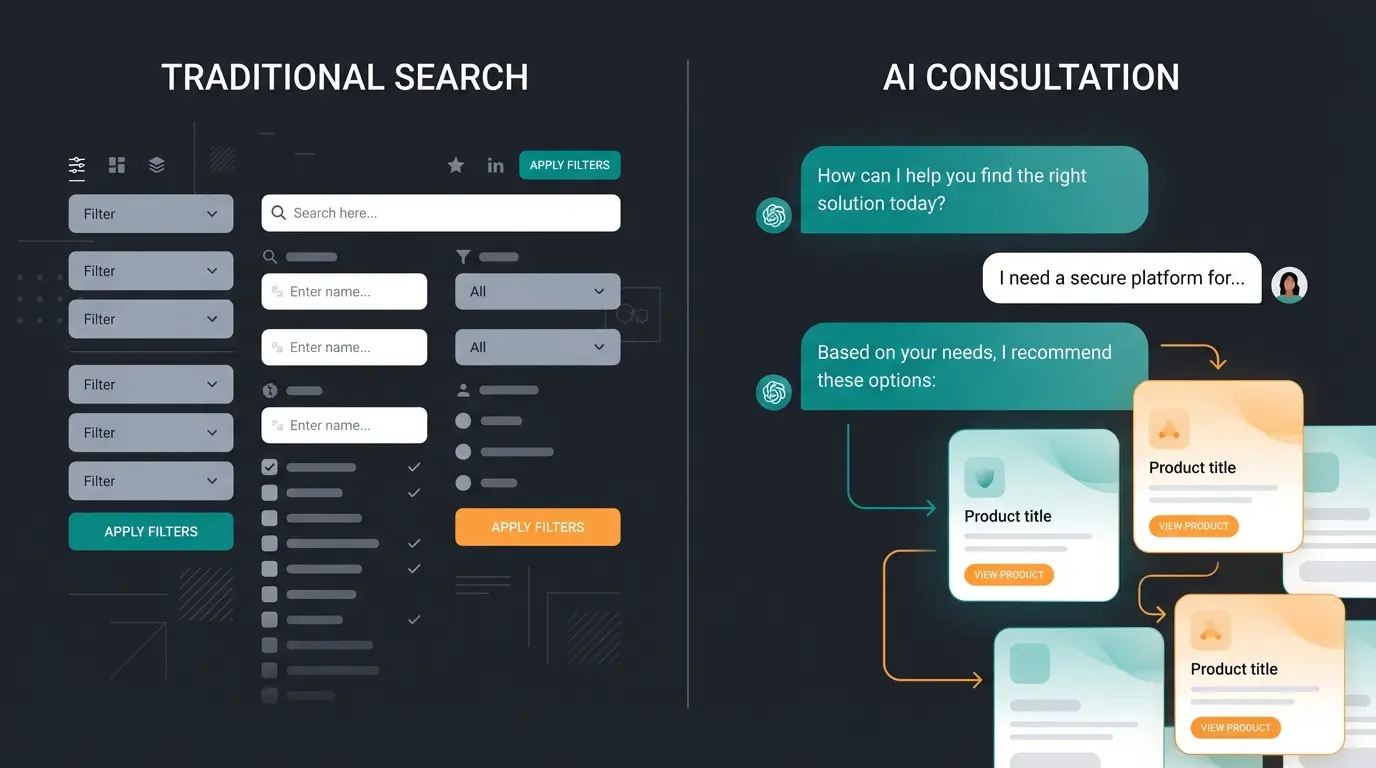
The Problem: Limits of Faceted Search
Imagine a B2B customer searching for fastening technology:
- Classic Search: The customer must know: 'I need an M8 screw, 50mm, stainless steel A2'. They filter. They find.
- The Problem: What if the customer only knows their problem? 'I need to fasten a wooden construction in an outdoor area near the sea.'
- Result in Standard Shop: 0 hits. The customer leaves the shop and calls the competition.
The Solution: AI-Driven Consultation
Magento offers the perfect foundation through its API-first architecture (GraphQL) to layer an AI system (e.g., based on OpenAI or specialized e-commerce LLMs) over the catalog. This enables true conversational commerce that transforms customer interactions.
| Feature | Classic Magento Search (Elasticsearch/Live Search) | AI Consultation (Conversational Commerce) |
|---|---|---|
| Input | Keywords ('laptop 16GB') | Natural language ('laptop for video editing under $1000') |
| Understanding | Matches words against database | Understands context, intent, and nuances |
| Result | List of products | Curated recommendation with reasoning ('Take model X because...') |
| Upselling | 'Customers also bought...' (Static) | 'You'll also need cable Y because model X has no HDMI port' |
| Goal | Finding (if you know what you want) | Consulting & Convincing (sales conversation) |
How Does This Work Technically in Magento?
It's not about installing a simple chatbot. It's about integrated consultation. Understanding the fundamentals of AI customer service is essential for implementing this effectively.
- Data Foundation (PIM): Magento or a PIM system (like Akeneo) delivers structured data. The AI needs access to attributes (material, standards, compatibility)
- Vector Search: Product data is vectorized. This enables the AI to understand semantic connections (e.g., that 'near the sea' = 'saltwater resistant' = 'stainless steel V4A')
- Frontend Integration: Instead of a sidebar with 50 filters, there's a 'consultation assistant'
The Business Case: This is the decisive competitive advantage over standard Shopware installations, particularly in B2B and with products requiring explanation (electronics, building materials, auto parts). While Shopware is often strong in lifestyle/fashion (visually driven), Magento can leverage its strength as a data engine here. Many businesses have already Scaled with AI using this approach.
The power of AI Chatbots combined with deep product knowledge creates an unmatched customer experience. Solutions like our KI Mitarbeiterin Flora demonstrate how AI employees can transform e-commerce conversion rates.
See how AI-driven product consultation can increase your conversion rates and provide 24/7 expert advice to your customers.
Get Started FreePart 4: Technical Setup and Cost Reality
A professional e-commerce Magento project is an investment. Cost transparency is crucial to avoid unpleasant surprises.
1. Cost Breakdown for the DACH Region (2025/2026)
The days of 'cheap Magento' are over. Those wanting quality pay corresponding hourly rates. According to MageMonkeys research on agency pricing:
Agency Hourly Rates
- Germany (Senior Devs): €100 – €150 / hour (~$110-165 USD)
- Eastern Europe (Nearshoring): €60 – €100 / hour (~$65-110 USD)
- Tip: Don't skimp on project management and architecture. Cheap development becomes expensive when the architecture doesn't scale
As Reddit discussions among Magento developers confirm, nearshoring can reduce costs but requires careful quality management.
Project Budgets (Estimates)
- MVP (Minimum Viable Product) on Hyvä basis: from $33,000 - $55,000
- Comprehensive B2B shop (ERP integration, custom features): $110,000 - $275,000+
- Enterprise (Adobe Commerce): License + project often > $330,000 in the first year
Ongoing Costs (Hosting and Maintenance)
Based on pricing from Uptain, Hosterz, and MagentoHosting.eu:
- Hosting (Maxcluster): Expect approx. €150 - €400 per month (~$165-440 USD) for a performant cluster (Web + DB + Redis + Varnish + Elasticsearch)
- Maintenance: Plan for 1-2 developer days monthly for security patches and updates (approx. €1,000 - €2,000 / ~$1,100-2,200 USD)
2. Checklist: Is Magento Right for You?
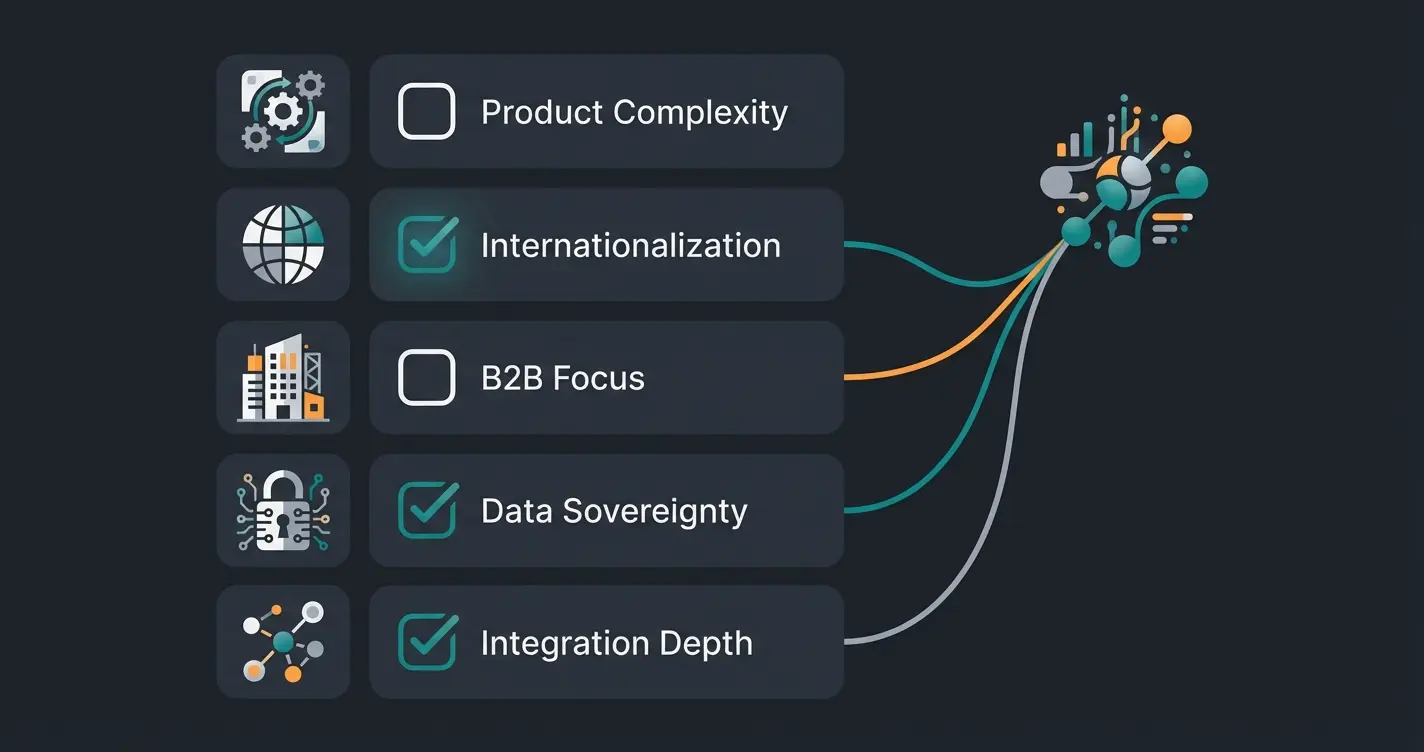
Before investing, check these points. If you say 'Yes' more than 3 times, Magento (with AI layer) is probably better suited than Shopify or basic Shopware. Consider how an AI product finder could enhance your customer experience.
- Product Complexity: Do you have products with many variants, dependencies, or configurations?
- Internationalization: Are you planning more than 3 country shops with different currencies, tax rates, and warehouses? (Magento Multi-Store is unmatched here)
- B2B Focus: Do you need individual price lists per customer, quick-order lists, or approval processes?
- Data Sovereignty: Do you want full control over your data and code (no SaaS lock-in)?
- Integration Depth: Do you need deep integration into complex ERP systems (SAP, Microsoft Dynamics, DATEV)?
Part 5: Practical Implementation – Your Roadmap
How do you start such a project? Here's your step-by-step guide to building a modern Magento ecommerce platform.
Step 1: Choose the Foundation
Rely on Magento Open Source + Hyvä Theme. This is the most modern, fastest, and most cost-effective combination in 2026. Avoid old Luma themes or PWA Studio unless you have a massive React development team.
Step 2: 'Made in Germany' Hosting
Book managed hosting with a specialist. Explicitly ask about:
- Varnish cache configuration (for lightning-fast load times)
- Elasticsearch / OpenSearch setup
- Daily backups and malware scanning
- Staging environment (for testing updates)
Step 3: Develop the AI Strategy
Don't just install any AI plugin. A comprehensive AI product consultation strategy requires careful planning:
- Analyze your support inquiries: What do customers ask on the phone?
- Use this data to build a 'consultation layer'
- Start small: Use e.g., the OpenAI API to dynamically reformulate product descriptions based on customer questions in chat
Our AI Product Consultation case study demonstrates the remarkable results achievable with proper implementation. The key is integrating an AI Chatbot ecommerce solution that understands your product catalog deeply.
Step 4: Establish Legal Compliance
Implement before go-live:
- Cookie consent tool (e.g., Usercentrics)
- Cancellation button (mandatory from June 2026!)
- Imprint/Terms & Conditions/Privacy Policy (automated via interfaces to legal service providers)
Choose Magento Open Source + Hyvä Theme combination
Configure Maxcluster or Hetzner with full caching stack
Implement GDPR tools, cancellation button, legal texts
Deploy consultation layer with product knowledge base
Go live, monitor performance, iterate on AI training
Conclusion: The Renaissance of Magento
Is Magento dead? No. It has simply evolved from a 'solution for everyone' to a 'solution for the demanding.'
In a direct Magento vs Shopware comparison, Shopware often wins with smaller to medium-sized projects through simplicity and good marketing. But as soon as requirements become complex—whether through international scaling, deep B2B processes, or the desire for individual AI consultation—Magento plays to its strengths.
The combination of the robust Magento platform, the lightning-fast Hyvä frontend, and an intelligent AI consultation layer is the success recipe for 2026. It transforms your shop from a silent catalog into an active salesperson.
Frequently Asked Questions About Magento
Magento Open Source is license-free, meaning you pay $0 for the software itself. However, 'free' is relative in enterprise contexts—you'll need to budget for hosting ($165-440/month), development ($110-165/hour for German agencies), and ongoing maintenance ($1,100-2,200/month). Adobe Commerce, the enterprise version, starts at approximately $22,000/year based on your revenue.
It depends on your needs. Shopware excels for small to medium German businesses seeking simplicity and strong local support. Magento wins when you have complex requirements: international multi-store setups, deep B2B functionality, complex product configurations, or the need for AI-driven consultation. For product-heavy catalogs requiring expert guidance, Magento's open architecture makes it ideal for integrating sophisticated AI consultation layers.
Hyvä is a completely rebuilt frontend for Magento that replaces the outdated Luma theme. It uses modern technologies (Tailwind CSS, Alpine.js) and dramatically improves performance—Google PageSpeed scores typically jump from 30 (Luma) to 90+ (Hyvä). In 2026, meeting Core Web Vitals requirements for SEO makes Hyvä practically mandatory for any serious Magento implementation.
Standard Magento search (Elasticsearch/Live Search) matches keywords against your database—users must know exactly what they want. AI consultation understands natural language and intent. A customer can ask 'I need a laptop for video editing under $1000' instead of filtering by technical specs. The AI then provides curated recommendations with explanations, mimicking a human sales consultant and dramatically improving conversion rates for complex products.
Key requirements include: GDPR compliance with German server locations recommended, proper cookie consent management, legally compliant imprint and terms & conditions (use modules like FireGento), the correct checkout button wording ('Zahlungspflichtig bestellen'), and critically—the new mandatory cancellation button (Kündigungsbutton) for subscriptions effective June 2026. Ignoring this risks legal warnings and penalties.
Join forward-thinking e-commerce businesses using AI consultation to outperform standard shops. Start transforming your customer experience today.
Start Your Free TrialDisclaimer: This article does not constitute legal advice. Please always consult a specialized attorney for implementing legal requirements (such as the cancellation button or GDPR).