E-Commerce Chatbot 2025: From Support Tool to AI Sales Consultant
Transform your e-commerce chatbot from FAQ-bot to revenue-generating AI sales consultant. Learn integration, metrics & conversion optimization strategies.

The Current State of E-Commerce Chatbots
The integration of chatbots is increasingly shaping the digital retail landscape. Current market data reveals compelling developments: According to a study on chatbot satisfaction, 64% of German online shoppers rate their experiences with automated assistants positively. This figure demonstrates the fundamental potential of the technology when implemented correctly.
However, the reality also reveals significant challenges: Many standard chatbots fail when answering complex customer inquiries. They don't recognize context properly and deliver stereotypical, unhelpful responses. This leads to customer frustration and actually burdens service staff additionally, rather than providing the relief it promises. The problem isn't the concept of chatbots—it's that most implementations treat them as simple FAQ deflectors rather than intelligent sales tools.
According to expert analysis on AI in customer service, specialized systems can reduce costs by up to 70% while simultaneously increasing customer satisfaction by 35%. These numbers underscore the economic potential of properly implemented AI solutions—but they only tell half the story. The real opportunity lies not in cost reduction, but in revenue generation through active product consultation.
This comprehensive guide analyzes the current weaknesses of common chatbot systems and presents proven solutions. The focus is on integrating specialized AI technology to sustainably improve the customer experience in e-commerce—transforming your chatbot from a passive FAQ responder into an active digital sales consultant that drives conversions.
The Silent Store Problem: Why Visitors Leave
E-commerce stores have thousands of visitors but no sales staff walking the floor. Unlike physical retail, where a knowledgeable employee can approach browsing customers and guide them to the perfect product, online stores leave visitors to figure everything out themselves. A standard live chat widget closes part of that gap, but only while someone is staffing it. Customers leave not because they don't like the products, but because they have unanswered questions about fit, compatibility, or which option best suits their needs.
The statistics on chatbot functions confirm this: 27% of users seek product information, and 21% need customer service—yet these are precisely the areas where most chatbots show their greatest deficits. The conventional approach treats these two needs identically, but they require fundamentally different capabilities.
Typical daily traffic to an e-commerce store
Visitors who need guidance before purchasing
Without AI consultation, questions go unanswered
Potential increase when questions are properly addressed
A central problem is the missing context processing capability. Chatbots frequently don't understand the connection between multiple consecutive messages. They treat each inquiry in isolation, leading to frustrating conversation flows where customers must repeat themselves constantly. Our guide to AI chatbots in business communication clarifies the technical background of this limitation and shows how modern solutions overcome it.
The lack of backend connectivity exacerbates this problem additionally. Many systems have no direct access to important company data like inventory availability, customer history, or order status. This results in superficial or outdated information that erodes customer trust. When a customer asks about product compatibility and receives a generic response that doesn't address their specific situation, they're far more likely to abandon their cart and shop elsewhere.
FAQ-Bot vs. AI Sales Consultant: A Critical Distinction
Most articles lump 'customer service' and 'sales' together when discussing chatbots. This is a fundamental mistake. The capabilities required to answer 'Where is my package?' are entirely different from those needed to guide a customer through selecting between two complex technical products. Both roles matter, but they run on different systems: reliable chatbot faq automation handles the repetitive questions, while a sales consultant handles the ones that decide a purchase.
| Capability | FAQ-Bot (Support Focus) | AI Sales Consultant (Revenue Focus) |
|---|---|---|
| Response Style | Reactive - waits for keywords | Proactive - identifies needs and suggests products |
| Understanding | Keyword matching, simple patterns | Context-aware, understands intent across messages |
| Typical Query | 'Where is my package?' | 'Which bike fits my height and riding style?' |
| Data Access | Order status, shipping info | Full PIM data, product attributes, compatibility rules |
| Business Impact | Cost center - deflects tickets | Revenue generator - increases conversions |
| Success Metric | Deflection rate, response time | Add-to-cart rate, AOV lift, consultation quality |
| Customer Value | Convenience | Confidence in purchase decision |
Particularly critical: The missing learning capability of standardized solutions. Even with recurring errors, these systems don't adapt. They repeat the same unsatisfactory response patterns instead of learning from interactions and continuously improving. A true AI sales consultant, by contrast, analyzes successful conversations to understand what guidance leads to conversions and applies those patterns to future interactions.
The technical architecture of many chatbots also prevents seamless integration into existing e-commerce processes. Without access to product databases, CRM systems, and inventory management, the interaction possibilities remain severely limited. This leads to media breaks in customer service and increased manual effort. But more importantly, it means the chatbot cannot perform actual sales consultation—it simply cannot access the information needed to recommend the right product.
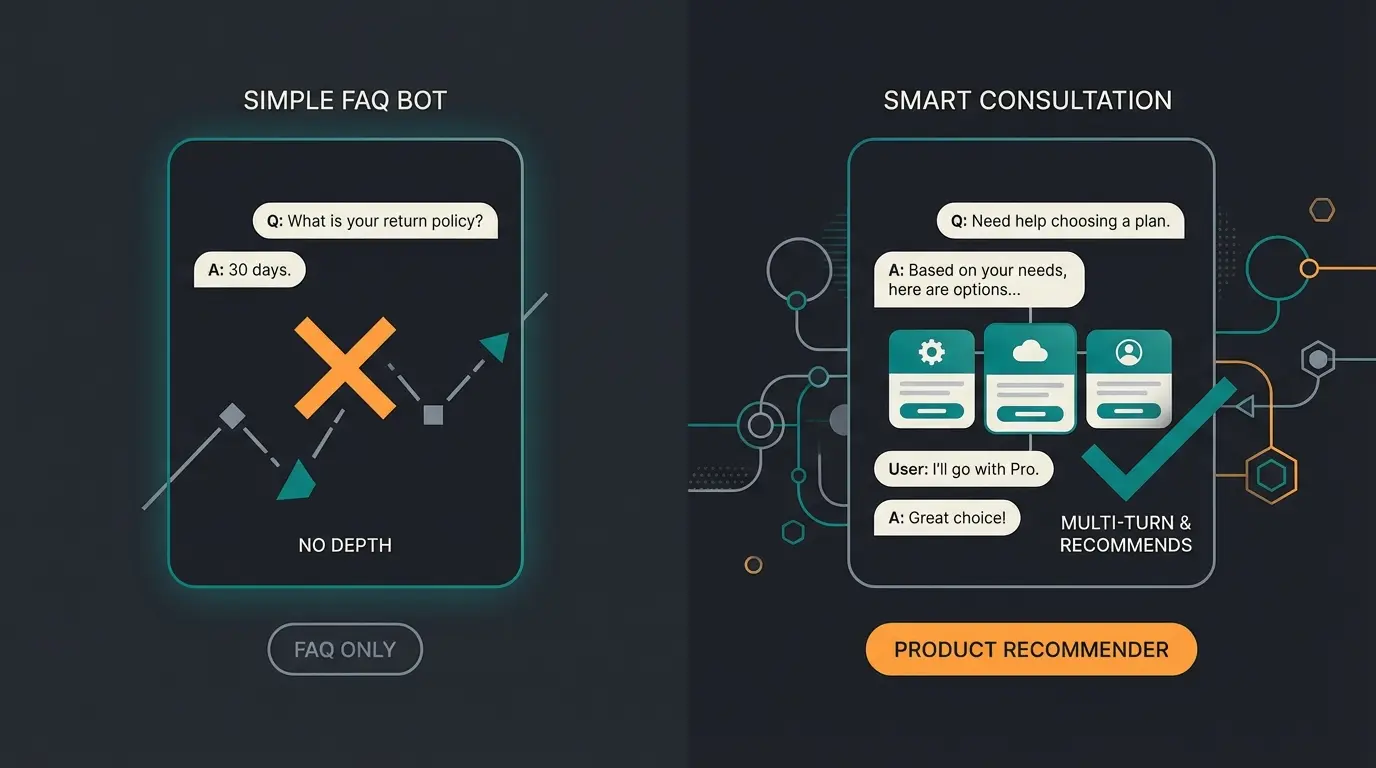
Real Consultation in Action: The Difference That Converts
To truly understand the gap between a support bot and a sales consultant, consider this real-world scenario. A customer visits an e-commerce store selling technical equipment and types: 'Is this compatible with Mac?'
The Standard Bot Response (What Most Stores Have)
Standard Bot: 'I don't understand your question. Please contact our support team or check the product specifications.' The customer, frustrated, either leaves the site entirely or submits a support ticket that won't be answered for hours—by which time they've already purchased from a competitor who provided immediate answers.
The AI Sales Consultant Response (What Drives Conversions)
AI Consultant: 'Yes, this device works perfectly with macOS 12 and later via USB-C connection. I notice you're looking at our standard model—if you frequently work with large files, our Pro version offers 2x faster transfer speeds. Do you need an adapter for your specific Mac model? I can check compatibility for you.' This response demonstrates product knowledge, anticipates follow-up needs, and opens a cross-sell opportunity—all within seconds.
This distinction matters enormously for German consumers in particular. There is a documented need among German shoppers for detailed product specifications and established trust before making a purchase decision. Generic advice translated from international content ('Shop 24/7!') fails to address this cultural expectation. German customers want to feel confident they're making the right choice, and that requires substantive consultation, not chatbot platitudes.
Integration: The Foundation for AI Sales Success
The proper integration of AI chatbots into existing e-commerce systems forms the foundation for positive customer experiences and revenue generation. Studies on AI in customer service show that thoughtful integration can increase customer satisfaction by up to 35%—but more importantly, it enables the chatbot to actually perform sales consultation rather than just deflecting support queries.
The Critical Difference: PIM Access vs. Order Status
Competitors talk about 'connecting to Shopify' or 'integrating with your store,' but this vague language obscures the crucial distinction between two very different types of integration. Support integration means accessing order status—allowing the bot to answer 'Where is my package?' Sales consultation integration means accessing your Product Information Management (PIM) data—enabling the bot to understand product attributes, compatibility rules, size guides, and feature comparisons.
A direct connection to inventory management systems and product databases enables chatbots to provide precise real-time information. Customers receive immediate details about availability, delivery times, and pricing. This reduces follow-up questions and builds trust in automated consultation. But the real value comes when the bot can use this information to guide purchasing decisions, not just report status.
Personalization Through CRM Integration
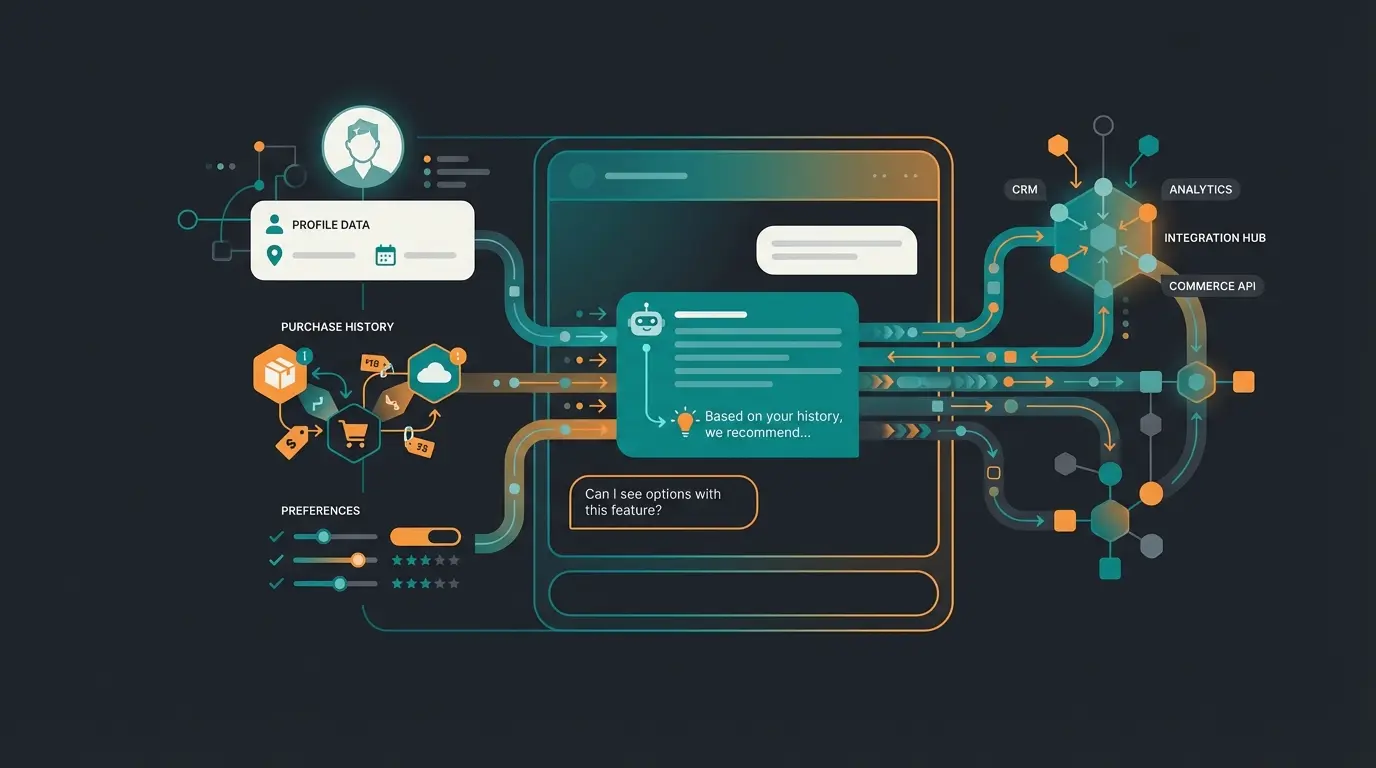
The connection with your Customer Relationship Management system enables individualized communication that transforms generic interactions into personal consultations. The AI chatbot accesses customer history, preferences, and previous purchases. This creates tailored recommendations instead of standardized responses that feel robotic and impersonal.
For example, when a returning customer asks about skincare products, an integrated AI consultant doesn't just list popular items. It references their previous purchases ('I see you've been using our hydrating serum'), asks relevant follow-up questions ('Are you still experiencing the dry skin you mentioned last time?'), and recommends products that complement what they already own. This is the digital equivalent of a knowledgeable salesperson who remembers regular customers.
Quality in = Quality out. Ensure product attributes, compatibility data, and specifications are complete and structured for AI consumption.
Establish tone of voice, consultation style, and brand personality. Your bot should feel like your best salesperson, not a generic assistant.
Connect to inventory, CRM, and order systems. Prioritize PIM access for consultation over basic order status.
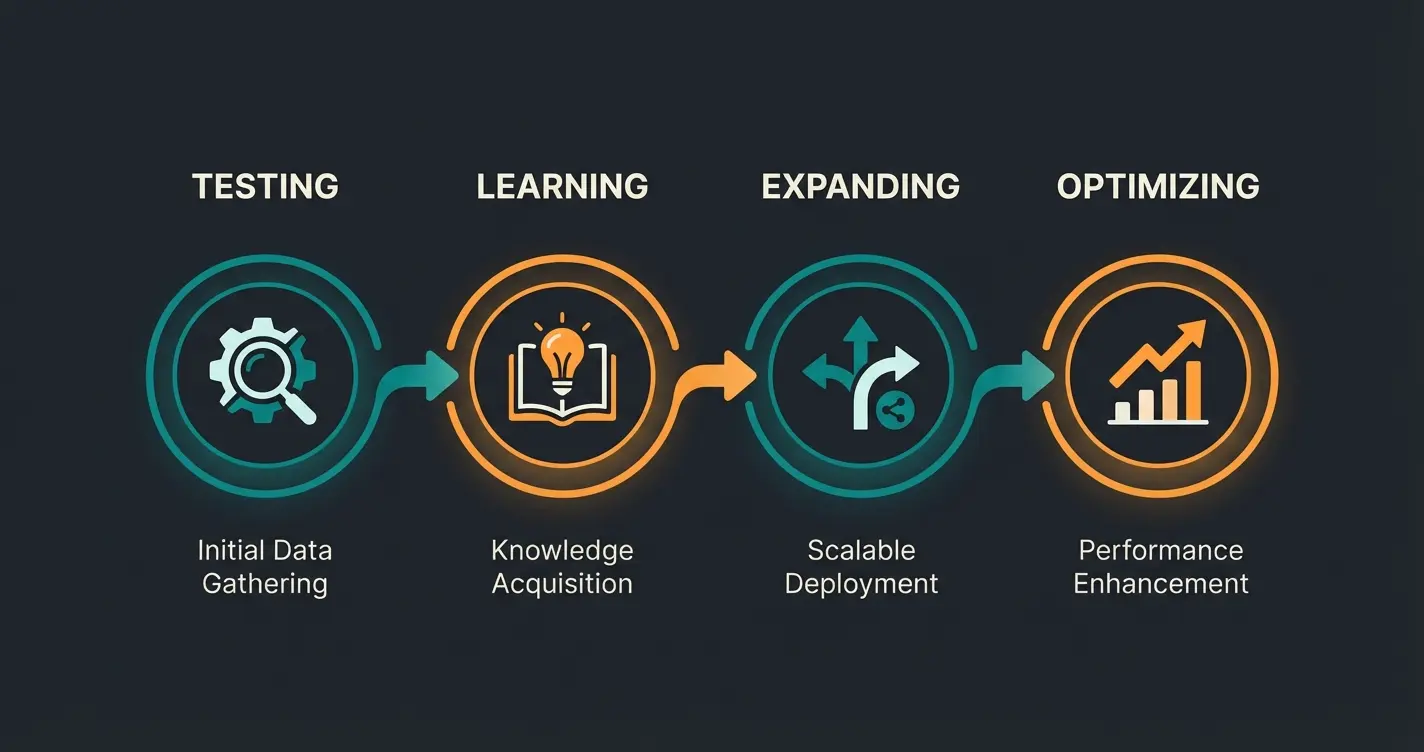
Start with limited product categories, gather data on successful consultations, then expand coverage.
Analyze which conversation patterns lead to conversions and train the AI to replicate successful approaches.
Core Benefits of AI Sales Consultation (vs. Support Bots)
The latest generation of AI-powered chatbots convinces through intelligent functions that go far beyond avoiding typical frustration points. When properly implemented as sales consultants rather than support deflectors, these systems deliver measurable business impact across multiple dimensions.
Conversion Rate Optimization Through Active Selling
Unlike passive FAQ bots that wait for specific keywords, AI sales consultants actively engage customers and guide them toward purchase decisions. They identify cross-sell opportunities based on the customer's expressed needs, suggest complementary products, and address objections before they become cart abandonment reasons. This active selling approach transforms the chatbot from a cost center into a revenue generator.
- Context Understanding: Modern systems capture conversation context across multiple messages, enabling natural dialogue flow
- Emotion Recognition: AI algorithms identify customer sentiment and adjust communication style accordingly
- Learning Capability: Continuous improvement through analysis of successful sales conversations
- Handoff Logic: Automatic escalation to human staff for complex situations that require personal attention
- Proactive Engagement: Initiating helpful suggestions rather than waiting for explicit questions
Zero-Party Data Collection for Future Marketing
Every consultation conversation generates valuable zero-party data—information customers voluntarily share about their preferences, needs, and circumstances. When a customer tells your AI consultant 'I have dry skin and prefer fragrance-free products,' that's marketing gold that no amount of behavioral tracking can provide. This data feeds into personalized email campaigns, product recommendations, and retargeting efforts.
Reduced Returns Through Better Consultation
Better consultation equals the right product choice, which equals fewer returns. This is particularly crucial for the German market, where return rates in e-commerce remain a significant cost factor. When customers receive genuine guidance that matches products to their actual needs—rather than generic descriptions—they're far more likely to be satisfied with their purchase. The integration of these functions demonstrably leads to higher customer satisfaction. A current study on chatbot usage confirms that well-integrated AI systems achieve satisfaction scores above 80%.
Stop deflecting customers and start converting them. Our AI consultation platform integrates with your PIM to deliver genuine product guidance that drives revenue.
Start Your Free TrialTechnical Integration for Optimal Performance
A professional technical integration is the cornerstone for preventing chatbot frustration and enabling sales consultation. Experience with modern AI chatbot systems shows that approximately 65% of all implementation problems trace back to inadequate technical integration, not AI limitations.
Necessary Technical Prerequisites
The basis for smooth integration forms a stable technical infrastructure. The chatbot solution must connect with the inventory management system, product database, and CRM system. Precise API documentation and standardized interfaces enable data exchange between all systems. But beyond mere connectivity, the integration must prioritize the data types that enable consultation: detailed product attributes, compatibility matrices, and customer preference histories.
Correct backend connectivity increases response accuracy by up to 40%, and that accuracy is the baseline for AI-powered customer service that customers actually trust. But accuracy alone is not the goal. The goal is consultation quality that drives conversions, and that requires access to rich product data, not just order status information.
Backend Connectivity and Interfaces
The seamless connection of the chatbot with relevant systems enables precise and current responses. AI chatbots require access to multiple data sources to perform genuine sales consultation:
- Product Data: Current prices, availability, detailed product information, compatibility rules, and feature comparisons
- Customer Data: Order history, stated preferences, previous interactions, and consultation outcomes
- Process Data: Status of orders, returns, and service requests for context when needed
- Content: FAQ content, product manuals, size guides, and support documentation as fallback resources
The personalized AI-powered customer support enables cost reduction of up to 70% while simultaneously increasing customer satisfaction. However, the greater opportunity lies in the revenue side: AI consultants that drive conversions pay for themselves many times over compared to bots that merely deflect support tickets.
Phased Implementation Approach
The integration of AI-powered chatbots ideally occurs in phases rather than a single large deployment. After a testing phase in a protected environment with limited product categories, the system rolls out gradually. Analysis of initial customer interactions helps with optimization—the system learns continuously from conversations and improves its consultation quality over time.
Measuring What Matters: Sales Metrics Over Deflection
Here's where most chatbot implementations go wrong: they measure the wrong things. Traditional metrics focus on support efficiency—response time, deflection rate, tickets avoided. These metrics optimize for cost reduction, which means they optimize for avoiding customer contact. For a sales consultant, that's exactly backward.
Metrics That Actually Matter for Revenue
The systematic capture of performance data provides insight into improvement potential, but only if you're tracking the right indicators. Stop measuring just deflection rate and start measuring consultation quality:
- Add-to-Cart Rate After Chat: What percentage of customers who engage with the AI consultant add items to their cart? This directly measures sales effectiveness.
- Average Order Value Comparison: Compare AOV of customers who used the chatbot versus those who didn't. A good AI consultant should drive higher basket values.
- Conversion by Conversation Depth: Do customers who have longer, more substantive conversations convert at higher rates? This validates the consultation approach.
- Cross-Sell Success Rate: When the AI suggests complementary products, how often do customers add them?
- Return Rate by Chat Engagement: Do customers who received AI consultation return products less frequently?
Traditional Support Metrics (Secondary Priority)
Traditional metrics still have their place, but as secondary indicators rather than primary success measures. A current study on chatbot satisfaction outlines the most important baseline factors:
- Response Speed: Average reaction time under 2 seconds maintains conversation flow
- Resolution Rate: At least 80% of inquiries answered directly without escalation
- Handoff Quality: Precise forwarding to employees for complex questions with full context
- Customer Satisfaction: Regular ratings from users after interactions
Continuous Improvement Based on Sales Data
The collected data forms the foundation for targeted optimizations. Regular updates to the knowledge base and adjustments to dialogue guidance increase the quality of customer interactions. A dedicated team monitors performance and implements improvements based on analysis results—but now those improvements focus on conversion impact, not just efficiency gains.
The targeted evaluation of these metrics enables fact-based optimization of AI-powered customer consultation. Professional integration and regular analysis lead to measurable improvements in customer service—and more importantly, measurable improvements in revenue generated through the chatbot channel.
Personalization and Context Understanding
The personalized AI customer support plays a central role in customer satisfaction and conversion. Chatbots must consider customer history, previous interactions, and individual preferences to deliver consultation that feels personal rather than robotic.
Data-Driven Customer Engagement
Through analysis of customer data and purchasing behavior, chatbots can deliver individualized recommendations that mirror the experience of working with a knowledgeable human salesperson. The integration of machine learning algorithms enables continuous improvement of response quality—the AI learns which consultation approaches lead to conversions and replicates those patterns.
This personalization extends beyond simple product recommendations. A sophisticated AI consultant remembers context from earlier in the conversation, references information the customer provided, and builds on previous interactions to create a coherent consultation experience. This contextual awareness is what separates true AI consultation from keyword-triggered FAQ responses.
Success Stories: AI Sales Consultation in Practice
Real Results from AI Sales Implementation
The successful AI product consultation at leading e-commerce companies demonstrates the potential of properly implemented chatbots. The numbers speak clearly: cost savings of 70% combined with a 35% increase in customer satisfaction. But the revenue impact tells an even more compelling story.
When chatbots shift from support deflection to sales consultation, the business model fundamentally changes. Instead of measuring success by costs avoided, companies measure success by revenue generated. This reframing transforms the chatbot from a necessary expense into a competitive advantage—a digital sales team that operates 24/7, scales infinitely, and improves continuously through machine learning.
The German Market Opportunity
German consumers present a particular opportunity for AI sales consultation. The cultural expectation for detailed product information and thorough consideration before purchase aligns perfectly with what a well-implemented AI consultant provides. Unlike impulsive shoppers who might convert on basic product pages, German buyers often need their questions answered before committing—and an AI consultant available at 2 AM can provide that guidance when human staff cannot.
Frequently Asked Questions About E-Commerce Chatbots
Costs vary significantly based on capabilities. Basic FAQ bots may cost €50-200/month, while sophisticated AI sales consultants with PIM integration typically range from €500-2000/month. However, the better question is ROI: a support bot reduces costs, while a sales consultant generates revenue. Calculate your expected conversion lift and compare that to the investment.
A traditional chatbot matches keywords to pre-written responses—it's reactive and limited to its script. An AI sales consultant understands context, accesses your product data in real-time, and actively guides customers toward purchase decisions. It's the difference between an FAQ page with a chat interface and a knowledgeable digital salesperson.
Basic implementations can go live in 1-2 weeks. A full AI sales consultant with PIM integration, CRM connectivity, and custom training typically requires 4-8 weeks. We recommend phased rollout: start with limited product categories, measure results, and expand based on data.
Yes, when properly integrated with your product information management system. The AI can understand detailed specifications, compatibility requirements, and feature comparisons. The key is data quality: if your PIM contains comprehensive product attributes, the AI can use that information to guide sophisticated consultations.
Track revenue metrics: add-to-cart rate after chat engagement, average order value comparison (chat users vs. non-chat users), conversion rate by conversation depth, and return rate reduction. These metrics capture the sales value of AI consultation, not just the support tickets deflected.
Conclusion: From Cost Center to Revenue Generator
The evolution of e-commerce chatbots from simple FAQ responders to intelligent AI sales consultants represents one of the most significant opportunities in digital retail. The technology exists today to transform your chatbot from a cost center focused on deflecting support tickets into a revenue generator that actively drives conversions.
The key insights are clear: proper integration matters more than AI sophistication, PIM access enables consultation while order status only enables support, and measuring consultation quality beats measuring deflection rate. German consumers in particular respond well to the detailed, trustworthy guidance that AI sales consultants provide.
The companies that recognize this shift early will gain significant competitive advantage. While competitors continue optimizing for ticket deflection, forward-thinking retailers are building digital sales teams that operate around the clock, scale without limit, and improve continuously through machine learning. The question isn't whether AI will transform e-commerce consultation—it's whether your business will lead that transformation or follow it.
Join the retailers already using AI consultation to increase conversions, boost AOV, and reduce returns. See how Qualimero transforms e-commerce customer experience.
Get Started Free
Lasse is CEO and co-founder of Qualimero. After completing his MBA at WHU and scaling a company to seven-figure revenue, he founded Qualimero to build AI-powered digital employees for e-commerce. His focus: helping businesses measurably improve customer interaction through intelligent automation.