AI Chatbots in E-Commerce 2025: From FAQ Bot to Digital Sales Consultant
Discover how AI chatbots transform e-commerce through conversational commerce. Learn about product consultation, PIM integration & conversion optimization.

AI Chatbots and Conversational Commerce: A Complete Overview
The e-commerce sector is experiencing a revolution through the introduction of AI chatbots and conversational commerce. These technologies are fundamentally changing how businesses interact with their customers and conduct transactions. Conversational AI, as an advanced AI system, enables natural conversations between humans and machines and forms the foundation for this development.
AI chatbots are intelligent software programs that simulate human conversations and can respond to customer inquiries in real-time. They use natural language processing and machine learning to understand customer needs and deliver appropriate responses. An AI chatbot can play a central role in building a personalized and efficient shopping experience in the e-commerce context.
Conversational commerce connects these AI-powered communication technologies with online retail. It enables customers to explore products, ask questions, and complete purchases directly through chat platforms or voice assistants. This integration of communication and commerce creates a seamless shopping experience that blurs the boundaries between consultation, sales, and customer service.
The main advantages of AI chatbots in conversational commerce include an improved customer experience through 24/7 availability, personalized product recommendations, and fast response times. For businesses, this means increased efficiency, cost savings in customer service, and potential revenue increases through higher conversion rates.
What is Conversational Commerce?
Conversational commerce refers to the use of conversational technologies such as chatbots, messaging apps, and voice assistants to support and optimize the shopping process. It enables customers to interact with businesses, discover products, and complete purchases—all within a single conversation.
The term was coined in 2015 by Chris Messina and has since gained significant importance. According to Cube Asia's market analysis, the global conversational commerce market is projected to grow from $7.6 billion in 2024 to $34.4 billion by 2034, with an annual growth rate of 16.3%.
Growing from $7.6B in 2024
CAGR for conversational commerce
Prefer chatbots for simple inquiries
In customer service operations
The changes in online retail through conversational commerce are profound. Customers increasingly expect personalized and immediate interactions. According to studies, 74% of users prefer chatbots for simple inquiries, and companies have been able to reduce their customer service costs by 30%. These figures underscore the growing acceptance and efficiency of this technology.
Various channels and technologies contribute to conversational commerce:
- AI Chatbots: Automated conversation partners that can understand and process natural language.
- Messaging Apps: Platforms like WhatsApp or Facebook Messenger used for customer interactions.
- Voice Assistants: Systems like Alexa or Google Assistant that enable voice-controlled purchases.
- Live Chat: Real-time communication with human employees, often supported by AI.
Among these technologies, AI chatbots play a key role. They combine the advantages of automation with the ability to understand and answer complex customer inquiries. The development from simple chatbots to Conversational AI has significantly expanded the possibilities of conversational commerce and enables increasingly natural and effective customer interactions.
The Critical Distinction: FAQ Bots vs. AI Sales Consultants
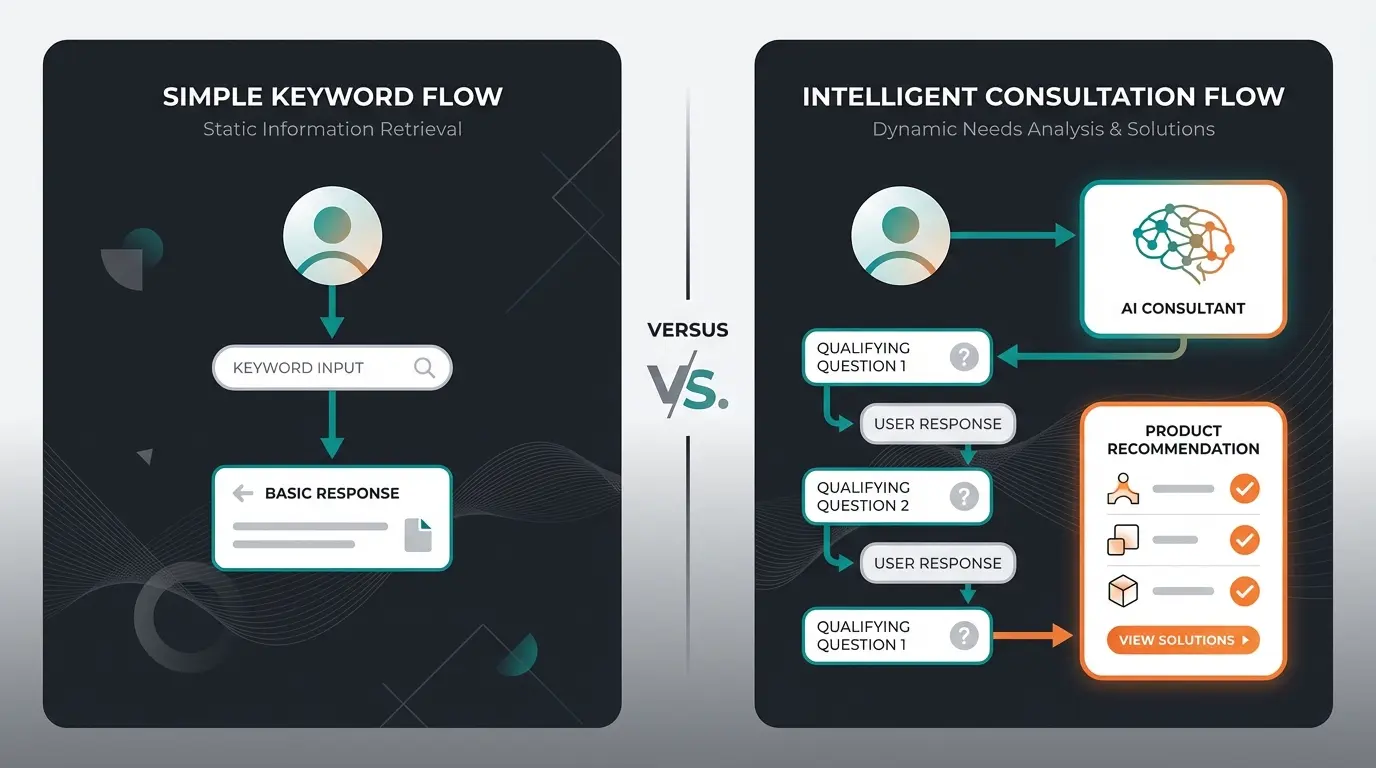
Most articles about AI chatbots lump sales and support functions together. However, there's a fundamental architectural difference between a bot that answers FAQs (e.g., 'Where is my package?') and a bot that consults on products (e.g., 'Which running shoe fits my pronation?'). Understanding this distinction is crucial for e-commerce success.
| Feature | Traditional FAQ Bot | AI Sales Consultant |
|---|---|---|
| Primary Goal | Ticket deflection & cost reduction | Conversion & revenue generation |
| Response Type | Static, keyword-triggered answers | Dynamic, context-aware recommendations |
| Data Source | Text-based FAQ database | Live product catalog (PIM) + knowledge base |
| Conversation Style | Reactive - waits for specific questions | Proactive - asks qualifying questions |
| Business Impact | Reduces support costs | Increases AOV and conversion rates |
| Learning Ability | Limited rule updates | Continuous ML improvement |
Declarative Bots (FAQ/Support) are designed to deflect tickets and answer straightforward questions. They excel at providing order status, return policies, and basic troubleshooting. Their success metric is ticket deflection rate.
Consultative Bots (AI Sales Consultants) function like top-performing in-store salespeople. They conduct needs analysis by asking qualifying questions ('What is your skin type?' or 'What is your budget?'), provide personalized recommendations based on answers, and educate customers on why a specific product fits their needs. Their success metric is conversion rate and average order value.
Definition and Functions of AI Chatbots in E-Commerce
An AI chatbot is a computer program that uses artificial intelligence (AI) and natural language processing (NLP) techniques to communicate with customers in real-time via messenger platforms. These intelligent assistants simulate human dialogues and thereby enable customers to have a personal and interactive shopping experience. AI chatbots can be deployed across various channels, including websites, messenger services like WhatsApp and Facebook Messenger, and voice assistants like Alexa and Google Assistant.
In e-commerce, AI chatbots offer numerous functions that facilitate and improve the shopping process. They can answer questions about products, make recommendations, take orders, and even help solve problems. Through integration into various communication channels, they are always available where customers need them, providing a seamless and consistent user experience.
AI Chatbots: The Driving Force in Conversational Commerce
AI chatbots have become the heart of conversational commerce. These intelligent systems use artificial intelligence and machine learning to conduct natural conversations with customers and provide personalized shopping experiences. In the e-commerce sector, AI chatbots bring numerous advantages:
- Availability: AI chatbots are available around the clock and provide immediate support.
- Scalability: They can easily handle a large number of customer inquiries simultaneously.
- Personalization: AI chatbots analyze customer data to provide tailored recommendations.
- Efficiency: They automate routine tasks and thus relieve the customer service team.
- Consistency: AI chatbots consistently deliver accurate and up-to-date information.
An example of advanced chatbots is ChatGPT, which can increase customer engagement through its interactive features by enabling direct exchange between brands and buyers.
The role of AI and machine learning in chatbots goes far beyond simple rule-based systems. Modern AI-powered chatbots can understand contexts, learn from interactions, and continuously improve their responses. They use natural language processing (NLP) to capture customer intentions and respond appropriately.
Successful implementation examples show the potential of AI chatbots in e-commerce:
- H&M: The fashion company uses an AI chatbot that advises customers on outfit combinations and gives personalized recommendations.
- Sephora: The beauty giant uses an AI-powered chatbot for virtual makeup consultations and product recommendations.
- Pizza Hut: An AI chatbot enables customers to easily order and customize pizzas across various messaging platforms.
These examples illustrate how AI chatbots are revolutionizing conversational commerce and improving the shopping experience. They not only provide practical support but also create emotional connections with customers through personalized and context-related interactions.
The integration of AI chatbots into e-commerce strategies is not a short-term trend but a fundamental change in how businesses interact with their customers. According to a study by Juniper Research, global retail revenue through chatbots is expected to reach $112 billion by 2024. This underscores the growing importance and enormous potential of AI chatbots in conversational commerce.
Chatbot Integration: How AI Learns Your Products
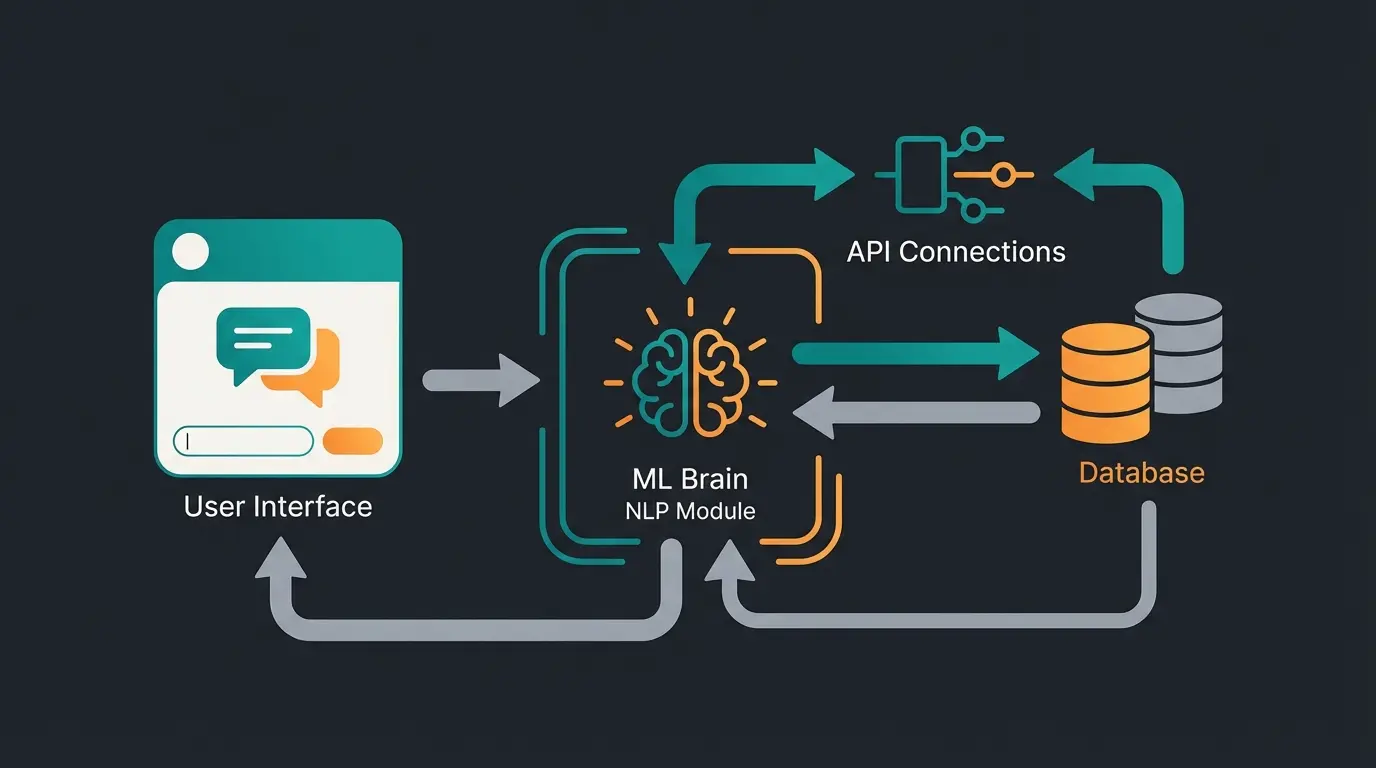
A critical differentiator for AI sales consultants is their integration with product data systems. Unlike simple FAQ bots that only access text-based knowledge bases, true AI product consultants need real-time access to your Product Information Management (PIM) system and e-commerce platform.
Chat widget on website, WhatsApp, or messenger apps
NLP understanding, intent recognition, context management
Real-time connection to PIM, Shopify, Magento, or Shopware
Live stock levels, pricing, and variant availability
Contextual product recommendations with accurate data
This integration architecture enables the AI to provide accurate, real-time information about product availability, pricing, variants (sizes, colors, configurations), and delivery times. When a customer asks 'Do you have this jacket in blue, size M?', the AI can immediately check live inventory rather than providing a generic 'Please check our website' response.
Key integration capabilities include:
- Shopify/Magento/Shopware Sync: Direct connection to product catalogs with automatic updates when inventory changes
- PIM Integration: Access to detailed product attributes, descriptions, and specifications for accurate recommendations
- Real-time Pricing: Current prices including promotions, discounts, and customer-specific pricing tiers
- Variant Management: Understanding of product variations (size, color, material) for precise recommendations
- Stock Alerts: Automatic notification when items are low in stock or back in stock
Personalized Product Recommendations through AI Chatbots
A key element of conversational commerce is the ability of e-commerce chatbots to provide personalized product recommendations. This function harnesses the power of data analysis and machine learning to present customers with tailored suggestions that are precisely matched to their needs and preferences.
AI chatbots analyze a variety of customer data, including:
- Purchase History: Previous purchases and viewed products
- Browsing Behavior: Pages visited on the website and time spent
- Demographic Data: Age, gender, location
- Preferences: Explicitly stated preferences or interests derived from behavior
- Contextual Information: Time of day, season, current trends
By processing this data, AI chatbots can generate highly relevant product recommendations. This leads to a significant improvement in the shopping experience for the customer and has positive effects on important e-commerce metrics:
Increase in Conversion Rate: Personalized recommendations increase the likelihood that customers will make a purchase. According to a study by Salesforce, personalized product recommendations can increase conversion rates by up to 150%.
Increase in Average Order Value: Through targeted cross-selling and upselling suggestions, AI chatbots can increase cart value. Amazon reports that 35% of its revenue is generated through personalized recommendations.
Improvement in Customer Satisfaction: Relevant recommendations save customers time in product search and improve their shopping experience. A study by Accenture shows that 91% of consumers are more likely to shop with brands that provide personalized offers and recommendations.
Reduction in Return Rate: More precise recommendations reduce the likelihood of wrong purchases. This can reduce the return rate by up to 20%, as an analysis by McKinsey found.
An example of successful AI product consultation is the online furniture retailer Made.com. Their AI chatbot 'Matilda' guides customers through a series of questions about their interior design style and budget. Based on the answers, Matilda presents a curated selection of furniture and accessories that are precisely tailored to the customer's individual preferences.
The implementation of personalized product recommendations through AI chatbots is a powerful tool in conversational commerce. It not only improves the customer experience but also increases the efficiency and profitability of e-commerce businesses. With the ongoing development of AI technologies, these systems will become even more precise and valuable for both customers and businesses.
Stop losing sales to abandoned carts. Our AI sales consultant guides customers from browsing to buying with personalized product recommendations.
Start Free TrialVirtual Shopping Consultation with Conversational AI
AI-powered chatbots are revolutionizing how customers are advised in online stores. Through the use of Conversational AI, online shops can offer personalized and effective shopping consultation around the clock. This virtual support simulates the experience of personal consultation in a physical store and offers numerous benefits for customers and businesses.
Support in Product Selection
AI chatbots analyze customer preferences and needs based on their questions and previous interactions. Based on this information, they can provide targeted product recommendations and guide customers through the assortment. Capturing the email address is important to enable personalized recommendations. This facilitates the purchase decision and increases the likelihood that customers will find the right product for them.
Answering Customer Questions
A major advantage of AI chatbots is their ability to immediately and precisely answer a variety of customer questions. They access an extensive knowledge database and can provide detailed information about product features, availability, shipping options, and more. This reduces waiting times for customers while simultaneously relieving the human customer service team.
Simulating Personal Consultation
Modern AI chatbots are able to conduct natural conversations and address individual concerns. They can give recommendations based on customer preferences, suggest alternative products, and even offer styling tips or application hints. This personal touch in virtual consultation creates a shopping experience that comes close to consultation in a brick-and-mortar store.
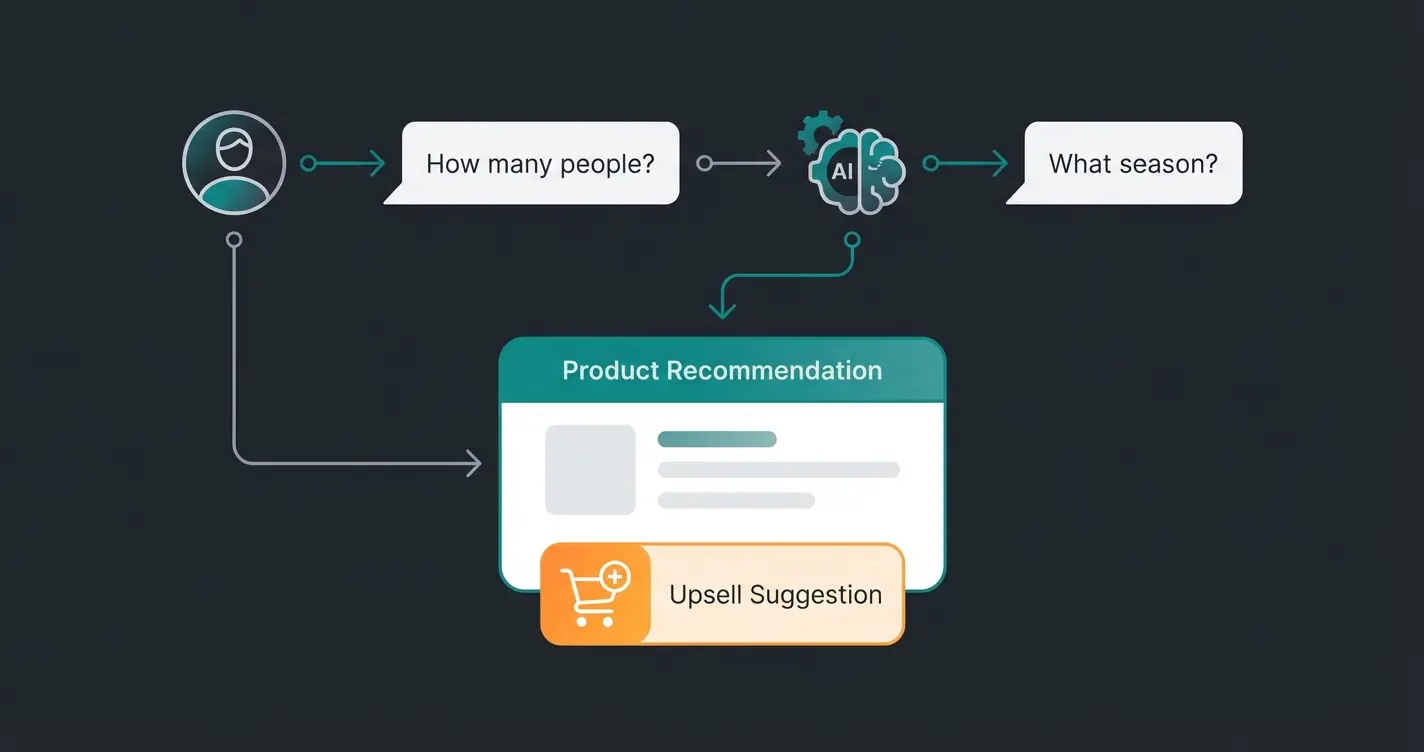
The Consultative Dialogue Flow in Action
Understanding how an AI sales consultant conducts a conversation reveals why it's so much more effective than a traditional FAQ bot. The consultative approach mirrors what top-performing in-store salespeople do naturally.
Notice how the AI asked qualifying questions before making recommendations. It didn't just search for 'tent' in a database—it understood the use case and provided contextual advice with a relevant upsell opportunity.
Support in the Purchase Process through AI Chatbots
AI chatbots play a central role in optimizing the entire purchase process in e-commerce. They provide support in various phases of the customer journey and contribute to reducing purchase barriers and increasing conversion rates. Two particularly important areas where AI chatbots support the purchase process are size consultation and product comparisons as well as availability checks and delivery information.
Size Consultation and Product Comparisons
A common challenge in online retail is uncertainty when selecting the right size or suitable model. AI chatbots can provide valuable help here:
Size Recommendations: Through targeted questions about body measurements or preferences, AI chatbots can provide precise size recommendations. They also consider information about different brands and their specific size charts.
Product Comparisons: Chatbots can make detailed comparisons between different products. They highlight differences in features, materials, or prices and thus help customers make an informed decision.
Availability Checks and Delivery Information
Transparent information about availability and delivery is crucial for a positive purchase experience. AI chatbots can effectively support here:
Real-time Availability: Chatbots can check current inventory in real-time and immediately inform customers about product availability. For temporarily unavailable items, they can suggest alternative products or offer notification options.
Delivery Information: AI chatbots can provide precise information about expected delivery times, shipping costs, and shipping options. They consider factors such as customer location, chosen shipping methods, and current logistics information.
Through this comprehensive support in the purchase process, AI chatbots contribute to strengthening customer trust and reducing purchase barriers. They enable a smooth and informed shopping process that increases customer satisfaction and reduces the likelihood of returns.
Technical Insight into How Chatbots Work
To understand customer inquiries, retrieve relevant information, and provide appropriate answers, several technical components are needed. These include:
- Natural Language Processing (NLP): This technology enables the chatbot to understand and interpret human language. NLP analyzes user inputs and identifies their intentions and needs.
- Machine Learning (ML): Through machine learning, the chatbot can learn from past interactions and continuously improve its responses. ML algorithms help the chatbot recognize patterns and make predictions.
- Application Programming Interface (API): APIs enable the chatbot to access external data sources and services. This is particularly important for providing current information, such as inventory levels or delivery times.
- Dialog Management: This component controls the conversation flow and ensures that the chatbot responds to user inquiries in a logical and coherent manner.
- User Interface: The user interface is the interface through which users interact with the chatbot. It can be text-based, voice-based, or a combination of both.
These components work together to enable effective and efficient communication between the chatbot and customers.
Integration of Payment Processes in Chatbot Conversations
The seamless integration of payment processes into chatbot conversations is a crucial step in optimizing conversational commerce. AI-powered chatbots can not only provide product recommendations and answer questions but also accompany the entire purchase process through to completion.
The benefits of this integration are manifold:
- Simplification: Customers can select products, clarify questions, and pay without leaving the conversation.
- Time Savings: The entire purchase process is accelerated, which increases customer satisfaction.
- Conversion Rate: By reducing friction in the purchase process, the likelihood of completion increases.
- AI chatbots can offer individual payment options based on customer preferences.
According to a study by Business DIT, the integration of payment processes in chatbot conversations leads to an average increase in conversion rate of 82%. Additionally, the average order value increases by 10% when customers have the opportunity to live chat before purchasing.
To leverage these benefits, it's important for e-commerce businesses to connect their chatbots with secure payment gateways and ensure a smooth user experience. The future of conversational commerce lies in the seamless linking of consultation, product selection, and payment in a single, continuous conversation flow.
After-Sales Service through AI Chatbots in E-Commerce
The use of AI chatbots in after-sales service is revolutionizing customer care in e-commerce. These intelligent assistants provide around-the-clock support for follow-up questions, complaints, and returns, leading to a significant increase in customer satisfaction.
Central aspects of AI-powered after-sales service are:
- Fast Response Times: AI chatbots can respond immediately to customer inquiries without waiting times.
- Consistent Quality: Consultation quality remains consistently high, regardless of time of day or workload.
- Scalability: Chatbots can easily handle a large number of inquiries in parallel.
- Learning Ability: Through machine learning, AI chatbots continuously improve their capabilities and knowledge.
As Qualimero reports, the use of AI chatbots in customer service leads to significant efficiency gains. Companies can save up to 30% of their customer service costs while simultaneously increasing customer satisfaction.
Another important aspect is the personalization of customer service through AI. Chatbots can offer individual solutions based on previous interactions and purchases, thereby improving the customer experience. This leads to stronger customer loyalty and increases the likelihood of repeat purchases.
For e-commerce businesses, integrating AI chatbots into after-sales service is not only a way to save costs but above all a way to sustainably increase customer satisfaction and differentiate themselves from the competition.
Advantages of an AI Sales Consultant (Revenue Focus)
While most competitors focus on cost savings through support automation, the real opportunity lies in revenue generation. An AI sales consultant delivers measurable business impact:
With personalized recommendations (Salesforce)
Amazon's recommendation-driven sales
Better advice means better fit (McKinsey)
With live chat integration (Business DIT)
Higher Average Order Value (AOV): Smart cross-selling based on actual purchase context. When a customer buys a camera, the AI suggests the compatible memory card, case, and tripod—not just any accessories, but the ones that match their specific model.
Lower Return Rates: Better advice leads to better product fit. When customers receive genuine consultation about which size, variant, or model suits their needs, they're far less likely to return items.
24/7 Sales, Not Just Support: Traditional chatbots provide 24/7 support. AI sales consultants provide 24/7 revenue generation. Every night owl browsing your store at 2 AM gets the same quality consultation as a daytime shopper.
Improving Conversion Rates through Conversational Commerce
Conversational commerce has a significant impact on conversion rates in e-commerce. Through the use of AI chatbots, businesses can significantly improve their purchase completions and customer retention. Current statistics and case studies demonstrate the positive effects of this technology on online retail.
According to a study by Sprinklr, the integration of Conversational AI leads to measurable improvements:
- Efficiency Increase: 90% of contact centers report faster complaint processing and improved call handling through the use of AI.
- Revenue Increase: Companies using conversational commerce see a revenue increase of 7-25%.
- Cost Savings: Through the introduction of conversational commerce, companies were able to reduce their customer service costs by 30%.
These figures clearly show how AI chatbots and conversational commerce can boost performance in the e-commerce sector. Particularly impressive is the impact on conversion rates:
- Live Chat Influence: The use of live chat can increase conversion rates by up to 82%.
- Average Order Value: Customers who use live chat before purchasing have a 10% higher average order value.
These results underscore the importance of AI chatbots for modern e-commerce. They not only offer improved customer interaction but also contribute directly to increasing revenue.
AI Customer Service and Data Protection (The German Context)
The use of AI chatbots in e-commerce also involves data protection and legal aspects that businesses must observe. It is crucial that businesses comply with applicable data protection regulations to gain customer trust and avoid legal consequences.
The most important data protection requirements include obtaining consent for data processing, secure storage of personal data, and ensuring data security during transmission. Businesses must ensure that customers are informed about the type and scope of data collection and have given their consent.
Furthermore, businesses must consider the legal aspects of using AI chatbots in e-commerce. This includes transparency and information obligations toward customers. It's important that customers know they are interacting with a chatbot and what data is being processed. Businesses should provide clear and understandable information and give customers the opportunity to exercise their rights, such as the right to access, correction, or deletion of their data.
By complying with these data protection and legal requirements, businesses can strengthen customer trust while fully leveraging the benefits of AI chatbots in e-commerce.
Frequently Asked Questions About AI Chatbots
Traditional chatbots follow pre-programmed rules and respond to specific keywords with fixed answers. AI chatbots use natural language processing (NLP) and machine learning to understand context, learn from interactions, and provide dynamic, personalized responses. An AI sales consultant can conduct genuine conversations, ask qualifying questions, and make intelligent product recommendations.
Costs vary significantly based on complexity and features. Basic chatbot solutions start around €50-200/month, while enterprise AI sales consultants with PIM integration and advanced personalization can range from €500-2000+/month. The ROI typically justifies the investment through increased conversions and reduced support costs.
AI chatbots can absolutely be GDPR compliant when implemented correctly. Key requirements include: obtaining explicit consent before collecting personal data, storing data on EU servers, providing clear information about data usage, enabling data access and deletion requests, and maintaining transparent communication that the user is interacting with an AI.
Implementation timelines vary based on complexity. A basic FAQ chatbot can be deployed in 1-2 weeks. A fully integrated AI sales consultant with PIM synchronization, personalization, and payment integration typically takes 4-8 weeks. The key is proper data preparation and clear definition of use cases.
Absolutely. While cost reduction is a common benefit, the real opportunity lies in revenue generation. Studies show personalized recommendations can increase conversion rates by up to 150%, and customers who interact with chat before purchasing have 10% higher average order values. The key is implementing a consultative AI that actively sells, not just a reactive FAQ bot.
Conclusion: The Future of E-Commerce with AI Chatbots
AI chatbots and conversational commerce are not temporary trends but represent the future of e-commerce. They offer businesses the opportunity to optimize customer interactions, automate processes, and simultaneously create personalized experiences.
The statistics from ProfileTree clearly show the growing importance of these technologies:
- Customer Expectations: 84% of customers expect to be able to communicate with businesses through messaging platforms like WhatsApp and Facebook Messenger.
- Preference: 54% of customers prefer communication with businesses through messaging apps.
- Productivity Increase: Over 50% of companies using conversational marketing solutions report increased sales productivity.
These figures illustrate that AI chatbots and conversational commerce not only increase customer satisfaction but also offer measurable benefits for businesses.
Outlook and Recommendations for Action
For businesses in the e-commerce sector, it's crucial to leverage the potential of AI chatbots and conversational commerce. Here are some concrete recommendations for action:
- Integration: Implement AI chatbots in your existing e-commerce platforms and customer service channels.
- Personalization: Use AI capabilities to offer personalized product recommendations and consultation.
- Omnichannel Strategy: Ensure your conversational commerce solutions are consistent across different channels.
- Continuous Improvement: Regularly analyze your AI chatbot performance and optimize based on customer feedback and data analysis.
- PIM Integration: Connect your chatbot to your product information management system for real-time, accurate recommendations.
- Revenue Focus: Configure your chatbot as a sales consultant, not just a support tool—measure success by conversion rate and AOV, not just ticket deflection.
The future of e-commerce lies in the seamless integration of AI-powered conversational commerce solutions. Businesses that adopt these technologies early and deploy them effectively will secure a decisive competitive advantage and elevate the customer experience to a new level.
Join leading e-commerce brands using AI-powered product consultation to increase conversions by up to 150%. Get started with a personalized demo today.
Book Your Demo
Lasse is CEO and co-founder of Qualimero. After completing his MBA at WHU and scaling a company to seven-figure revenue, he founded Qualimero to build AI-powered digital employees for e-commerce. His focus: helping businesses measurably improve customer interaction through intelligent automation.