The Trust Barrier: Why Language Is Only Half the Battle
In today's globalized business landscape, AI chatbots play an increasingly important role in international marketing strategies. A smart and intuitive chatbot solution enables efficient and personalized customer interaction around the clock—and across multiple languages. Current statistics underscore the growing deployment of chatbots worldwide: According to a study by Juniper Research, chatbot interactions are projected to reach 22 billion per year by 2023.
But here's the critical insight most businesses miss: The problem isn't just language barriers—it's trust barriers. When a potential customer lands on your website from Japan, France, or Brazil, they're not just looking for translated FAQ answers. They're looking for an expert who understands their specific needs, cultural context, and buying preferences. The shift from simple FAQ automation to active product consultation represents the single biggest opportunity in multilingual AI.
Multilingual AI chatbots offer companies decisive advantages in international marketing:
- Global Reach: They enable addressing customers in their native language with cultural sensitivity
- Cost Efficiency: Automated communication saves personnel and translation costs while maintaining quality
- Customer Satisfaction: Fast, contextually appropriate responses in the respective local language boost satisfaction
- Scalability: Chatbots can easily adapt to increasing demand without proportional cost increases
- Conversion Optimization: Unlike basic support bots, consultation-focused AI actively guides purchase decisions
The integration of multilingual AI chatbots into global marketing strategies is becoming increasingly important for internationally operating companies to remain competitive and optimally serve customers worldwide. However, the key differentiator lies not in translation capabilities, but in consultation intelligence.
Customers prefer purchasing in their native language
Projected chatbot interactions globally by 2023
Average decrease in customer service burden
Lift in international customer conversion rates
Foundations of Conversational AI and Chatbot Technology
To understand how multilingual chatbots function, it's essential to know the technical foundations of Conversational AI and AI chatbots. Conversational AI refers to technologies that enable computers to understand, process, and respond to human language. AI assistants play a central role here by utilizing advanced linguistic data processing and large language models to comprehend and answer user queries.
Defining Modern AI Chatbots
AI chatbots are advanced computer programs developed using artificial intelligence (AI) and machine learning (ML) to understand human language and respond appropriately. These chatbots can imitate natural, interpersonal communication and provide tailored responses to user inquiries. They are frequently deployed in customer communication, customer service, and marketing to help companies better understand and more efficiently serve their customers. Through the use of AI chatbots, companies can provide personalized support around the clock while simultaneously increasing customer satisfaction.
However, there's a critical distinction that separates market leaders from followers: the difference between a Translator Bot and a Consultant Bot. A translator bot essentially wraps Google Translate functionality—it converts words from one language to another. A consultant bot, on the other hand, understands that "Handy" means mobile phone in German but "practical" in English. It grasps context, cultural expectations, and buying intent.
Natural Language Processing and Machine Learning
Two key technologies form the foundation of modern AI chatbots:
Natural Language Processing (NLP): NLP enables computers to analyze and understand human language. Techniques such as tokenization, part-of-speech tagging, and named entity recognition are employed to capture the meaning of texts. For multilingual applications, advanced NLP must understand not just syntax but semantic intent across cultural contexts.
Machine Learning (ML): ML algorithms enable chatbots to learn from data and continuously improve their performance. Neural networks and deep learning play a central role in natural language processing. The key advancement for multilingual systems is cross-lingual transfer learning, where insights from one language improve performance in others.
How AI Chatbots Process Requests
AI-powered chatbots typically go through the following steps when processing user inquiries:
- Input Processing: The chatbot receives and analyzes the user input, including language detection
- Intent Recognition: The user's intent is identified using NLP techniques—not just what they said, but what they want
- Context Analysis: The context of the conversation is considered, including previous interactions and cultural norms
- Information Retrieval: Relevant information is retrieved from the knowledge database or Product Information Management (PIM) system
- Response Generation: An appropriate response is formulated and sent to the user in culturally appropriate language
It's important to evaluate and compare various chatbot software solutions to find the best option in terms of user-friendliness, adaptability, and cost.
Rule-Based vs. AI-Powered Chatbots
In contrast to rule-based chatbots, which operate on predefined if-then rules, AI chatbots use machine learning and NLP to respond more flexibly to user inquiries. They can conduct more complex conversations, learn from interactions, and adapt to new situations. These capabilities make AI chatbots particularly valuable for multilingual and cross-cultural communication in global marketing.
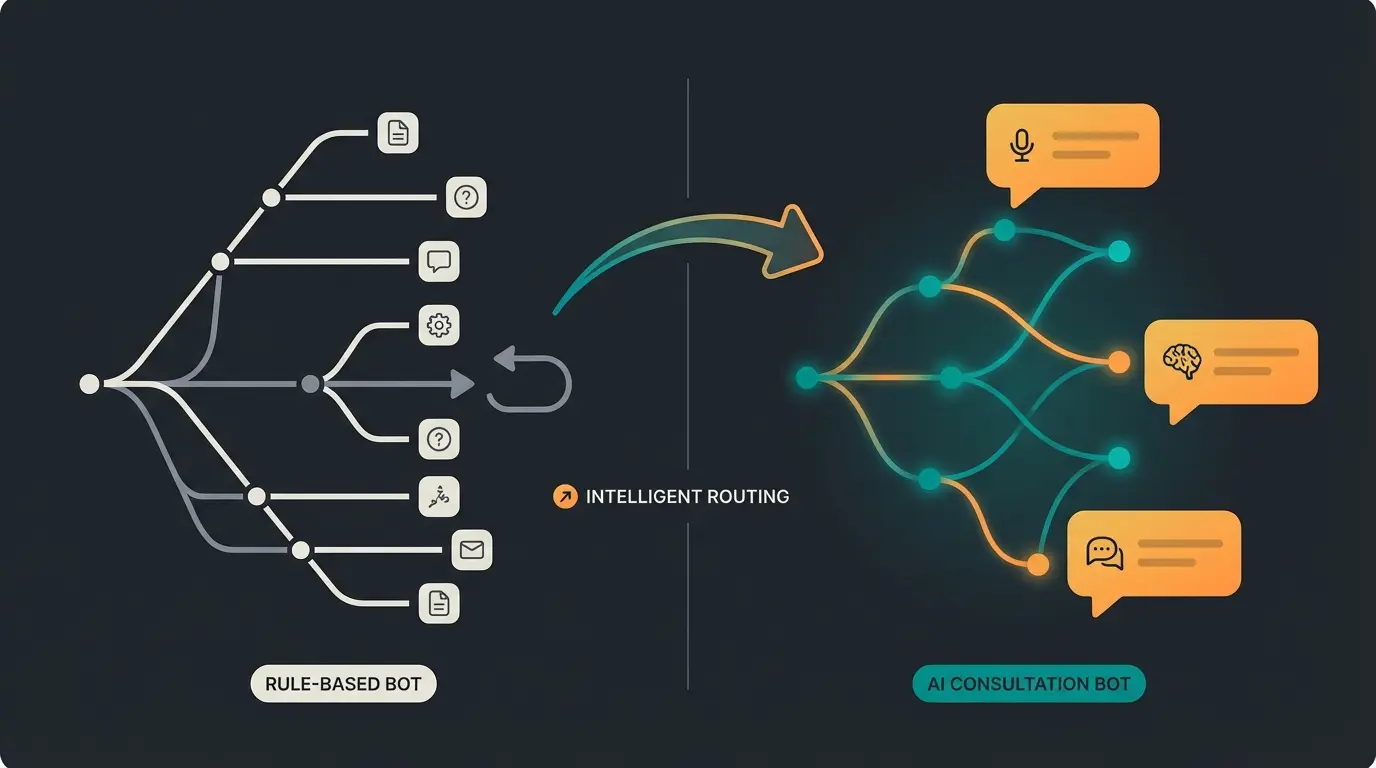
The Product Consultant Difference: Your Competitive Edge
This is where the separation between average implementations and market-leading solutions becomes clear. Most competitors in the multilingual chatbot space focus on reactive support—answering FAQs, reducing ticket volume, and deflecting simple questions. But the real opportunity lies in proactive consultation.
Consider the difference: A user asks "I need a camera for sports." A standard support bot gives a link to all cameras—helpful, but generic. A Product Consultant AI asks "Indoor or outdoor? Professional or hobby? What's your budget range?" in the user's native language with culturally appropriate phrasing. This guided discovery process dramatically increases conversion rates.
| Feature | Standard FAQ Bot | Product Consultation AI |
|---|---|---|
| Primary Goal | Ticket Deflection | Conversion Optimization |
| Knowledge Source | FAQ List / Static Content | Deep Product Data (PIM Integration) |
| Interaction Style | Passive / Reactive | Active / Guiding |
| Cultural Handling | Basic Translation | Native Understanding + Cultural Adaptation |
| Complex Products | Struggles with Technical Specs | Handles Compatibility & Requirements |
| Sales Impact | Minimal | 20-30% Conversion Lift |
Understanding Product Knowledge Graphs
Where competitors explain how bots translate language, leading solutions focus on how AI understands complex product relationships across languages. This requires integration with Product Information Management (PIM) systems to access:
- Technical specifications and compatibility data
- Cross-sell and upsell relationships between products
- Regional availability and pricing variations
- Feature comparisons relevant to customer use cases
- Warranty and support information by market
A true product consultation AI doesn't just translate "This laptop has 16GB RAM"—it understands that a customer asking about video editing in Spanish needs to know about GPU capabilities, storage speed, and display quality, and can guide that conversation naturally.
Cultural Buying Behavior: Beyond Translation
While "cultural nuances" are frequently mentioned by competitors, few explain how buying conversations differ structurally across cultures. Consider these critical differences:
- German conversations tend to be direct and fact-focused—customers appreciate detailed specifications upfront
- Japanese interactions require careful attention to honorifics and indirect communication styles
- US customers often respond to enthusiasm and social proof elements
- French buyers may expect more formal initial interactions before warming up
- Brazilian customers often appreciate a more personal, relationship-building approach
A consultation-focused AI handles these differences not through manual rules, but through training on culturally-diverse conversation data that captures these patterns naturally.
See how AI-powered product consultation can boost your international conversion rates. Our multilingual chatbot doesn't just translate—it sells.
Start Your Free TrialChallenges in Developing Multilingual Chatbots
The development of multilingual AI chatbots for global marketing strategies brings several complex challenges. To create effective solutions, companies must understand and overcome these hurdles. A free trial version can help implement and evaluate new chatbot technologies before full integration.
Speech Recognition and Translation Quality
One of the biggest technical challenges lies in precise speech recognition and translation. AI chatbots must be able to correctly capture and interpret various languages, dialects, and accents. Translation must not only be grammatically correct but also consider the context and intention of users. Advanced AI models like Meta AI show promising approaches here by being trained in multiple languages and delivering context-sensitive translations.
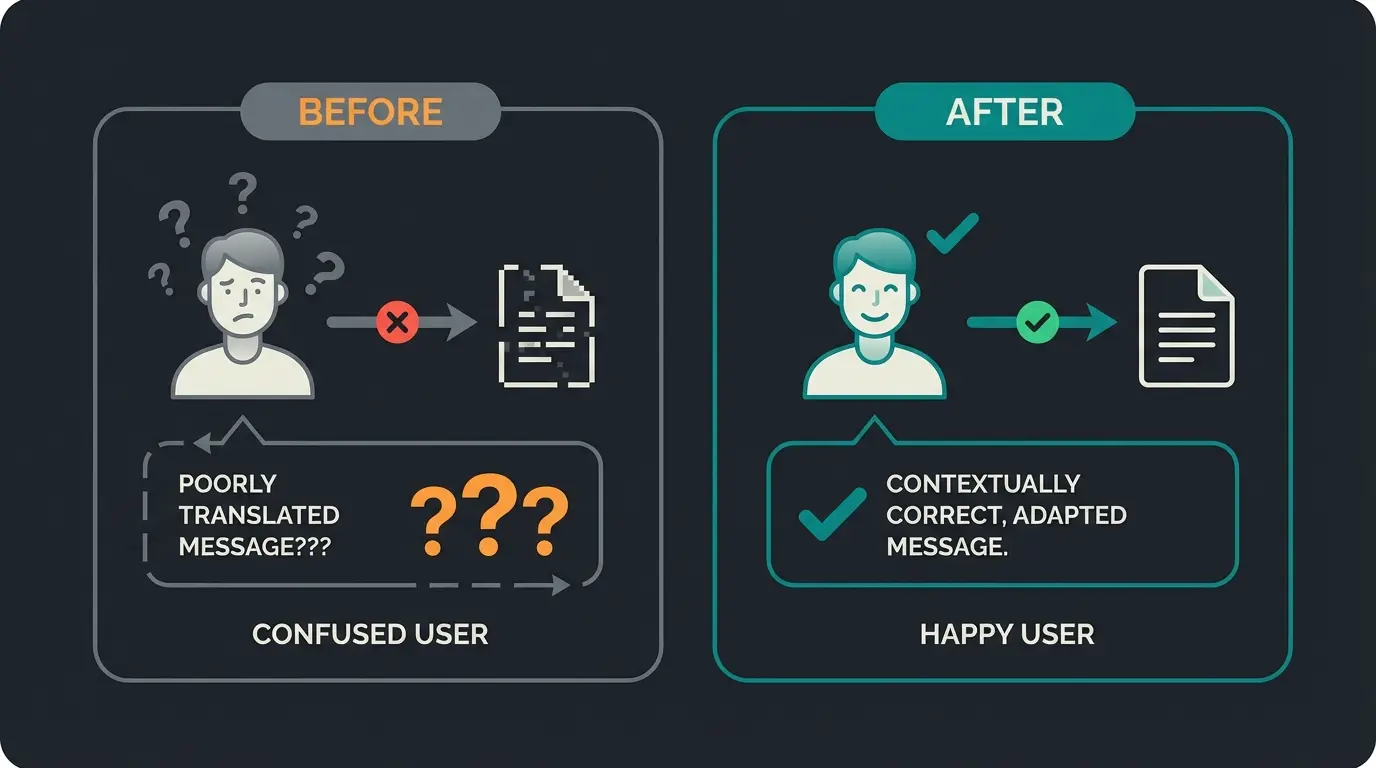
The critical distinction is between real-time translation and native understanding. Translating a sales pitch often fails because cultural expressions, humor, and persuasion techniques don't transfer directly. An AI that "thinks" in the target language—having been trained on native content—outperforms translation-layer approaches significantly.
Localization Beyond Word Replacement
Simple translation of responses is often insufficient. Chatbots must adapt their communication to local circumstances. This includes considering regional peculiarities, colloquialisms, and specific expressions. Effective localization requires extensive data collection and continuous training of AI models with local content.
Consider the German formal/informal distinction (Sie/Du): Using the wrong form can immediately signal that your brand doesn't understand the local market. Japanese honorifics present similar challenges. These aren't just language features—they're trust signals.
Cultural Sensitivity and Communication Norms
Particularly challenging is considering cultural differences in communication. Chatbots must respond sensitively to cultural norms, taboos, and communication styles. What is considered polite in one culture may be perceived as rude in another. Developing culturally sensitive AI chatbots requires not only technical know-how but also deep understanding of intercultural communication.
To master these challenges, leading companies like Meta are deploying advanced AI technologies. Their systems are continuously trained with multilingual datasets and can thus increasingly better address the nuances of various languages and cultures. These developments pave the way for AI chatbots that can conduct authentic and culturally appropriate conversations in different languages.
Strategic Implementation of Multilingual AI Chatbots
Successful implementation of multilingual AI chatbots requires a well-thought-out strategy and careful planning. Here are the most important steps and considerations for companies wanting to deploy global Conversational AI solutions:
Selecting the Right AI Platform
Choosing the right AI platform is crucial for the success of multilingual chatbots. Companies should prefer platforms that are robust, scalable, and optimized for multilingual applications. Important criteria for selection include:
- Language Support: Wide range of supported languages and dialects with native-level quality
- Customization Capability: Ability to fine-tune for industry-specific terminology and brand voice
- Integration Options: Compatibility with existing systems, PIM, CRM, and databases
- Scalability: Ability to handle growing user volumes and additional languages
- Consultation Features: Support for guided selling and product recommendation workflows
Additionally, the use of live-chat software is crucial for enabling seamless integration of chatbots into customer service. This software ensures efficient handoff between automated chatbot interactions and human support agents, increasing customer support efficiency and ensuring quick responses to customer inquiries.
Essential Selection Criteria for Chatbot Software
When selecting suitable AI chatbot software, companies should consider several important criteria to ensure the solution meets their specific requirements:
- Interface and User-Friendliness: An intuitive user interface facilitates implementation and use of chatbot software
- Conversation Elements and Personalized Responses: The chatbot's ability to conduct natural, personalized conversations is crucial for customer satisfaction
- User Insights and Customer Data: The software should be able to provide valuable insights into user behavior and preferences
- Messaging and Communication Channels: Support for various communication channels such as live chat, email, and social media is important for seamless customer communication
- AI and NLP Capabilities: Advanced AI and NLP functions are necessary to improve natural language processing and understanding
- Integrations with Other Systems: The chatbot software should integrate seamlessly with existing systems and platforms, especially PIM for product consultation
- Pricing and Cost Structure: Transparent and fair pricing is an important factor in software selection
- Analytics and Interaction Tracking: The ability to analyze and track interactions helps continuously improve the chatbot
- E-commerce Functions: Special features for e-commerce can optimize the sales process and improve customer experience
Industry Specialization Options
AI chatbot providers can specialize in various industries to offer tailored solutions for specific requirements. Some of the most common specializations include:
- Customer Service and Communication: Providers focusing on this area offer solutions for improving efficiency and quality of customer service
- Marketing and Sales: Chatbots optimized for marketing and sales support companies in lead generation and customer retention
- E-commerce and Online Retail: Specialized chatbots for e-commerce help with product consultation, order processing, and customer support—this is where consultation AI excels
- Healthcare and Medicine: In this industry, chatbots support appointment scheduling, patient consultation, and provision of medical information
- Financial Services and Banking: Chatbots for financial services provide support for banking transactions, financial advice, and customer service
- B2B and Complex Products: High-consideration purchases like machinery, technical equipment, and enterprise software require sophisticated consultation capabilities
Language Portfolio Considerations
AI chatbots can be deployed in a variety of languages to serve a global customer base. Commonly supported languages include English, German, French, Spanish, Italian, Chinese, Japanese, and Korean. However, strategic market entry decisions should drive language prioritization.
The ability of an AI chatbot to understand and process different languages depends on the quality of training data and the NLP technologies employed. High-quality, multilingual datasets and advanced AI models enable chatbots to deliver precise and contextually relevant responses in various languages. This is particularly important for companies operating internationally who want to address their customers in their native language.
Automatic identification of visitor's preferred language and regional variant
Guided questioning in native language to understand requirements and preferences
Intelligent matching of needs to products with culturally appropriate presentation
Address concerns using locally relevant proof points and comparisons
Seamless purchase assistance with local payment and shipping options
Data Collection and Preparation
High-quality data is the foundation of every successful AI chatbot. For multilingual systems, it's important to collect extensive and diverse datasets in all target languages. This includes:
- Collection of customer conversations, FAQs, and product information in various languages
- Preparation and cleaning of data to remove errors or inconsistencies
- Annotation of data to improve understanding of context and intention
- Gathering of culturally-specific sales conversations and consultation patterns
A thorough data preparation process ensures that the chatbot can provide precise and contextually relevant responses in all languages. Chatbots play a crucial role in providing service in customer and IT support by automating communication and support for customers and employees.
Model Training and Fine-Tuning
Training AI models is a critical step in implementing multilingual chatbots. Companies should rely on an iterative process:
- Initial training with prepared multilingual datasets focusing on consultation patterns
- Testing the chatbot in various languages and scenarios with conversion metrics
- Analysis of results and identification of improvement potentials
- Fine-tuning models based on insights and comparison of various chatbot providers
- Repetition of the process for continuous improvement
This approach allows optimizing chatbot performance in all supported languages step by step.
Continuous Improvement Cycle
Implementing a multilingual AI chatbot is not a one-time event but an ongoing process. Companies should develop strategies for continuous improvement:
- Regular analysis of chatbot interactions to identify weaknesses and conversion drop-off points
- Collection of user feedback in all languages
- Updating the knowledge database with new product information and market developments
- Adaptation to changing linguistic trends and expressions
- A/B testing of different consultation approaches by market
Through this continuous maintenance and optimization, companies can ensure their multilingual AI chatbots always remain up-to-date and effectively respond to the needs of global customers.
Successful implementation of multilingual AI chatbots requires a combination of technical know-how, cultural understanding, and strategic planning. With the right approach, companies can create powerful Conversational AI solutions that effectively support global marketing strategies and improve customer experience across various languages and cultures. Find more practical tips for integrating AI chatbots in our AI chatbot integration guide.
Best Practices for Multilingual Marketing Chatbots
The deployment of multilingual AI chatbots in global marketing opens new possibilities for companies to reach their target audiences worldwide. To fully exploit the potential of this technology, companies should observe several proven practices:
Personalizing Customer Interactions
Effective personalization of chatbot interactions is crucial for success in international marketing. AI chatbots can analyze customer data to deliver tailored recommendations and responses. This increases communication relevance and significantly improves customer experience.
Examples of personalization:
- Language Preferences: Automatic recognition and adaptation to user's preferred language and regional dialect
- Purchase History: Product recommendations based on previous purchases and interests
- Local Offers: Consideration of location for region-specific promotions and pricing
- Browsing Behavior: Contextual recommendations based on current session activity
- Communication Style: Adapting formality and tone based on cultural expectations
Integration into Existing Channels
Seamless integration of multilingual chatbots into existing marketing channels is of great importance. This enables a consistent customer experience across all touchpoints. AI chatbots in marketing can be integrated into social media platforms, websites, and email campaigns.
Through integration, chatbots can:
- Support advertising campaigns and provide product information in real-time
- Collect customer feedback and use it to improve marketing strategies
- Optimize the sales process through targeted product recommendations
- Maintain conversation context across channel switches
- Provide consistent brand voice regardless of entry point
Measuring and Analyzing Performance
To ensure the success of multilingual chatbots in marketing, continuous measurement and analysis of their performance is essential. Important KPIs for evaluating chatbot performance include:
- Conversion Rates: How many chatbot interactions lead to desired actions (purchases, sign-ups)?
- Customer Satisfaction: Ratings and feedback after chatbot conversations
- Response Accuracy: How precise and relevant are the chatbot's answers?
- Engagement Rate: How long and intensively do users interact with the chatbot?
- Revenue Attribution: Direct and assisted revenue from chatbot interactions
- Language-Specific Performance: Conversion differences across markets
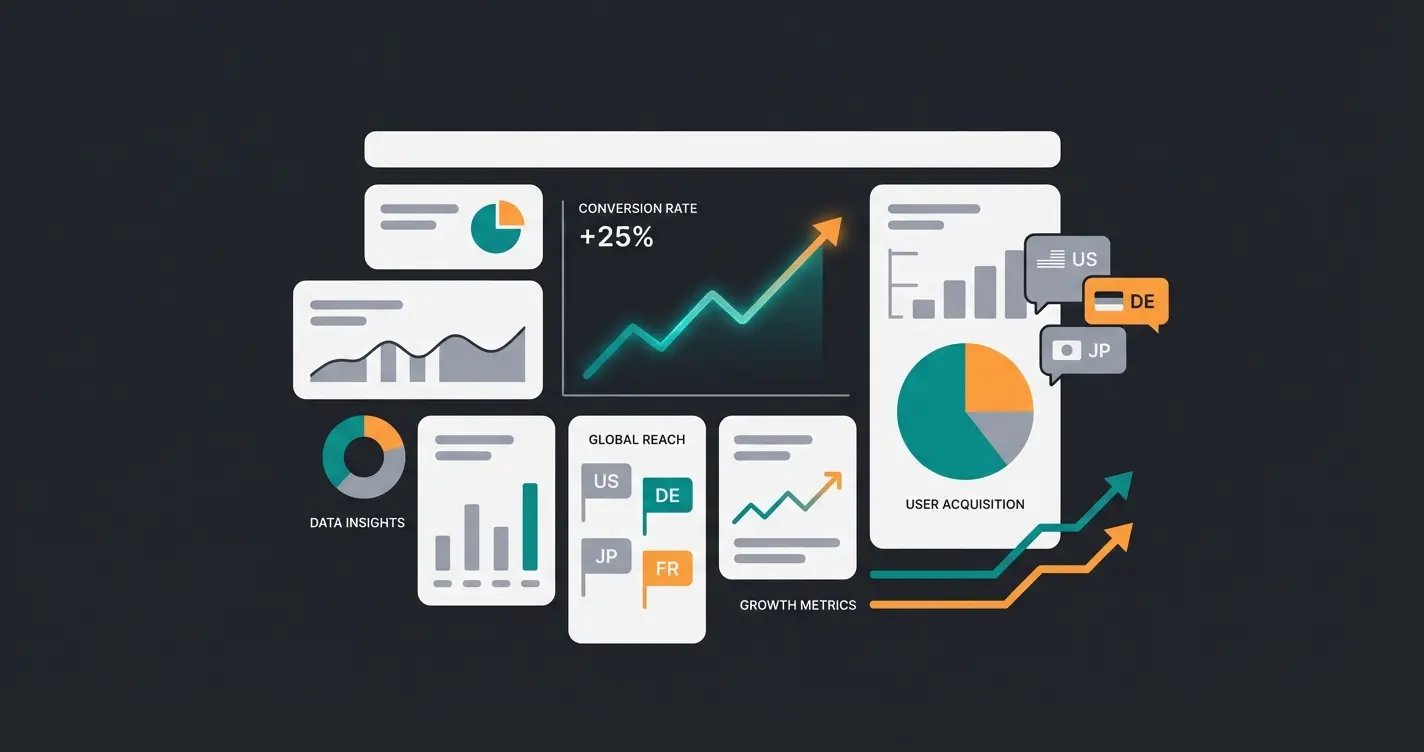
Using analytics tools, companies can track these metrics and continuously improve their chatbots' performance. This enables data-driven optimization of marketing strategies and constant improvement of customer experience.
Case Studies: Successful Multilingual AI Implementation
The practical application of multilingual AI chatbots demonstrates their immense potential for global marketing strategies. Based on three case examples, we can illustrate how companies from various industries benefit from this technology:
International E-Commerce Provider
A leading e-commerce provider implemented a multilingual AI chatbot to better serve their global customer base. The chatbot was trained in 10 languages and could answer product inquiries, support purchase processing, and resolve customer problems—but critically, it was designed as a product consultant, not just a support bot.
Results:
- 30% increase in conversion rate among international customers
- 40% reduction in customer service team burden
- 95% positive customer ratings for multilingual support
- 25% higher average order value through intelligent cross-selling
Global Travel Company
An international travel company deployed a multilingual chatbot to support customers in travel planning and booking. The chatbot could communicate in 15 languages and provide recommendations based on customer preferences and local offerings.
Results:
- 25% increase in online bookings through the chatbot
- 50% faster processing time for customer inquiries
- 35% improvement in customer satisfaction with travel planning
- Significant reduction in abandoned booking sessions
Technology Corporation's Multilingual Support
A global technology corporation implemented an AI-powered, multilingual chatbot for their customer service. The chatbot was able to answer technical questions, perform problem diagnostics, and guide customers through solution steps—all in 20 different languages.
Results:
- 60% of customer inquiries resolved without human intervention
- 45% cost savings in customer service
- 98% accuracy in recognizing and resolving customer problems
- Consistent quality across all language markets
These case studies demonstrate how AI chatbots are revolutionizing customer service while simultaneously supporting marketing efforts. They show that multilingual chatbots not only increase efficiency but can also significantly improve customer experience.
Key insights from these examples include:
- The necessity of thorough preparation and training of AI models
- The importance of continuous improvement based on customer feedback
- The value of integrating chatbots into existing business processes
- The importance of balance between automated and human interaction
- The critical shift from support to consultation mindset
These case studies underscore the enormous potential of multilingual AI chatbots for global marketing strategies. They show how companies can expand their international reach through this technology, increase customer satisfaction, and simultaneously optimize costs.
Future Trends: AI Chatbots and Global Marketing Evolution
The rapid development of AI technology is also driving the evolution of multilingual chatbots in global marketing. Advances in language models and AI enable increasingly natural and context-sensitive conversations across language boundaries.
A groundbreaking trend is multimodal AI systems that combine text, speech, and visual elements. Chatbots can analyze images, generate visual content, and incorporate them into conversations. Meta AI demonstrates this with the new "Imagine me" function for creating personalized images based on user photos and descriptions.
The integration of AI chatbots into comprehensive marketing strategies is also advancing. Chatbots are becoming central touchpoints that collect customer data, recognize preferences, and deliver personalized recommendations across various channels. The connection with CRM systems enables holistic customer profiles for targeted marketing.
Additional future trends in multilingual AI chatbots include:
- Emotional Intelligence: Chatbots recognize and respond to user moods and emotions in culturally appropriate ways
- Cross-Lingual Learning: AI models transfer insights from one language to others for more efficient training
- Augmented Reality Integration: Chatbots interact in AR environments for immersive product presentations
- Voice-First Interactions: Expansion to voice bots for markets with different digital adoption patterns
- Predictive Consultation: AI anticipates customer needs before they're explicitly stated
Advances in AI technology promise fascinating new possibilities for global, multilingual marketing. Companies that utilize these developments early can secure decisive competitive advantages.
Frequently Asked Questions About Multilingual AI Chatbots
Translation bots essentially add a language layer on top of existing content—they translate words but often miss cultural context and buying intent. Native AI consultation bots are trained on content in each target language, understanding idioms, cultural expectations, and communication norms. The result is conversations that feel natural and build trust, leading to significantly higher conversion rates.
Yes, when properly integrated with Product Information Management (PIM) systems. Advanced AI chatbots can understand technical specifications, compatibility requirements, and feature comparisons, then communicate these in culturally appropriate ways. The key is training on domain-specific content in each language, not just translating generic product descriptions.
This depends on your target markets, but strategic prioritization typically includes English (global reach), German (strong e-commerce market), French, Spanish (covers multiple regions), and Mandarin Chinese (market size). Japanese and Korean are important for Asian expansion. Start with markets showing highest conversion potential, then expand based on performance data.
A basic deployment can launch in 4-8 weeks, but achieving consultation-quality performance typically requires 3-6 months of iterative training and optimization. The timeline depends on existing content availability, language count, product complexity, and integration requirements. Companies should plan for continuous improvement rather than a single launch date.
Companies typically see 20-40% reduction in customer service costs combined with 15-30% improvement in international conversion rates. The ROI accelerates as the AI learns from interactions. Many businesses achieve positive ROI within 6-12 months, with consultation-focused implementations showing faster payback than support-only deployments.
Join leading brands using AI-powered multilingual chatbots to increase international conversions. Our consultation-focused approach goes beyond translation to deliver real sales results.
Get Started TodayConclusion: Multilingual AI as Your Global Sales Force
Multilingual AI chatbots have become an indispensable tool for companies seeking success in the global market. They enable personalized, culturally adapted customer engagement around the clock in numerous languages.
The advantages of multilingual chatbots for global marketing are manifold:
- Reach: Opening new international markets without language barriers
- Efficiency: Automated handling of customer inquiries in various languages
- Customer Satisfaction: Fast, precise responses in the customer's preferred language
- Data Insights: Valuable perspectives on cross-language customer needs and behavior
- Conversion Optimization: Active sales consultation, not just passive support
However, successful implementation of multilingual chatbots requires careful planning and continuous optimization. Cultural sensitivity, precise translations, and regular training of AI models are crucial for success. The shift from support-focused to consultation-focused AI represents the biggest opportunity for competitive differentiation.
Looking to the future, multilingual AI chatbots will assume an even more central role in global marketing. The integration of advanced technologies such as multimodal interactions, emotional intelligence, and AR promises even more natural and effective customer interactions across language boundaries.
Companies that invest now in multilingual chatbot solutions and continuously expand their capabilities position themselves optimally for global competition. They create the prerequisites to individually address, inspire, and long-term bind customers worldwide to their brand.
Multilingual AI chatbots are more than just a trend—they are the key to successful global marketing in an increasingly connected and multilingual world. But the winners won't be those who simply translate their support bots. The winners will be those who deploy AI as a global sales consultant—understanding intent, guiding decisions, and building trust across every language and culture they serve.

Lasse is CEO and co-founder of Qualimero. After completing his MBA at WHU and scaling a company to seven-figure revenue, he founded Qualimero to build AI-powered digital employees for e-commerce. His focus: helping businesses measurably improve customer interaction through intelligent automation.